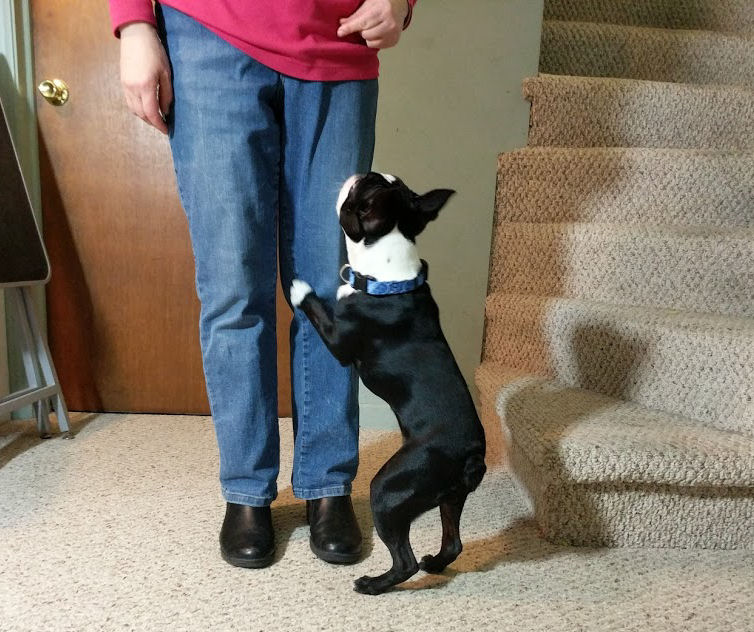
Do you push your dog off when they jump on you?
Congratulations! You just taught your dog to play a fun new game called “Throw Your Dog Away!”
You didn’t mean to start a rough-and-tumble wrestling match? Then we need to stop rewarding the wrong stuff.
You’re Not Alone
Everybody does it. Everybody inadvertently rewards the wrong behavior at some point. Perfect timing, flawless mechanics, and constant attention are hurdles that every dog owner stumbles over.
Fortunately, dogs are incredibly forgiving. Messing up is inevitable—after all, we’re only human. But the first step in fixing a training problem is recognizing that it exists.
Watch Your Hands
One of the most common things we see is people swinging their hands up and away when a dog gets a little too excited or jumpy. It’s a natural, human reaction.
The problem? Dogs are hard-wired to track motion. If your arms go swinging up, your dog is going to follow them. If you don’t want your dog jumping at you, keep your hands down and still.
The same rule applies if your dog is a bit too grabby when taking treats. If you jerk your hand away, they will just lunge forward to follow it. It can get painful, which is why children shouldn’t play grabby games. But rather than jerking away, try keeping your hand still, or making it “bigger” by closing it into a fist until they back off.
In fact, learning to control those teeth is a huge part of teaching a dog boundary control. If you want a structured way to teach your dog to back off instead of grabbing, check out our favorite impulse-control game, “Whatcha Gonna Do?”
Flip the Script: Teach What to Do
Many of the things we want our dogs to learn are “don’ts.” Don’t jump. Don’t grab. Don’t pull. Don’t counter-surf.
But teaching a negative to a dog is like trying to explain baseball to an alien. After a while, you just wind up with total confusion. (Have you seen Who’s On First?) Dogs don’t understand the absence of a behavior; they need an active job to do.
By consistently rewarding the behaviors you do want—like when your dog chooses to keep four paws on the floor or sit politely in front of you—you build a habit of good decision-making. Whenever your dog chooses the right thing, acknowledge and reward it immediately.
It’s always a revelation when handlers see their dogs explicitly “choose” the right behavior. You can actually see the lightbulb go on! Celebrate those moments—that’s where a strong foundation is built.