Here’s a non-trick question for you:
What training game do dogs value, keeps you in the game, and is a reward all by itself?
The answer, of course, is tug!
There was an aberrant few years when “experts” advised people not to play tug-of-war with their dogs because it might cause aggressive or dominant behavior. Fortunately, dominance theory has been proven poppycock, and we recognize just how fantastic a game tug can be.
Best of all, just about any toy, rag, rope, or vegetable can be used to play.
What’s that you say? You’ve never played Veggie Tug?
You would have if, like Hope, you’re desperate to get your dog to play with you and your dog’s favorite thing in the world is celery.
Pro-Tip: Veggie Tug works best if the celery is a bit wilted. Crisp celery is too easily snapped to work for tugging!
Get Your Dog To Tug (With You!)
It’s not enough to toss a toy on the floor and tell your dog to play with it. Even if your dog is a self-starter and plays by themself, you want to become an integral part of the game.
Especially if you want to play any kind of dog sports, you want your dog to believe that all good things come from you. Everything from meals to playtime involves being with you and interacting with you. You and your dog are partners, and you rely on each other.
Some dogs are natural-born tuggers. Hold a toy and they’ll grab the end, plant their feet, and start the game. Other dogs just don’t get it. But even truly hard cases—like Hope’s first Frenchie, Dax—can learn to love tugging.
Two Kinds of Dogs
- The Exuberant: They want to be in the middle of all the action. For them, life is all about having fun and doing stuff.
- The Spectator: They watch from the sidelines, scoping out all the possibilities before they commit.
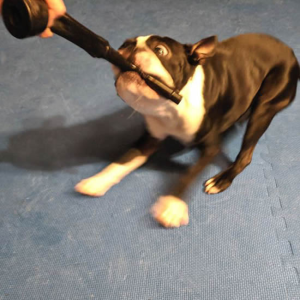
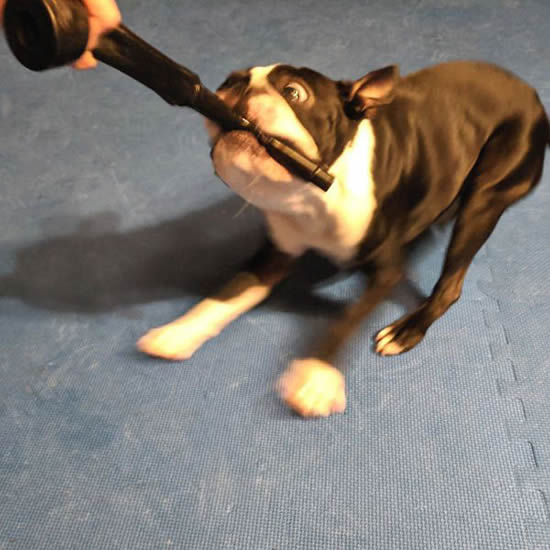
We’ve owned and trained both kinds. It is a lot easier to channel an exuberant dog’s energy than it is to cheerlead a lower-key, spectator personality. Simon (in the photo) is a natural-born, exuberant tugger and loves the game. But other dogs learn to love the game, too, as you’ll learn.
Great For Raising Energy
Hope wanted Dax to tug in order to energize her for playing agility. Dax liked agility, but lacked any sense of urgency on the course. She didn’t have a lot of drive, and didn’t care to play tug or hold onto toys at all.
Playing tug is a fantastic way to get a lower-drive dog amped up, focused, and engaged.
Getting a non-tugging dog to pull takes some determination and patience. Think of it as playful persistence. You want to mimic the way puppies badger older dogs to play.
The 2-Minute Tug Trainer: Step-by-Step
Teaching a reluctant dog to tug doesn’t require hours of work—just two minutes of focused, high-energy fun a day. Here is your quick start guide:
- Step 1: Find the “Gold Medal” Motivator Don’t start with a boring rope if your dog doesn’t care about toys. Find what makes them tick. Is it a plush squeaker? A fleece braid? Or, like Dax, a slightly wilted piece of celery? Start with their absolute favorite thing.
- Step 2: Bring the Toy to Life (The “Puppy Swish”) Dead toys are boring. Get down on their level and slowly drag or swish the toy side-to-side on the floor, mimicking prey. Let it lightly brush their front paws. Be as persistent as a puppy!
- Step 3: Reward the “Micro-Try” Don’t wait for a massive pull. If the first toy doesn’t work, try something else. Dax didn’t care about plush, latex, rubber, or rope, but she loved food—so we played with our food. The second your dog sniffs, glances at, or puts their mouth on the toy, throw a party and reward them. (Similar to the “Carry It” game, but this goes further.)
- Step 4: Introduce the “Tension Game” Once they are willingly putting their teeth on the toy, add a microscopic amount of tension. Don’t yank—just hold your ground for a split second so they feel a tiny bit of resistance.
- Step 5: Let Them Win! As soon as they pull back, even a tiny bit, let go of the toy and celebrate like they just won the lottery. Winning builds massive confidence and makes them want to play again.
The Magic of “Transfer of Value”
When something the dog cares about (food) is always associated with something they don’t care about (tugging), eventually they see the same value in the game as in the reward.
Dax transferred the value of the celery to the game itself. In time, she’d happily tug with anything Hope offered.
- Was it messy? A bit. There were celery bits to clean up.
- Did it work? You betcha. Dax turned into an enthusiastic tugger and agility competitor. It even turned her into a happier dog overall.
- Would we do it again? Absolutely. (Although we now start tugging with puppies from the day they come home!)