Tired of the Nail Trim Battle? Install a “Start Button” in Your Dog

Spread the love

Most of life’s surprises aren’t good. Our mindset has always been “hope for the best, prepare for the worst.” But every once in a while, something works out just the way it should. Even in dog training.

Like every profession, good dog trainers are always open to learning from colleagues—both seasoned pros and innovative thinkers just getting started. Sharing ideas, building stronger foundations, and opening up new insights is exciting.

Recently, we attended a virtual masterclass dealing with cooperative care for pets. It dove deep into the idea of “start buttons.” One of the follow-up questions asked if we’d ever taught our own animals a start button. Fortuitously, we realized we already had. We use it multiple times a day, every day.

What’s a “Start Button”?

As the notions of “cooperative care” and “fear-free” handling spread through animal welfare, a Start Button is simply the animal’s distinct signal to the caregiver that they are ready to go ahead with a procedure.

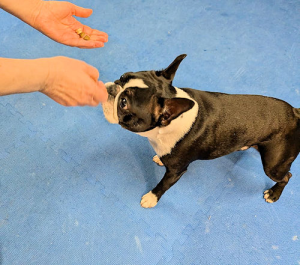
  • The Setup: Imagine brushing teeth or trimming nails. A Start Button for nails might be your dog willingly placing their paw flat into your open hand. That is them saying, “I’m ready. You may begin.”
  • The Stop Button: For every “Start,” there must be a paired “Stop.” In this example, the dog simply pulls their paw away.

Respect is Key

It all boils down to respect. For cooperative care to work, we have to respect when the animal in our care says “No,” “Not Now,” or “Not Yet.”

It may take a while to install a Start Button and change a grooming battle into a peaceful process. In the meantime, when those nails have to get trimmed, don’t ask. Just get it done as you always have, outside of your training sessions.

Be patient while you’re building the button. It’s worth it in the long run. Once you build your first one, every subsequent button will be easier.

Torque’s Story: Gradual Cooperation

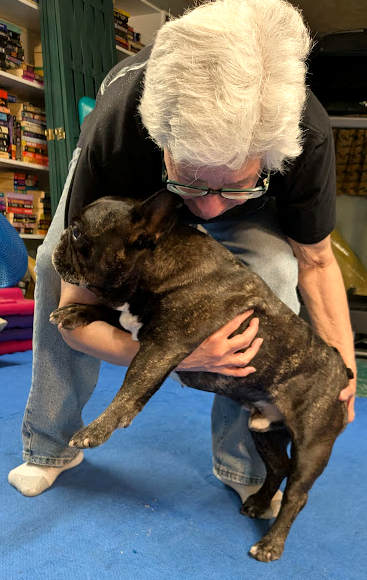
The Start Button we installed on Hope’s French Bulldog, Torque, happened before we even knew the official name of the game.

Torque, at 11 years old, has issues with his hips. Stairs have never been his favorite thing, and neither has being carried around. He’s always been a bit frightened of both. But the training area and bedroom are on the lower level, while the kitchen is upstairs. Multiple trips are a daily necessity.

His “Go ahead, I’m ready” button is kind of adorable:

  1. Hope puts one arm under Torque’s chest and the other over his butt.
  2. The Button: When he is ready to be lifted, he actively shifts his weight and lifts his chest onto Hope’s arm.
  3. Only then does she lift him.

It happened gradually. He learned that he won’t get picked up before he gives the green light—and he always goes someplace he wants to be.

Slow And Steady: How to Build Your Button

Respect and trust are the foundations of this training. Don’t lie to your dog. Show them what’s going to happen, and reward them for participating.

Let’s use nail trimming as a quick how-to:

  • Step 1: Introduction. Sit on the floor with your nail clipper (or grinder) and a handful of high-value treats. Invite your dog to check out the tool. Reward them for looking at it, sniffing it, or touching it.
  • Step 2: Define the Button. Offer your open palm. The moment your dog rests their paw in it, praise and reward. This is your new “Start Button.”
  • Step 3: Add the Tool. While their paw is in your hand, bring the clipper nearby with your other hand. If the dog keeps their paw in your hand (the “Start” signal), reward. If they pull away (the “Stop” signal), remove the clipper immediately.
  • Step 4: Inching Closer. Gradually move through the steps—touching the clipper to the nail, turning a grinder on, and eventually clipping a single nail. Always reward at every single step.

If your dog pulls their paw away at any point, that’s okay! Respect the “Stop.” Either take a step back, or end the session for the day.

Build Your Button Today

In time, what might have been a traumatic experience becomes a predictable, stress-free routine. All animals appreciate having some control over what happens to them.

If you’d like to see examples of cooperative care in action, the internet is chock-full of incredible videos. You can find keepers teaching alligators, giraffes, hippos, tigers, and even sharks to voluntarily participate in their own medical care.

If a tiger can do it, you and your dog can, too!

The “Screw-Up Snack”: Reward Your Training Mistakes

Spread the love

There’s a glitch in the matrix.

Your dog thinks you’re perfect. You know you’re not. Sometimes, like everyone on the planet, you mess up. You use the wrong hand signal, or you say “sit” when you meant “stay.” You know you “oopsed.” But your dog doesn’t have to. Enter the “screw-up snack.”

The Human Instinct That Halts Training

When we make a mistake, our instinct is to verbalize it. We sigh, we groan, or we let out a frustrated “Ugh,” “Damn,” or “No, wait.”

Here is the problem: Your dog doesn’t know it’s possible for you to screw up. They assume the universe operates flawlessly. So when you make a mistake and let out a mini verbal tantrum, your dog thinks they did something wrong. Because they are so attuned to your energy, that tiny drop in your mood can instantly shut them down and kill their confidence.

Flip the Script: The “Screw-Up Snack”

Next time you fumble a cue, don’t sigh. Reward.

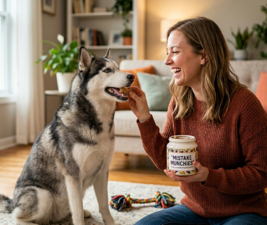
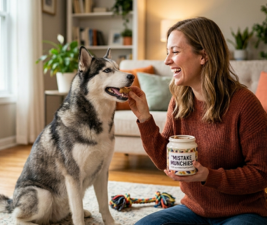
Mark your mess-up with a “mistake munchie,” a “screw-up snack,”, an “oops cookie,” or a “goof goody.” The second you realize you blundered, happily hand over a high-value treat.

Your dog won’t have a clue why they just got a freebie, and they won’t care. All they know is that when Mom or Dad confuses their words, awesome things happen. You protect their confidence, keep the training vibe fun, and give yourself a grace period to reset.

Onward & Upward: The Reset

That mistake munchie buys you a few beats to reset your own brain. Once you’ve handed over the treat, take a deep breath, smile into those puppy-dog eyes, and say, “Let’s try that again!”

Even if you were almost done with your training session, it’s important to give it one more successful go so you don’t leave your dog confused.

Dogs—especially softer or less-confident pups—can easily shut down when they sense negative energy. If you fumbled while playing a brand-new game, temporarily go back a step to a version your dog knows well. If the whole game is totally new and clunky, pivot entirely and play one of their absolute favorite, easiest training games just to end on a high note.

While you don’t always have to end a session with a flawless, advanced result, you do want to avoid leaving your dog with the impression they failed. There is no “wrong” when playing training games. You may not get exactly what you were looking for, but you always get great information for next time.

But Wait… Am I Rewarding a Mistake?

People often worry about “rewarding” behavior they didn’t mean to cue. “Isn’t that rewarding the wrong thing?” is a question we hear a lot.

Here is a golden rule to train by: It’s better to give a dog a million rewards they don’t deserve than to miss one they do.

In this case, you are the one who messed up, not the dog. That goof goody simply lets them know that they are doing fine and everything is okay.

Dogs genuinely worry about doing the right thing, and leaving them in limbo causes stress. When dogs aren’t sure what’s happening, they start showing subtle stress signals like lip-licking, yawning, scratching, or turning away.

Use the screw-up snack to ensure your dog always feels safe, confident, and successful. Just don’t tell them the referee made the mistake!

Streamline Your Dog Training: The Commercial Break Dog Training Challenge

Spread the love

Last week, we talked about building your dog’s habit to play “Touch!” This week, it’s your turn to build a habit with the Commercial Break Dog Training Challenge.

You already know that repetition is the best way to train a dog. But pairing that repetition with a specific trigger is how you cement the habit into your own muscle memory, allowing it to grow seamlessly into your daily routine.

Triggering Your Behavior

When 2-Minute Trainer first started, we were all adjusting to having powerful timers right in our pockets. Smartphones meant we could play training games anytime, anywhere, with very little prep.

Now? It’s even easier.

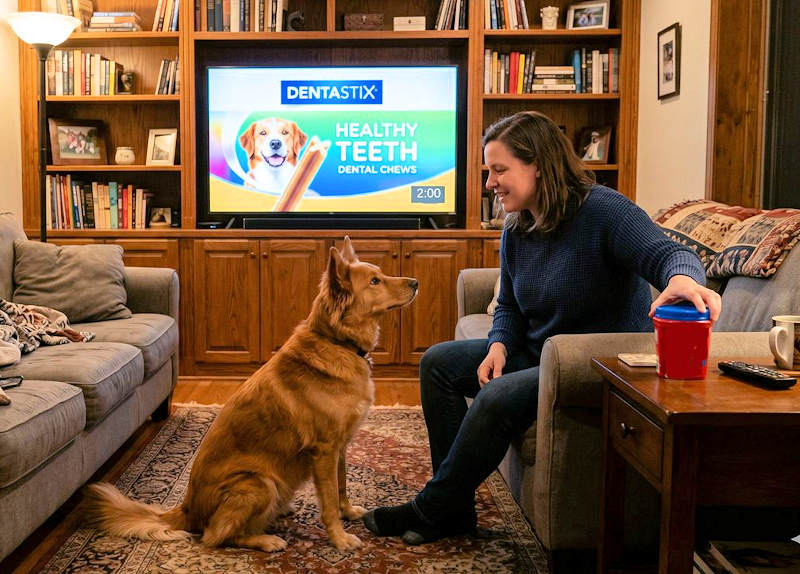
Whenever we watch TV or stream media, we are periodically interrupted by ads with handy-dandy countdown timers in the corner. Instead of reaching for your phone to scroll social media, you can use that countdown as your trigger for a short burst of training. We call it the Commercial Break Challenge.

Prep Your Favorite Spaces

To make this work, you need to eliminate any friction. If you have to walk to the pantry for treats every time an ad comes on, the habit will die. Instead, preload your relaxation spaces.

Every room in your house can—and should—be a place where you play training games. Here is how to prep:

  1. Grab some stash jars: Get a few small, airtight containers with lids.
  2. Make a “Training Trail Mix”: Mix up a big batch of dry treats. Use a variety ranging from your dog’s regular kibble and cereal “O’s” to high-value rewards like popcorn, freeze-dried chicken hearts, and dehydrated beef liver.
  3. Hide the stash: Scatter these loaded containers around the house—by the couch, on your nightstand, or near your desk.

By including your dog’s absolute favorites in the mix, they will always stay eager to see what prize they win next.

Perfect Timing

The next time an ad timer pops up on the screen, reach for the container.

It doesn’t have to happen during every commercial, or even at the same time every day. But we guarantee that after just two or three ad-break training games, your dog will get excited the moment your hand moves toward that jar.

Eventually, your dog might even recognize the sudden change in volume (seriously, why are commercials so loud?) and jump up ready to work before you even move.

The Best Part: It takes so little time and effort to bolster the bond with your dog, and it makes them incredibly happy. When the ads roll, everybody wins with the Commercial Break Dog Training Challenge.