
Most of life’s surprises aren’t good. Our mindset has always been “hope for the best, prepare for the worst.” But every once in a while, something works out just the way it should. Even in dog training.
Like every profession, good dog trainers are always open to learning from colleagues—both seasoned pros and innovative thinkers just getting started. Sharing ideas, building stronger foundations, and opening up new insights is exciting.
Recently, we attended a virtual masterclass dealing with cooperative care for pets. It dove deep into the idea of “start buttons.” One of the follow-up questions asked if we’d ever taught our own animals a start button. Fortuitously, we realized we already had. We use it multiple times a day, every day.
What’s a “Start Button”?
As the notions of “cooperative care” and “fear-free” handling spread through animal welfare, a Start Button is simply the animal’s distinct signal to the caregiver that they are ready to go ahead with a procedure.
- The Setup: Imagine brushing teeth or trimming nails. A Start Button for nails might be your dog willingly placing their paw flat into your open hand. That is them saying, “I’m ready. You may begin.”
- The Stop Button: For every “Start,” there must be a paired “Stop.” In this example, the dog simply pulls their paw away.
Respect is Key
It all boils down to respect. For cooperative care to work, we have to respect when the animal in our care says “No,” “Not Now,” or “Not Yet.”
It may take a while to install a Start Button and change a grooming battle into a peaceful process. In the meantime, when those nails have to get trimmed, don’t ask. Just get it done as you always have, outside of your training sessions.
Be patient while you’re building the button. It’s worth it in the long run. Once you build your first one, every subsequent button will be easier.
Torque’s Story: Gradual Cooperation
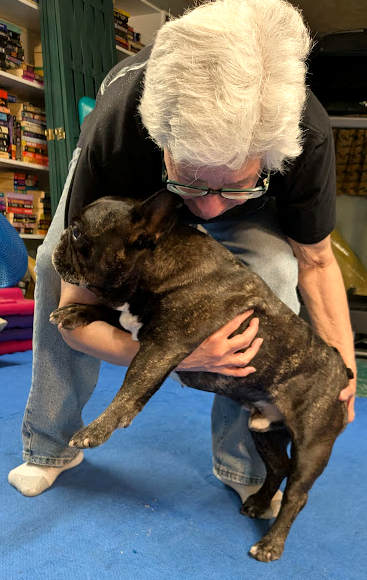
The Start Button we installed on Hope’s French Bulldog, Torque, happened before we even knew the official name of the game.
Torque, at 11 years old, has issues with his hips. Stairs have never been his favorite thing, and neither has being carried around. He’s always been a bit frightened of both. But the training area and bedroom are on the lower level, while the kitchen is upstairs. Multiple trips are a daily necessity.
His “Go ahead, I’m ready” button is kind of adorable:
- Hope puts one arm under Torque’s chest and the other over his butt.
- The Button: When he is ready to be lifted, he actively shifts his weight and lifts his chest onto Hope’s arm.
- Only then does she lift him.
It happened gradually. He learned that he won’t get picked up before he gives the green light—and he always goes someplace he wants to be.
Slow And Steady: How to Build Your Button
Respect and trust are the foundations of this training. Don’t lie to your dog. Show them what’s going to happen, and reward them for participating.
Let’s use nail trimming as a quick how-to:
- Step 1: Introduction. Sit on the floor with your nail clipper (or grinder) and a handful of high-value treats. Invite your dog to check out the tool. Reward them for looking at it, sniffing it, or touching it.
- Step 2: Define the Button. Offer your open palm. The moment your dog rests their paw in it, praise and reward. This is your new “Start Button.”
- Step 3: Add the Tool. While their paw is in your hand, bring the clipper nearby with your other hand. If the dog keeps their paw in your hand (the “Start” signal), reward. If they pull away (the “Stop” signal), remove the clipper immediately.
- Step 4: Inching Closer. Gradually move through the steps—touching the clipper to the nail, turning a grinder on, and eventually clipping a single nail. Always reward at every single step.
If your dog pulls their paw away at any point, that’s okay! Respect the “Stop.” Either take a step back, or end the session for the day.
Build Your Button Today
In time, what might have been a traumatic experience becomes a predictable, stress-free routine. All animals appreciate having some control over what happens to them.
If you’d like to see examples of cooperative care in action, the internet is chock-full of incredible videos. You can find keepers teaching alligators, giraffes, hippos, tigers, and even sharks to voluntarily participate in their own medical care.
If a tiger can do it, you and your dog can, too!