Quitting means whatever you’re doing isn’t working right now. You’re setting it aside to revisit later. In dog training games, it simply means the cue isn’t connecting, you’re on different wavelengths, or one of you is just having an off day. So, on any given day you can quit but you can’t give up.
Because giving up means you’re done. Whatever goal you set will never see social media virality. You and your dog are never going to get that ribbon, those titles, or that sweet internet validation.
Quit Every Day
Training game sessions aren’t marathons.
Comedian Rita Rudner put it perfectly:
“One of my friends told me she was in labor for 36 hours. I don’t even want to do anything that feels good for 36 hours.”
Your dog doesn’t either—and neither of you has to.
You don’t even have to end on a good note. Your training session may have been wildly successful, or a total drain-circler. It doesn’t matter. You quit for now, reset, and try again another time.
We see our students get frustrated when the mechanics of a training game elude them, or when their dog just isn’t catching on. Honestly? It happens to us all the time. When we’re developing a new training game, the first session is rarely a success.
We try out a new concept, holding a mental image of the goal. Unfortunately, even our 10+ year-old dogs still can’t read our minds. So when there’s a disconnect, we quit, drop a “We’ll have to think about that one,” and move on.
Different Dogs, Different Games
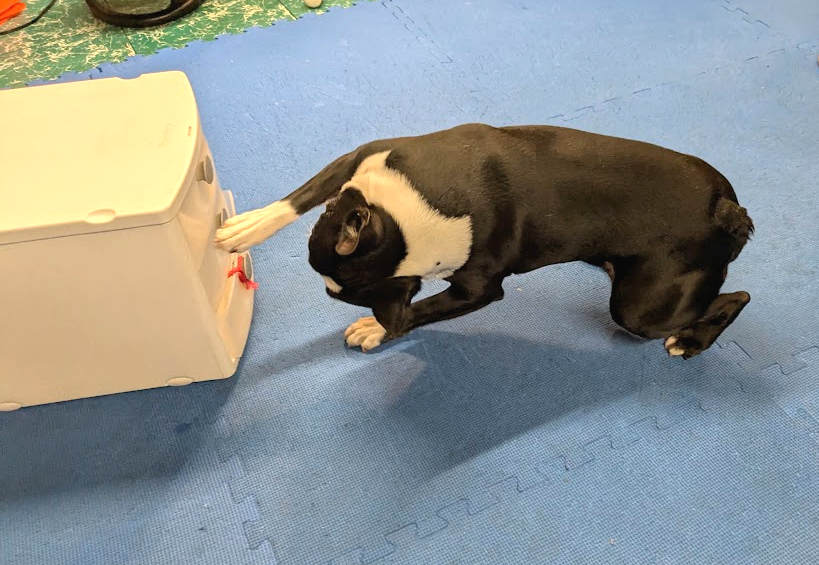
It happened just the other day. Fran decided to teach Simon, her eight-year-old Boston Terrier, to “Push” a drawer closed. He already knows how to push objects along the floor, but this was brand new.
Hope and Torque had already worked out their version of the drawer push, so Fran attempted to copy what worked for them.
The objective: the dog uses their muzzle to shove a slightly open drawer closed. Torque learned it in just a couple of two-minute sessions because it built on his strength—using his enormous French Bulldog noggin to go charging in.
Simon’s head isn’t all that huge. And he prefers using his paws, not his face. He kept batting at the open drawer until he knocked it off the track entirely.
Rather than pushing through and spiraling into frustration, Fran opted to quit the session until she had a clear plan. It might include revisiting “Gimme Your Face.” Or the new plan might mean changing the game so Simon can use his paws. “Shove” can be a Simon game; Torque can stick with “Push.”
Giving Up Shouldn’t Happen
So, give yourself permission to quit (for now). Taking time to regroup and assess where you are should be a regular part of your process.
If you’re stuck because your dog doesn’t understand, don’t throw in the towel. Table the discussion for later. Let it rattle around in the attic until an answer pops into your head, or ask other dog people what worked for them.
Quit for today. But never give up on your good dog.