“’Tis the gift to be simple.”
Whether you know that line from the Shaker hymn or Copland’s Appalachian Spring, we’d bet everything in our wallet (about $9.53) that the tune is now running through your head. You can thank us for the earworm later. It’s not only hypnotic, it’s also true. Clear communication with your dog requires simplicity. Even the most brilliant dog on the planet (mine, of course!) can’t do calculus. But they do love variety, as long as there are familiar elements involved. You don’t always have to buy new toys or invent brand-new games. Dogs are wonderfully uncomplicated creatures. If you run old plushies through the laundry or rubber toys through the dishwasher, they feel brand-new. Or stash a few neglected toys in a closet for two weeks—out of sight means “brand-new discovery” when they reappear. Here’s how to refresh your dog’s favorite training games.
Works For Training Games, Too
The wheel is already invented. You just need to give it a little spin.
Let’s say your dog’s favorite training games are:
- Put Your Toys Away
- Touch!
- Boxey
If you change just one variable, it becomes a whole new game. Your dog still recognizes the setup, so they won’t feel stressed—just intrigued.
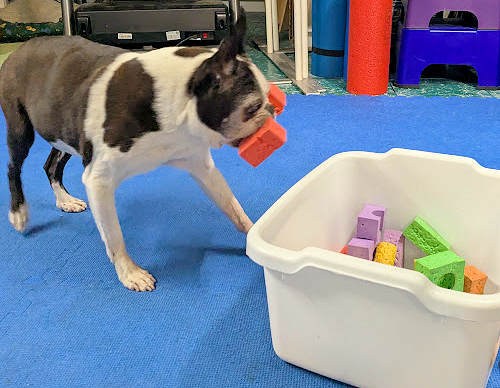
This morning, Hope and Torque played “Put Your Toys Away.” Torque knows this game inside out, but lately he’s just been going through the motions. To mix it up, Hope stacked his toys in a new pile, used a different bin, and placed it on the opposite side of the room.
Torque fired right up! It was a brand-new game. He got momentarily confused looking for the usual spot, but he didn’t stress—he just looked around, spotted the new bin, and figured it out. And because this new bin had shorter sides, he decided to be a little cheeky: he dropped a toy in, looked right at Hope, grabbed it back out, and dropped it in again. That brilliant sense of humor was naturally rewarded with a “made-me-laugh” cookie.
Refreshing the Classics
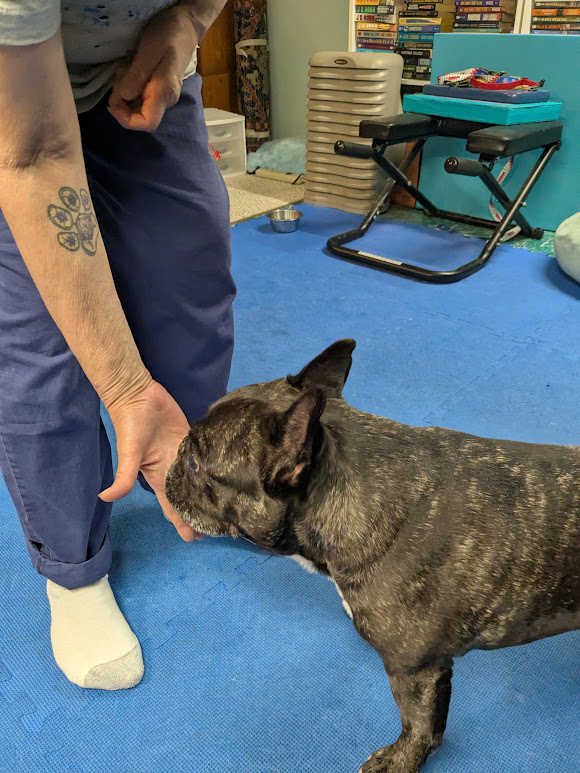
- Touch! It’s a staple, but familiarity can breed boredom. If you rely on “Touch!” to get your dog’s focus, refresh their interest. Smear a tiny dab of peanut butter on your palm before offering the cue. Suddenly, the game is ten times more interesting.
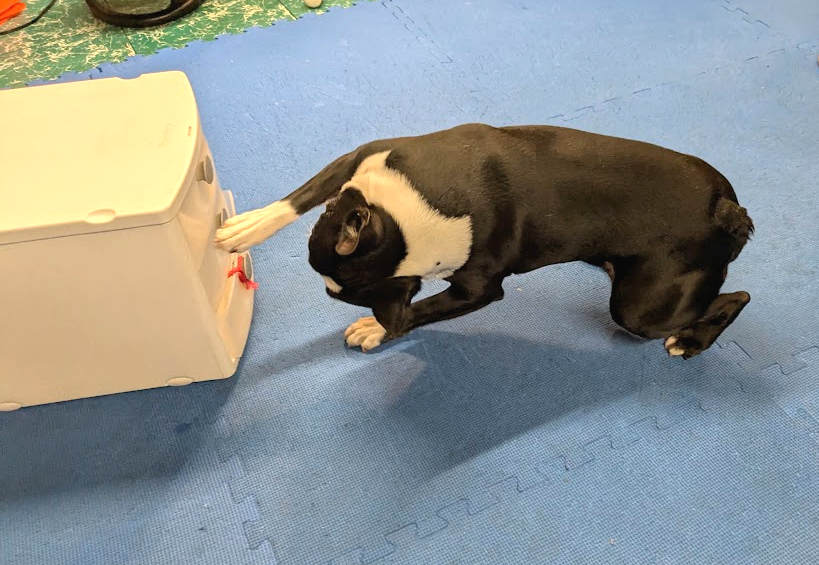
- Boxey: This one offers infinite variations. Change the size of the box, turn it on its side, flip it upside down, or line up multiple boxes to see if your dog offers a new behavior for each one.
Do you have a training game that’s gone a little stale? What simple tweak can you make today to refresh your dog’s favorite training game?