You can’t cram dog training

Spread the love

Scenario: You’re hosting a big, buffet-style party in a couple of weeks. Your dog is a counter-surfing expert. Nothing on any flat surface is safe. Sadly, you don’t have time to change that. You can’t cram dog training.

In this case, managing the situation is the best you can do. You can either secure your dog away from the food, or have him on leash and tethered to a responsible person throughout the party. Left to her own devices, your dog will find the most rewarding option. Which would be a festival of party food.

Assigning someone to guard the banquet isn’t ideal, either. That person’s only option would be to reprimand the dog for being naughty. If your dog doesn’t know the “right” choice, they default to what’s most rewarding. In this scenario, it’s a feast.

Crisis training doesn’t work

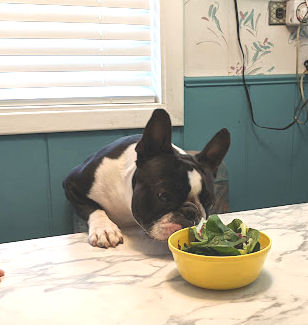
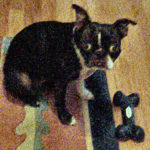
You can't cram dog training. Simon thinks he can help himself to the salad on the kitchen table.
Simon thinks he can help himself to the salad on the kitchen table.

You can’t train a dog “stay off the counter” during a party. Likewise, you can’t train a dog to “stay” when the delivery guys are currently in and out of your house. If push has come to shove, your option is to manage the situation and the dog. (We talked about setting your counter-surfing dog up for success a while ago.)

Remember there are three ways to deal with dog behavior; ignore, manage, or train. 

If you choose to ignore something your dog does, they’ll keep doing it. That’s okay, since it doesn’t bother you enough to do something about it. 

In an urgent situation, like our fictional party or deliveries, the best option is management. Without a thorough understanding of what to do, your dog may get in trouble. If you need your entire attention on other chaos, manage your dog’s access. Securing your dog in another room or in a crate is a viable management choice. Trying to cram dog training in before a deadline is a losing proposition.

The long-term solution is to train your dog to cope with temptation and excitement. Athletes, musicians, and dancers practice constantly to build their “muscle memory.” Similarly, dogs rely on well-trained responses to decide their actions in somewhat familiar situations.

Set up for success

If your dog is a counter-surfer, set up training sessions to teach them how to react. This is a perfect time for a 2-Minute session. 

Put a handful of yummy food on the counter and stand there. If your dog sniffs at it, paws at it, attempts to reach it in any way, cover it. You can use your hand or a bowl or container. 

When the dog backs off, click (or praise) and reward. If the dog sits, even better! Praise and reward from the handful of food that’s already there. You’re teaching your dog that you are the source of all good things. She doesn’t get to help herself.

It’s an easy concept for people. Ask politely and you’ll get what you want. 

Since we want our dogs to be comfortable in human society, they need to learn manners. Dogs have instincts. Manners must be taught. We empower our dogs by giving them the tools, and manners they need.

How to stop constant dog barking

Spread the love

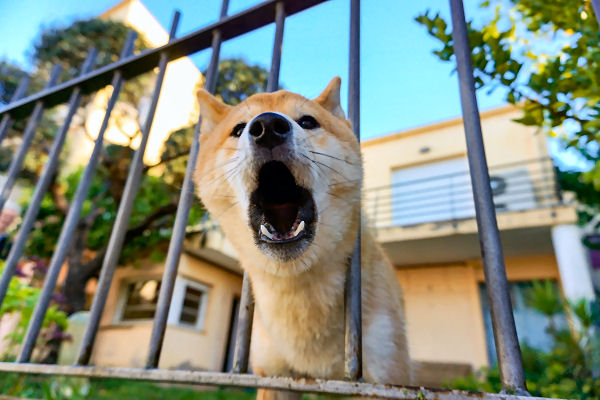
“How do I get my dog to stop barking?” is always in the top five questions all trainers get.

In response to our last tip “Be There,” we got some questions about the story with the barking dogs. The immediate “fix” was to restrict access to the windows where the dog barks. We talked about how dog learning never happens if you’re not there to teach.

So we have to turn the question around a little. You have to put yourself in the picture. It’s “How do I teach my dog to stop barking?” You’re the one causing the change.

Stop Barking game

Recognize your dog's barking trigger is the first step to training "Quiet."
What’s your dog’s barking trigger?

Recognizing your dog’s barking triggers is the first step in changing the behavior. Is there a particular time of day that your dog barks? If so, what’s going on at that time? It could be any number of things, from kids on their way to school, to the postal carrier, to delivery people. 

If you really want the barking to stop, restrict access to the area/room/window where the dog finds the trigger. This can be as simple as closing the blinds, or putting up a gate. It’s a temporary restriction, until your dog learns “Quiet!”

If there is a regular time your dog barks, be ready in advance. Make sure you have your clicker and really, really yummy treats. If your dog is a habitual barker, he or she is happy when barking. Turning it around will require a really terrific reward.

When your dog lets out a bark, get excited and move toward the window where the dog is barking. “What’s there, Fido?” “What do you see?” Don’t look at your dog, look outside. Chances are this will confuse your dog, since he or she is used to you paying attention to them, instead of what’s outside.

Focus on you

When you think about it, that’s pretty true, isn’t it? When your dog barks, you’ve probably immediately paid attention to the dog, not what they’re barking at. An unintended consequence is that you’ve rewarded your dog with your attention whenever they bark. Which means they’ve learned to bark to get your attention. (Next week we’ll talk about Barking for Attention.)

When your dog looks at you in his confusion, click and reward. “Good quiet!” And walk away from the window. Invite your dog to come with you, rewarding for coming away.  If they don’t keep you company, run away from the window. When your dog catches up to you, give him a treat, or if your dog’s favorite reward is a toy, play a quick game of tug.

That’s all there is to the game – getting your dog’s attention on you instead of the barking trigger. If you have to get between your dog and the stimulus, do it. When Hope’s French Bulldog Torque started barking incessantly at the Husky two doors down, she stepped between Torque and the fence, talking to him to get his attention. As soon as he glanced at her, he got a click and a cookie. A really, really good cookie. Most of the time he just glances at the Husky now. And then runs over to Hope for a treat.

Control the situation

In Torque’s case he went out in our own fenced backyard on leash until he learned the game. Training games only work if both of you are there and paying attention. This wasn’t a game Torque really wanted to play, but he got it.

Your dog will, too. If it happens that your dog starts barking when you’re not prepared, do anything to interrupt the behavior and reset your dog’s focus. You know your dog’s magnets. One of our dogs would come running whenever he heard a M & Ms package rattle. (He only got one – we asked the vet for permission.) Another dashes over when he hears the treat cabinet. Use what you know about your dog! 

Allowing the barking to continue just solidifies the habit. And, as you know, habit is one of the most powerful forces in the universe. Changing an entrenched behavior will take time, but it can be done with patience and consistency.

.

Body language wins

Spread the love

It was like a revelation to our puppy class students. When you want your dog to release something, you don’t tug on it.  That’s just common sense. One of dogs’ favorite games is tug. Being the logical creatures they are, dogs think that if you’re tugging, you’re playing. If your mouth is saying “drop it” or “let go” but your body language is saying “PLAY WITH ME!” – body language wins.

As a matter of fact, body language pretty much always wins. We’ve mentioned before how dogs are wonderful at reading signaled behaviors. It’s even a requirement in competition obedience. Not a word, just a gesture clues your dog into what you want him/her to do.

Try it yourself. If you’re like most people, your dog knows both the word “Sit!” and some kind of gesture that you always use that goes along with it. While you’re making the motion for “sit!”, say “Down!” instead. We’d bet your dog puts the emphasis on the motion.

Hard wired for motion

It makes sense. Dogs are predators. They’re attracted to motion. It’s exciting and gets their attention. They’re not animals that communicate with sound. We must make a conscious effort to teach our dogs to listen to the actual words we’re saying. Otherwise, we’re doomed to sound like the adults in the Peanuts cartoons “wah wah wah wah wah.” 

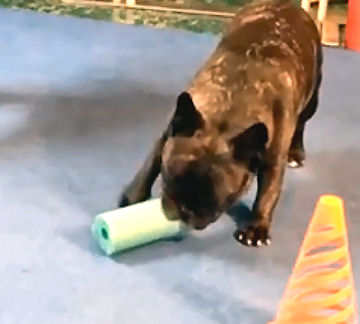
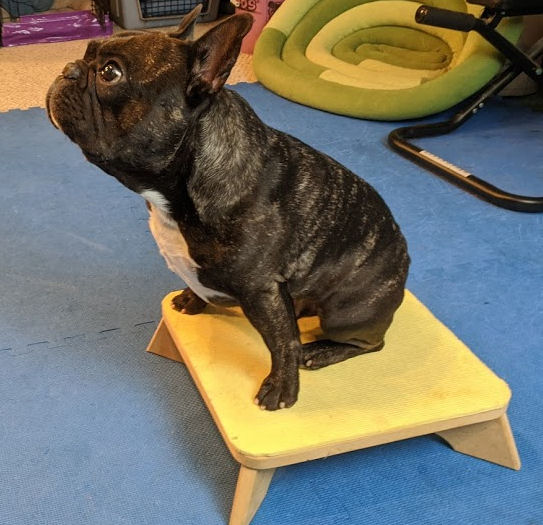
Torque starts with a sit on the stool.
Does Torque “have his ears on?”

It can be done. Every other morning Torque, Hope’s French Bulldog, does specific exercises on a low stool that involve his hips/knees/ankles. Frenchies are notoriously front-heavy, so we make sure he works on strengthening his back end. The specific commands Hope uses are “Squat!” for him to put his front legs on the floor with his back end on the stool, and “Crouch!” for him to move off the back end with his front on the stool. 

Hope is sure to “mix up” the order (with a “Sit!” on the stool between). Not knowing what’s coming up next, Torque has to listen. And Hope has a good indicator of how attentive he is that day – whether he “has his ears on” or not.

Get something to trade

So, when your dog steals your underwear out of your drawer and your natural instinct is to grab it, what are you supposed to do? (By the way, it’s best to address those bad habits now, because puppies don’t usually “grow out” of them.)

This was one of our puppy students’ real-life scenarios, and it ended with a trip to the emergency veterinarian’s office when the puppy ate the undies. 

So yes, grab it. And hold on for dear life. You don’t want to make that trip to the vet. 

But don’t pull. Just hold on. If you can, hold with both hands, one on either side of the dog’s mouth. And stay as still as you possibly can. If someone else is there, have them hold the dog so she can’t initiate the tug game. (Because, again, body language wins. If you’re calm and still, chances are your dog might be a little more calm.) If you’re alone, move forward, backing the dog into a dead-end space, if you can. Sometimes, just the action of moving the item further into the dog’s mouth will get them to release it. 

Try to speak calmly and say whatever you want in a nice voice. If you amp up the volume, your dog will get more excited. The objective is to make the situation as un-game-like as possible. If there is someone else there, or if you can reach something, offer a particularly delicious treat or favorite actual tug toy in exchange.

Next week we’ll work on the “Drop it!” game

.

Stop Your Dog from Jumping on People

Spread the love

It’s really cute when puppies jump up to get attention. It’s not cute anymore when the dog grows up and isn’t a cute, tiny puppy any more. So how do you stop your dog from jumping on people? 

Cry for attention

How do you stop a dog from jumping on you?
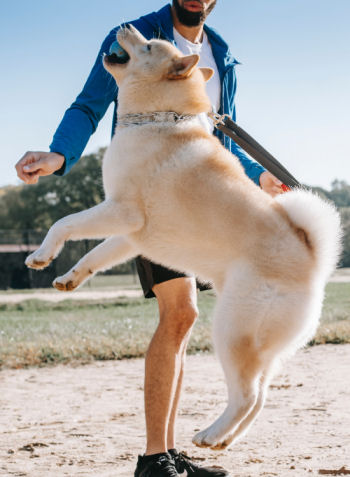
A dog jumping on you is a plea for attention.

Dogs don’t generally just jump for joy. When they’re so full of energy they just can’t contain themselves, jumping up and down isn’t the usual behavior. Instead, they’ll get the “zoomies” and run like crazy. If your house, like ours, has a circular path, they’ll make it into a race track. And you’d best just stay out of the way until the zoomies run out.

Jumping, especially on people, is a plea for attention. And the best way to get it to stop is by ignoring it. Which, we freely admit, is easier said than done. 

In Hope’s Beginning Obedience/Puppy classes, dogs will often jump on her as she approaches. We don’t know if you can tell from our videos, but she’s not a big person. She’s about five-foot-nothing tall, and not incredibly substantial. In one session, there was a lovely, 50+ lb. Lab puppy named Gus who adored jumping on Hope and grabbing the mask off her face. On his hind legs, Gus is about the same height as Hope, so her mask was well within reach. It’s worth noting that he really is a very nice dog – he never snagged anything but the mask.

Be prepared

Knowing when your dog is likely to jump on someone, and what circumstances trigger the behavior, is key in stopping it. Set up the situation and be prepared. 

In this case, Hope had Gus’s people keep hold of his leash until she braced herself and was ready for his enthusiasm. Then she told them to release enough slack for Gus to reach her, but not go past. Gus grabbed the mask again, but Hope did nothing. She didn’t move, didn’t play “tug” with the mask, didn’t look at him, didn’t pay any attention to him. She looked past Gus at his people. And had to tell them repeatedly not to react.

And, after a few seconds of acting the fool, Gus got all four feet on the ground. Immediately, Hope told him what a good boy he was and started petting him. Which triggered his jumping. 

Hope instantly returned to braced-statue mode. No reaction whatsoever. And Gus got all four feet on the ground. Which earned him the praise and attention he wanted. 

Instant gratification

Timing is important in teaching dogs. If the lesson is “don’t jump on people” there has to be a visible difference. Jump = no attention. No jumping = praise, treats, and attention.

We’ve often said that doing nothing is, by far, the hardest part of dog training. (“The hardest part of dog training“) If you pay attention to behaviors you don’t want, you’re encouraging that behavior. If you remove that attention, the dog has no reason to continue the behavior – it’s not working for him.

Dogs always give you more of the behavior you focus on. If you repeatedly say “off, get off, no jump” it’s paying attention to the behavior. It works much better to emphasize when your dog is doing something you want. Instant praise, treats, or a game of tug will tell your dog he’s being “good,” that you like what he’s doing, and he’ll get more attention with this good choice.

Making good choices

Everyone, dogs included, is sufficiently selfish to do what works best. If jumping on people results in attention, even if it’s “No, No, bad dog,” it’s working. Dogs don’t discriminate between negative and positive attention. To your dog, anytime you focus on them, it’s a good thing. 

If you ignore the behavior you don’t want, your dog has no reason to continue doing it. The dog’s behavior isn’t working, so they stop doing it. 

If your dog is jumping on someone, have them stand like a statue. Fold their arms across their chest and stare at the ceiling. It may take some repetitions, but your dog will learn that jumping gets them nothing they want. Dogs particularly hate it when you don’t look at them. So make a point of looking away.

Flip side

The other side of the coin has to be just as fast and clear. If the dog has all four feet on the ground, meet their eyes, praise them mightily, and give treats, pets, toys. For as long as the good behavior lasts. Be ready to stop in mid-word if the jumping starts. 

It may take some time for the lesson to sink in. Each time the dog gets the same message, the “right” choice penetrates deeper into their personality. By the end of the class session, Gus sat whenever Hope came over to see him. Good boy, Gus!

Why does my dog love other people more?

Spread the love

Does your dog love other people more than you? Does he go running to a favorite person, leaving you abandoned and standing all alone?

Before you get frustrated, jealous, or start trying to woo your dog back, try to decipher what’s actually going on.

You adore that person

Why is Simon running to someone else?

One of the most likely explanations of the situation is that you adore that person and your dog is picking up on your delight in seeing him/her. Our dogs have excellent antenna for our feelings. If someone makes you happy, chances are that person will make your dog happy, too. 

These days, we can’t always hug people we care about – but our dogs have no concept of social distancing and can go rushing in where people fear to go.

Recognizing “dog people”

Dogs in our shop’s neighborhood know we’re a great place to stop. There are a few who even pull their owners/walkers in our direction. Dogs have great memories and know they’ll get a treat and a scritch when they stop in. Lots of dogs, all over the world, have their “regular rounds” of people and places they visit as a matter of routine. It doesn’t mean the dogs love those more – it means you’re a great owner who enriches your dog’s life with great experiences.

Dogs should also adore their dog walkers, if you use one. We know of many people, now working from home, who continue to use their walkers. It’s good for everyone – the walkers have continued employment in tough times, the owners have a few minutes to themselves, and the dogs love it. 

Loving too much?

If you’ve attended a dog training class, or hired a private trainer, your dog may also adore the trainer. Sometimes that’s a good thing. Sometimes not so much. 

Most good trainers are wary of using a dog in the class for a “demo dog,” or paying too much attention to any attendee’s dog. It’s not that the trainer doesn’t like you, or your dog. A good trainer will avoid substantial interaction with other people’s dogs. 

We know that dogs respond to clear, consistent instructions and rewards. Dogs that seem clueless and untrainable can instantly become stars of the class when the trainer takes the leash. Good trainers have spent years honing those skills – crystal clear instructions, prompt delivery of rewards.

He really does love you best

Don’t despair if your dog runs off to greet someone else. The joy she feels in seeing that person reflects the confidence and fun you’ve built into her life. And remember, you’re greeted with exuberant delight when you return. Even if you were just gone long enough to take out the trash. Your dog really does love you best.

Actually, your dog doesn’t know better

Spread the love
Ceilidh looks like she's feeling guilty about something.
Ceilidh looks guilty, but…

We hear it all the time. 

“My dog peed on the bed to spite me.”

“Fifi knows better – she did it because she was mad at me.”

“Phydeaux is so stubborn – he just ignores me when I tell him something.”

“Rover is so defiant. He knows he’s not supposed to do that!”

Actually – no. That’s not how dogs think. If your dog is sitting there staring at you after you’ve told her to do something, either she’s confused or she doesn’t know what you want. And, chances are, she’s afraid of making the wrong decision.

Dogs don’t think the way we do. They truly live in the moment, without comprehension of “cause and effect.” We know that, for many dogs, eating grass will result in vomiting. Dogs don’t know that. The “eating grass” is far enough removed (even if it’s minutes later) from the “vomiting” that the dog is incapable of making the connection. Even though Spot throws up EVERY SINGLE TIME he eats grass, he will never connect the two (causation) and develop a dislike of eating grass.

We humans make that connection so easily that it takes some doing to “think like a dog.” Trying to adjust your thinking, see things from your dog’s perspective, will help you communicate better with your dog.

Causation vs. correlation

Dogs learning with positive-reinforcement games are willing to try and keep trying. The worst consequences of “getting it wrong” for our dogs is lack of reward

That’s part of the difference in thinking. Dogs are good at connecting the dots – if I do good “stuff,” I get a treat, or I get to play. They excel at association, or correlation, especially if the things (behavior and reward) are close in time. Dogs see the relationship between the two events (correlation). 

It’s why the “clicker,” which is a “bridge” to the reward is such a valuable tool. It lets the dog know that, right now, I was a good doggo. Even if the reward is delayed, the dog knows it’s coming.

If, however, a dog is punished or negatively reinforced for incorrect behavior, he may develop a fear of doing the wrong thing. The consequence can be that the dog either does nothing (stares at you), or, since he can never “win,” gives up and does whatever he feels like doing (defies authority). 

It’s not easy to adjust your thinking. People are always in “if this” then “that” mode. From the time we’re infants we’re taught to think of the consequences of our actions and to plan for the future. Dogs’ brains don’t work that way.

We can learn a lot from our dogs about how to be “in the moment” and enjoy every day as it comes. It can be frustrating at times, like when you see your dog eating grass again. And it can be joyful as every single toss of the ball is as much fun as the first one.

Smart dogs find a way

Spread the love
Teddy the smart French Bulldog figured out that he'll get treats by sitting on the kitchen chair. He's teaching Booker the Boston Terrier this trick.

With 2-Minute Training, you may be creating a monster! A smart dog who can solve problems all by himself! Smart dogs will inevitably find a way.

We had to laugh this week when we saw a post on social media. It was in a group for positive reinforcement dog training. This person’s Basset Hound had moved a chair up to her kitchen counter, jumped up, stole the roast she had defrosting on the counter, and eaten it. She wanted to know how to prevent her dog from doing “naughty” things when she wasn’t home.

Almost everyone responded exactly the same way – don’t leave your roast on the kitchen counter!

Be ready for trouble

When you teach your dog, as we do here in 2-Minute Trainers, to think for themselves and find solutions to the questions we ask, they will learn to apply their new abilities to other aspects of their lives. 

And you have to prepare for smart-dog behaviors you’ve never seen before, and would never have thought of! It happened to us, as well. We “stage” our dogs’ dinners in the dining room, setting their bowls on the table while we prepare our own meal. Our dining room chairs are on casters, and while we were prepping dinner we heard the unmistakable sound of those casters moving on wood floors. 

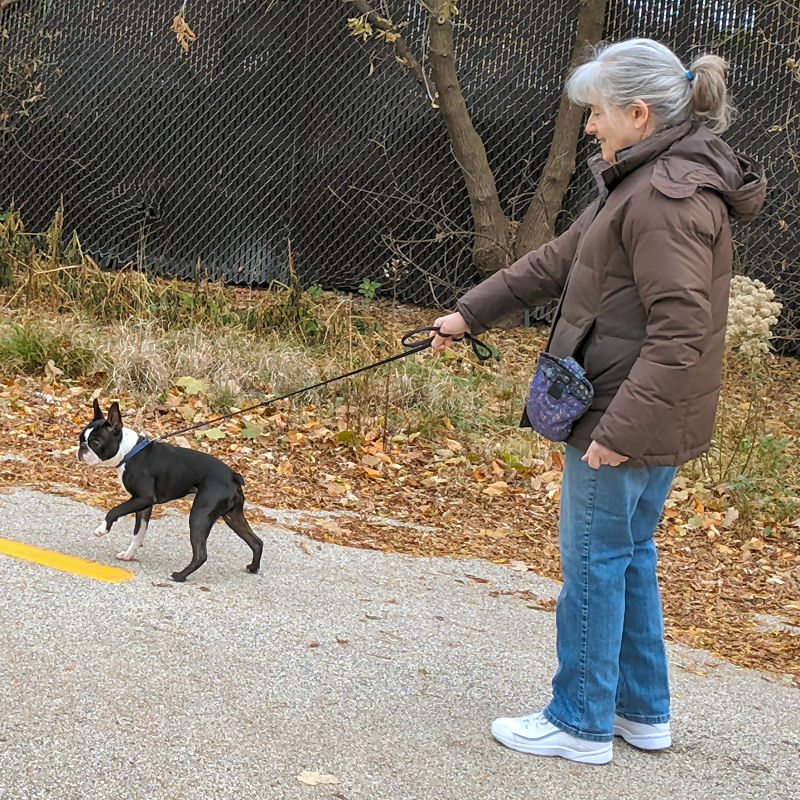
We went in to see what was happening. Simon (Fran’s year-old Boston Terrier) had moved a chair, jumped on it, and was helping himself to dinner! While we admired his problem-solving ingenuity, we also started staging the dogs’ meals elsewhere. 

Never before

None of our dogs had ever thought to do that before. So we were surprised when Simon did think of it. All his life, he’s been rewarded for thinking and coming up with new “answers” for the “questions” we ask of him. We’re the ones to “blame” for his creativity. We were proud of him for thinking of it. And we were laughing too hard to get angry about it. And we don’t leave unattended food on the table any more.

As each of our smart dogs has gotten “creative,” we’ve adapted the way we do things. No one can control a situation when they’re not there. So if you’re not there, change the situation. We can’t expect our dogs to abide by rules they don’t know, especially if we’re not there to teach them.

Smart dog kitchen rules

We were right there when Teddy, Hope’s French Bulldog, decided he would “help” us prep dinner. He was allowed to sit on the kitchen chair, but one day he decided to jump up on the adjacent table where food prep was happening. He was, needless to say, promptly removed. Although, again, there was a lot of giggling going on.

From then on, Teddy was taught to maintain his place on the chair. He was rewarded for sitting politely and observing. And got an “oopsie” (non-reward marker) for putting his paws on the table. When he sat back down, he got a treat and a “Good off!” Soon he learned the word “Off.” 

Perils of positivity

There are some who will point out that Teddy was, in fact, a very smart dog and “played” us to get the treats. That’s true, at least in part. He knew what behaviors would get him rewarded. 

That’s the deal we make with our dogs. When they do the “right” thing, they get rewarded, whether that’s a treat, praise, or petting. And, in return, we get the joy of living with smart dogs!

My puppy has a temper

Spread the love

He’s great, but …

It’s not easy learning that your puppy, in addition to all his wonderful qualities, has a temper and can be aggressive toward other dogs. Simon just turned one year old. He’s a tiny little thing, but has a HUGE personality and a hair-trigger temper. Once he’s had enough play (usually with my sister’s French Bulldog, Torque), it’s almost as if he says, “That’s enough! I’m done with you!” and turns into a snarling little demon.

It’s my job to fix that. 

Tango, Brussels Griffon

Fortunately (or unfortunately?) I have experience with turning an aggressive dog around. Tango, my 10-year-old Brussels Griffon, is much better now, but when I got him (at 11 months old) was reactive towards everyone. When Tango was young he hated everyone that wasn’t me. Even my sister. Since we live together, that was a big problem. Hope hand-fed Tango his dinner for weeks until he accepted her. He still wasn’t crazy about her, but we could all live together. 

Work in progress

Day after day, week after week, month after month, even year after year, Tango’s training was a top priority. I knew that he could be an excellent agility dog but I didn’t want him branded as aggressive. We had to be able to walk together through crowds, down the street, through a parking lot when I had my hands and arms full of crates, treats, toys, and other paraphernalia. So, while we were going to class for agility fundamentals, I was also training him to be a good pet.

It was essential to keep him focused on me at all times. I was vigilant about our surroundings and noticed what was going on around us at all times. If anyone was approaching, I made sure to start a focus behavior. At first the approaching person / people / person and dog had to be at a significant distance. As Tango started accepting that other beings were allowed to exist on the planet, the distance could be slightly reduced. This was not a matter of days or even weeks, but months.

Focus phrase

A key phrase that I used to keep him focused on me was, “Cute dog!” I did not say anything at first – remember that we were at a significant distance. When Tango looked at me, I’d say our focus phrase and give him a yummy treat. If he kept looking at me, I’d give him another treat and say something like, “Yes, you’re the cute dog!” Eventually I could say the phrase when he wasn’t looking at me and Tango’s eyes would latch onto my face. 

Why the phrase “Cute dog?” Even though Tango is small, I didn’t want people to see him as aggressive. People look at aggressive dogs differently. Their posture is different. But when someone sees a little fuzzy dog and hears that phrase, they’ll have a smile on their face. 

Tango and I competed in agility for quite a few years, and he advanced to the Master level. We walked confidently through crowds at trials and Tango kept his attention on me. I still don’t trust him completely. I’m always watchful when we’re out and about, but he’s worlds better than he was as a puppy.

Phrase that pays – again

So now I have to train Simon to keep his attention on me. I’ll be training the “Cute dog!” cue and I’ll also be doing other small tricks to keep him engaged when we’re waiting for a red light on our walks. 

Those small tricks? Fun stuff for treats, like hand touches, spins, simple position exercises. 

And Simon is learning to come to me when I call him. That’s proving to be very useful when I see him starting to ramp up in his play.

I know that it won’t be done in a day, and Simon may never play nicely with dogs that aren’t in the family, but that’s OK. He doesn’t have to play with other dogs. And there’s no deadline for having a nice dog.