Setting your dog training goals

Spread the love

Most people seek out dog training help when there’s a problem they want to solve. Or because they’ve acquired a new dog and realize it’s been a while and need a refresher.

Providing solutions for those immediate dog training goals may be how you found us. We hope you’re staying because we’ve opened your eyes to how amazing it is to have a training-game routine with your dog.

Setting some dog training goals

We often say that there’s no deadline for dog training games, and no one but you and your dog should set the pace for your progress.

But say you do have a specific dog training goal. And a timeline you’d like to achieve it. Absolutely go for it!

Once you and your dog are familiar with the 2-Minute-Training method, you can set your own schedule and play games that will let you achieve your goal. You can play as often as you like, tailoring your games to emphasize the skills your dog needs.

Like what?

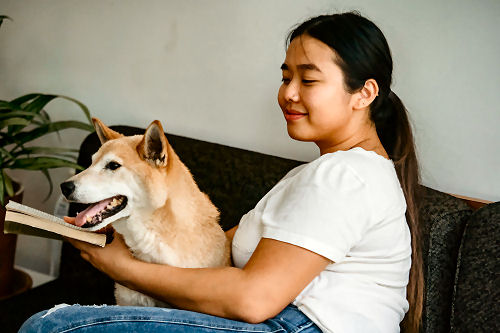
Participating in the "Reading to Dogs" program is a great dog training goal.
Participating in the “Reading to Dogs” program is a great dog training goal.

Let’s say your goal is to do therapy work with your dog. There are many programs for helping people from children to seniors; from “Reading to Dogs” to hospice or comfort-animal therapy.

For many of these programs, getting your dog’s certification as a therapy dog starts with getting the Canine Good Citizen title from the American Kennel Club. 

There are 10 specific “tests” a dog must pass to earn the CGC:

  • Accepting a friendly stranger
  • Sitting politely for petting
  • Appearance and grooming
  • Walking on a loose lead
  • Walking through a crowd
  • Sit and down on command, stay
  • Come when called
  • React calmly to another dog
  • React calmly to distractions
  • Calm during supervised separation

Every single one of these “tests” can be the focus of a 2-Minute-Training game. If you’re able to play training games multiple times a day, you can change which one to work on – or focus on one or two through the day. For specific requirements of each test, check the AKC website, or look for an animal-assisted therapy group near you.

Competitive goals

Some of us get so addicted to playing training games with our dogs that we’re just itching to find a place to show off their skills. 

It’s become apparent that Hope’s French Bulldog Torque is adept at the skills required for Rally Obedience – and he just loves doing all the stuff. Hope’s goal for 2022 is to find, enter, and compete in Rally Trials. Her long-term goal is for Team Torque to earn a Rally Championship title. She has no timetable for that goal. Time, the pandemic, and financial considerations will all impose constraints. 

Those constraints don’t matter to Torque. All he knows is that he gets to play fun games with his mom every single day. He doesn’t care whether it’s “Stack your Rings” or “Figure 8 with distractions” – it’s all fun and games for Team Torque. 

What’s your team name?

Get serious about having fun with your dog. Call yourselves “Team (Insert Dog Name Here)” Be intentional with your training games. If your only goal is to have fun, and build your relationship with your dog – that’s a great goal. Commit to your team. If you design a logo – we’d love to see it!

Looky-Loo Part II (Dog Training Game)

Spread the love

Looky-Loo is a dog training game that reminds your dog that the two of you are a team, doing things together. It lets dogs be dogs – investigating their surroundings, being aware of the world around them. While always maintaining a “check in” mentality. The fun continues as long as your dog remembers to “check in” with you.

This applies whether you’re out for a meandering walk around the neighborhood or running a competition agility course. The invisible connection between you and your dog is an important part of your relationship. In unfamiliar circumstances, or if your dog’s unsure, your demeanor when your dog checks in will help determine how interactions proceed.

Next step in Looky-Loo

In the first phase of Looky-Loo you held a toy or other object behind your back, showed it to your dog briefly while saying “Look!”, and then hide it again. When your dog looked at your face, rather than for the toy, you clicked and rewarded. After just a few sessions, your dog should realize the object of the game is to focus on you.

The next step is to keep the toy visible. Only say “Look!” once when you first show it. If it’s a particularly desirable toy, it may take a while until your dog remembers to focus on you. As soon as they do, click and reward. The reward can be a treat or even a game of tug with the “Look!” toy. Focusing on you has to be the most rewarding part of the game. The click-and-treat comes when the dog looks at you, not at the object.

Timing is important

The click-and-treat comes when the dog looks at you. That’s the goal of “Looky-Loo.” Getting your dog to return his/her gaze to you after something distracting happens. (See last week’s tip: Looky-Loo Part 1.) It’s not the end of the world if your timing is off sometimes. It happens to everyone. When it does, and it will, give your dog an “Oops! Cookie” and reset the game. Just keep the goal in mind and watch your dog’s eyes. 

Dogs learn through the timing and placement of rewards. Some people, playing attention games, even start holding the treat by their noses to bring their dog’s focus up to their eyes. That lures the dog to look at their face, rather than rewarding the dog’s decision to watch. “Watch me!” is a phrase you might hear a lot in dog training classes. It works sometimes. It doesn’t teach the dog that watching is more interesting than that speck on the floor. 

Upping the game

The next step, before you take “Looky-Loo” out on the road, is to get your dog to look at distractions in the environment and still choose to look at you. Rather than holding the object, it will be on the floor where you’ll be passing by it. 

It’s time to move the game someplace where you have space to move a few steps and place a distracting object to the side. Place an object that isn’t very interesting to your dog on the floor. Holding the dog’s leash, try to walk by the object, saying “Look!” Keep walking, and when your dog’s focus is on you, click and reward. If the dog’s attention stays on the object, go back to the last step, using the same object. Your dog will let you know when they’re ready to move on, or if it’s not quite time.

Fran and Simon have a variation of Looky-Loo:

Moving on

Remember, there’s no timetable for dog training games. Dogs learn at their own pace. And some games go more slowly than others. If your dog is extremely curious, this may be a tough one for them.

The next steps would be to change the object used as a distraction. We started our Looky-Loo dog training game with something that the dog didn’t really care about. Make the distraction more desirable in gradual steps. Work your way up to things that your dog loves. Can your dog still “Look!” and come back to you? What if it was a favorite toy? Or a bowl of food?

Taking it to the streets

When your dog is fairly proficient at “Look!” and focus, it’s time to move the game to places you may actually need it. When you do, start the game with a quick reminder of where the game began – hide an object behind your back, show it briefly while saying “Look!” and hide it again. Just a quick refresher helps the dog know what game you’re playing.

Simon is distracted - we need to take a step back in the Looky-Loo dog training game.
Time to go back a step in the “Looky-Loo” dog training game…

When you’re out and about, you can make anything the subject of “Looky-Lou!” Just tell your dog to “Look!,” whether it’s a squirrel, a person walking, or a dog being walked in the distance. When your dog looks back at you, click and reward. 

Be ready

Your dog is learning to gauge their reaction to “stuff” by your response. Stay calm, tell your dog to “Look!” and wait for them to pay attention to you. Be sure you’re watching your dog’s face so you can tell the exact moment their focus is on you. Be more excited by your dog watching you! That’s the tremendous accomplishment – celebrate it with enthusiasm!

Never too many dog training treats

Spread the love
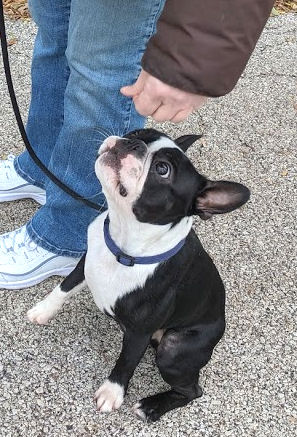
Simon agrees that there are never too many dog training treats. He's sitting at Fran's side in "Heel" position for a reward.
Simon agrees there are never too many treats.

There is no such thing as too many dog treats. Especially when introducing your dog to something new, there can’t be too many rewards. It’s one of the best investments you can make – whether your dog is learning to eliminate outside, or being calm when someone comes in the house, there are never too many dog training treats.

But my dog will get fat!

Every class session there’s a student who worries about their dog getting fat. While we understand the concern, there are ways of controlling your dog’s calories without cutting back on training treats. Use the dog’s regular food for training! Why not? Your dog would love getting food from you instead of a bowl. It will take longer to eat, and you both accomplish something. 

If your dog isn’t crazy about their food, try mixing in tidbits of some delicacy to make it more appealing. Measure out their regular portion and stir in some bits of hot dog or cheese. Most dogs love those. One student in our classes even used defrosted, popcorn shrimp. Her dog loved it and the other dogs in class got very good at working despite the distracting smells.

More calorie-friendly tips

There are lots of ways to control your dog’s intake without cutting back on quantities. Every good choice your dog makes deserves a reward. That reward can be a carrot slice, or a green bean. It could even be air-popped popcorn! Most dogs adore it. 

Your dog may have a different opinion on things we don’t consider treats; rice cakes, diced celery, apple pieces are all possibilities. If it’s safe for dogs to consume, it’s worth trying. You never know what surprising food item your dog will go crazy for. 

But my dog has tummy trouble

This week we talked to a woman whose 16-week-old puppy is on prescription canned food. Per the veterinarian’s advice, he can’t have anything else for a time. After our talk, she’s getting creative. Taking that icky, smelly, gooey canned food and scooping pea-sized “meatballs.” She’s freezing them and using them for training treats. 

With a little thought and problem-solving, you can find a way to reward your dog for every single good choice she makes. 

Does it have to be food?

Rewards for your dog can be anything the dog enjoys. (A while ago we discussed the various methods of rewarding your dog.) If your dog’s favorite thing in the world (other than you) is a tennis ball, throw the ball as a reward! If it’s a scratch behind the ears, do that. Just acknowledge every single good decision your dog makes. Even if it’s just a “Good Dog!” By itself, praise isn’t usually enough to encourage dogs to repeat a behavior. But interspersed with more substantial treats, it’s fine.

Some people are still stuck in the old-school idea that “Because I said so!” should compel obedience from dogs. It generally doesn’t work with children, and it certainly doesn’t motivate dogs to obey. The idea of positive reinforcement training is to get your dog to understand “good” behavior. The stuff that’s rewarded will be repeated. If there’s no reward, there’s no reason to do it again.

Transfer of value

Once you and your dog have developed a training game habit, you’ll find your dog eager to play training games with you for the sheer fun of it. When that happens, you can randomize rewards. Instead of rewarding each step in a sequence, a treat for “job well done!” is enough. 

The game itself becomes the reward for your dog. Having your complete attention and focus, even if it’s only for 2-Minutes, is enough to make your dog happy. They learn, your relationship deepens, you understand each other better. Life with your dog improves with every reward delivered.

Top 10 reasons to play dog training games

Spread the love
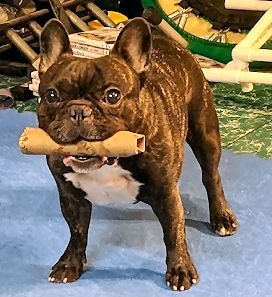
Torque holding cardboard tube. So cute! This is why we play dog training games.
Look at that face! That’s why we play dog training games!

We’re always surprised when people we assume are “dog people” don’t play dog training games regularly. It’s great for both dogs and people and so much a part of our lives that we sometimes forget that not everybody is convinced. Even people we thought would be on board. 

Our dog obedience club rents space at a doggy day care in the area. The timing overlaps a bit with the daycare operation, so we’ve gotten to know some of the employees. This week Hope was showing a dog training game video to one who claims to be a dog trainer. She was shocked when he asked “Why do you bother with that?”

The why of it all

It’s a valid question. Why do we bother with dog training games? There are so many reasons it’s difficult to list them all, but here are the top 10:

Reasons to play dog training games:

  1. It’s fun. Especially if you stick to the time limits. We call it 2-Minute-Dog-Training, but we usually stretch it to five, since we get to play with our dogs. Once you start playing, and see how much the dog enjoys it, how much they can learn, and how eager they are to play, it’s addictively fun.
  2. It grows your relationship with your dog. Some dogs may be a bit aloof, or more independent. Even these dogs become better companions through dog training games. They look to their people for direction, for feedback, and for rewards, be it a tidbit or food, a scratch, or a “good dog!” 
  3. You evolve into a better teacher. When you realize that your dog, who doesn’t speak your language, is learning what you’re teaching, it’s a revelation. You’re able to connect, even without a common tongue.
  4. Your patience grows. We’ve talked before about how hard it is to just wait and do nothing while your dog tries to figure something out. Doing nothing to “help” is tough. But growing your patience with dog training helps your relationships with people, too. 
  5. Your dog, and you, both learn to be better problem solvers. Just the practice of breaking things down into small steps helps change your approach to almost any problem. Seeing the trees, as well as the forest, helps you develop workable solutions.
  6. Dog training games require lots of dog energy. Thinking is hard work for your dog. It’s fun, but it does require focus and concentration, which are tiring. A few minutes playing dog training games is as tiring for your dog as miles of walking, or a half hour of “fetch.” Even high-energy dogs usually need a nap after an intense dog training game.
  7. Training games add variety to your dog’s life. You don’t play the same game every day. There’s always the excitement of anticipation for your dog when you start a session – “What will we play today?” Even if you play more than once a day (you should!), it’s never the same game twice in a row. 
  8. You learn your dog’s preferences, strengths, and weaknesses. Some dogs love “finding” stuff. Others love carrying things. Or it may be a combination, like “hide and seek,” or “put your toys away.” And they have particular favorites: Booker loves “putting away” soft foam blocks. Torque prefers cardboard tubes. 
  9. You and your dog become more creative. You can make up games that only you and your dog know the rules for. We noticed that Simon loves stacking things in the bin when he plays “put your toys away.” So we’ve started a new Simon game – stack the blocks. 
  10. Playing dog training games enriches both your lives. Sure, you could sit on the couch and watch TV together. And that’s fun, too. But it’s even better after a short, fun, dog training game session. Because you did something good for both of you, enjoyed each other’s company, gained respect for your dog’s capabilities, and shared your commitment to each other.

Get up and play

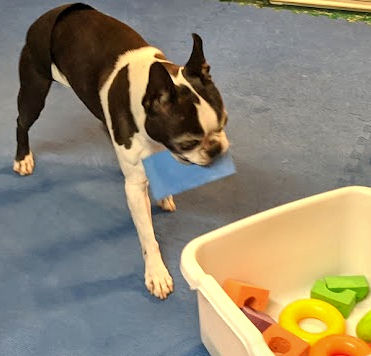
Booker loves to play with his foam blocks and put them "away."
Booker loves to carry foam blocks and put them “away.”

Frankly, we don’t know why anyone wouldn’t play dog training games. In addition to all the other stuff, the videos are fun to watch – whether you’re remembering what a good time you had, or showing off your dog’s skills to someone else. 

We think everyone with a dog should commit a few minutes a day to giving attention to their dog. While it’s understandable to skip a day here and there, a 2-Minute Dog Training Game is a minimal ask. And if someone isn’t willing to focus on their dog a couple minutes a day, we wonder why they have a dog at all.

Forbidden fruit is sweetest

Spread the love

There’s a streak in all of us that’s a bit rebellious. The thing you’re absolutely not supposed to do is the most appealing option. It’s true for dogs, too. Forbidden fruit is sweetest.

As an example: There’s a narrow little walkway next to the unattached garage that goes back to the alley. We’ve gated it off at the edge of the garage – there’s no reason the dogs have to line up at that back portion to watch/bark at the people walking their dogs down the alley. 

It’s just a little path, no more than a couple of feet wide. There’s nothing interesting back there – just the pooper scooper and bucket, the walk, and some edging stones. Absolutely nothing to fascinate dogs.

But it’s the best thing/place/activity

Naturally, the dogs became obsessed with getting behind that gate. Our normally gate-respecting dogs got it into their heads that the citadel must be breached! So they did. Battered right through the gate to go sniffing around.

The first, and totally natural reaction, is to yell for them to get out of there, get a bit angry, grab their collars and haul them back to the “safe” zone. That would have worked – for the moment.

But it also would have emphasized the space as important – something that got them all kinds of attention. Remember – dogs don’t distinguish between “good” attention and “bad” attention. They have your focus, and that’s their favorite thing.

Still the hardest thing

Simon and Booker, far away from the forbidden but attractive gate

Instead, we worked to make the area as uninteresting as possible. We opened the gate wide and went to the other side of the yard where we proceeded to reward any dog who decided to come with us to the “good” side. By ignoring the naughty behavior, we changed it from “attractive” to “boring.” 

It still goes against natural instinct. When we see a miscreant doing something they shouldn’t, we absolutely want to call them on it. But again – that’s drawing attention to the thing.  A while back we wrote about the hardest part of dog training: patience! Patience pays in all aspects of training!

It took a few tries, but that gate and area have lost the dogs’ interest and they’re on to new and different ways to push our buttons.

People love forbidden fruit, too

It’s a reminder of how similarly human and canine minds work. Back in the day, many of our friends’ parents kept their liquor cabinets locked. And our friends plotted ways to get into those cabinets and into trouble. It was a “thing.” 

Our house worked a little differently. The liquor was always accessible on a shelf. It was no big deal. On the rare occasion that the adults in the house had a cocktail, we asked for a taste and were given one. For the most part, we found the taste nasty and would happily go back to our own “special” drinks. It was a rare treat to have a soda and we thoroughly enjoyed our Canfield’s 50/50 for cocktail hour.

Dogs’ minds work very much like ours. If you make something “off limits” it can become more attractive. You’ll find that bright, inquiring little mind obsessing over things they oughtn’t. A better alternative is to minimize the importance so it loses its attraction.

It’s an example of how doing nothing is so important, and so difficult. Our attitude, attention, posture, and focus all communicate to our dogs. If we focus on the “bad” stuff, our dogs will, too. Instead, communicate clearly with your dog by rewarding them with good timing and good placement. If you want your dog away from that gate – go away from that gate and reward when they come with you.

Doggie see, doggie do – dogs learn from other dogs

Spread the love

Dogs are sponges. They watch, and absorb. And dogs learn from other dogs, as well as from people.

One of the great things about having multiple dogs is that they do learn from each other. It’s easier to housebreak a puppy when you have an older, housebroken dog. The puppy copies what the older dog does. Same thing with the household routine. If the already-trained dog waits to go out the door until it’s allowed, the puppy will figure out the rules, too.

Idol worship

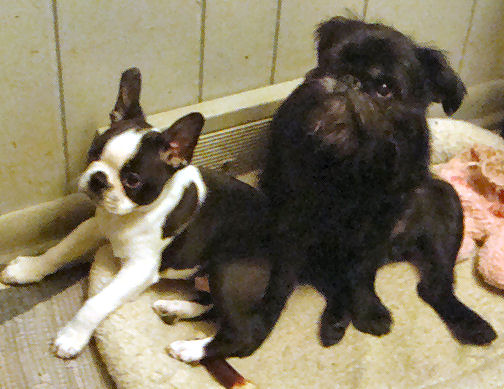
Dogs learn from dogs - baby Booker is with his idol Tango in a small dog bed.
Baby Booker emulates his idol Tango – dogs learn from dogs.

It helps if the older dog is puppy-friendly and likes having the little one around. They will be more tolerant of puppy shenanigans, and actively teach the puppy what’s okay and what’s not. When the play gets too rough, you may see the older dog holding the puppy down. It’s entirely appropriate and teaches the pup when enough is enough.

Puppies tend to be single-mindedly selfish little creatures. They want what they want when they want it. If they see another dog waiting patiently for food or other desirable thing, they’ll learn to emulate that behavior. However, for everyone’s safety, we do recommend separating, even crating the puppy for feeding time. This has the dual benefit of teaching the puppy that crates are good, and making sure the older dog won’t feel they have to guard a valuable resource like food. The older dog will probably also appreciate a chance to relax and enjoy his meal without worry.

Flip side of the coin

Dogs learn all kinds of wonderful things by watching other dogs. Ours seem to absorb the training games we play just by watching. When it’s their turn, they jump right in, seeming to know stuff we don’t remember teaching.

The downside is that puppies also absorb all the things you’d rather they wouldn’t, too. And they tend to learn the “bad” stuff even more quickly than the good stuff. 

If you have one dog that barks at any movement on your street, the puppy will probably develop the same habit, too. To avoid perpetuating the cycle, you have to take an active role. Because it’s almost impossible to train two dogs at the same time, you must set your priority. 

Barking up a storm

In the barking example – if the dog has been doing it for any length of time, it’s going to take a concerted, consistent effort to change the habit. Rather than trying to “fix” the older dog’s behavior, it’s simpler to avoid the situation with the puppy. By nature, some dogs are “better” watchdogs than others, but all can become barkers.

When the older dog barks, the puppy will probably run to see what’s going on. To show they’re being a good student, they may even join the barking, without even knowing why.

Instead of yelling at everyone to “be quiet!” – call the puppy and run the other way. Find a toy and start playing. Turn the other dog’s bark into a reason to come to you! If you’re a lot of fun and your game plan is exciting, you may even get the older dog to join the fun, rather than persist in barking. (We discussed another way of “breaking the feedback loop” a little while ago.

Timing is never good

There’s never really a “good” time to get another dog. Life has a way of interrupting plans. If you’re considering adding another dog to your family, it’s best to be ready when the opportunity presents. 

To get ready – take an honest look at the dog you already have. Are there any behaviors or habits that you’d hate for a puppy to develop? If so, now is the time to teach your present dog to be better. Develop a plan, setting the goal you want to achieve. Then back-chain the steps you need to take to get there. Turn each step into a training game.

With a plan in place and a goal in mind, even if the puppy doesn’t show up at your doorstep, the dog you have will benefit from training games. You’ll both be happier.

Dog training shouldn’t hurt

Spread the love

Decades ago, it was commonly thought punishment was necessary to dog training. That dogs wouldn’t understand, or obey, unless they were forced. When you know better, you do better. We now know that dog training shouldn’t hurt.

Positive reinforcement dog training isn’t permissive – dogs aren’t allowed to do whatever they want whenever they want to do it. But it also isn’t punishing. If you ever enlist the help of a dog trainer who advocates the use of either “corrections” or “punishment,” run away. 

But the old ways worked

Maybe so. But punishment is never a long-term solution to any problem. In studying human psychology, also applicable to dogs, the problems with punishment include:

  • It only tells you what not to do. There’s no guidance.
  • It creates fear, which may lead to 
  • Increased aggression.
  • The behavior which triggered the punishment is not forgotten. It’s suppressed and can return when the punishment is absent.

In force-based training, when a puppy had an “accident” in the house, the advice was to “rub the dog’s nose in it,” while yelling “No!” This didn’t teach the puppy not to mess in the house. It taught them not to let you find the mess. So they got sneaky about it, instead of learning not to do it. There was a major interrupt between what was being taught, and what was learned.

Not spiteful creatures

Dogs are really honest beings. They’re not spiteful, or vengeful, or “mad.” They simply don’t understand the “right” thing to do because they don’t know what it is. A classic example is the dog who might urinate on the owner’s bed when left alone. That dog isn’t angry at being left alone. He’s anxious and stressed because he hasn’t been taught how to cope with separation. 

Positive reinforcement training, as 2-Minute-Trainers teach, is building the dog’s understanding so she can make good decisions when faced with unfamiliar situations. If your dog has been taught to rely on you for guidance and feedback, she’s less likely to make poor choices on her own. 

Purely positive is a myth

Realistically, it’s impossible to never use “aversives” in dog training. Since the definition of “aversive” includes anything the dog doesn’t like, even the mildest could qualify. Something as simple as walking away from a dog that’s barking at you can be viewed as aversive, since the dog doesn’t like it. 

Getting technical, it’s called “Negative Punishment” – removing something the dog wants (you) in order to decrease behavior. In the four quadrants of Operant Conditioning, “negative punishment” is the pair to “positive reinforcement”- like giving a treat for a prompt response to “Sit!”

For the most humane, and effective dog training, we use only these. Reward what you like, ignore what you don’t. 

Not the fastest method

We know that in today’s world we all want what we want when we want it. But dogs learn at their own pace. If we’re patient and consistent, our dogs can learn whatever we choose to teach them. Step by step, teaching then testing their comprehension. Some things your dog will get almost instantly. Others take a while. Some things will require that you find a different way of explaining things. It’s worth it.

Simon's "Stand" required a new way of explaining what was required. But force was never involved. Dog training shouldn't hurt.
Simon, not standing.

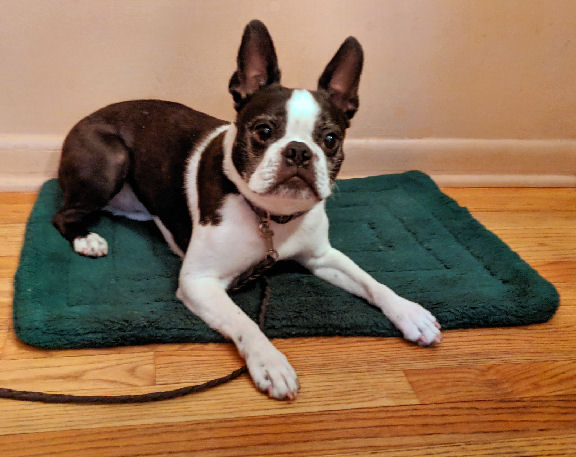
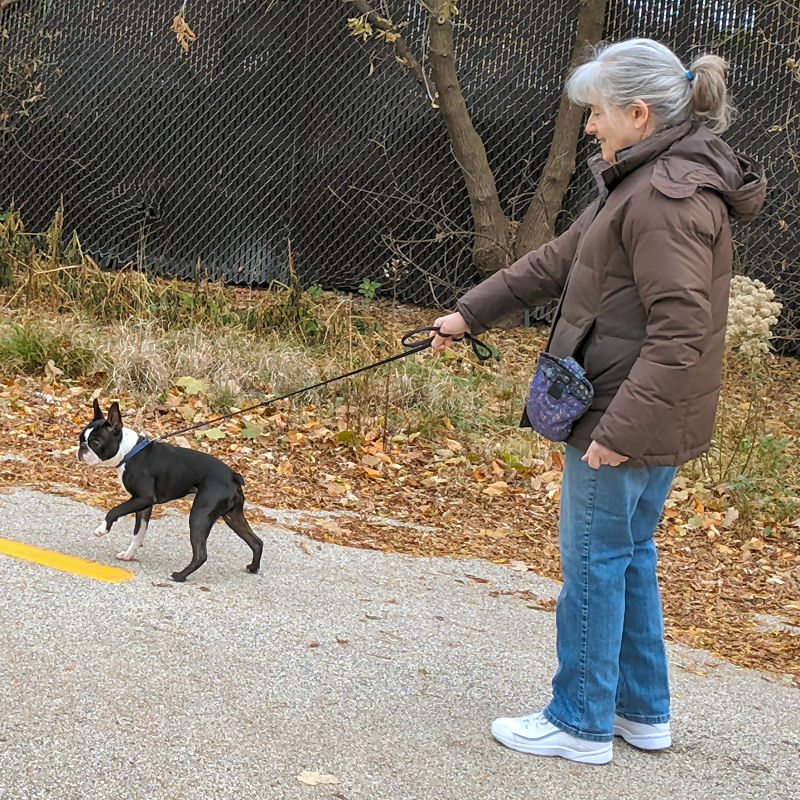
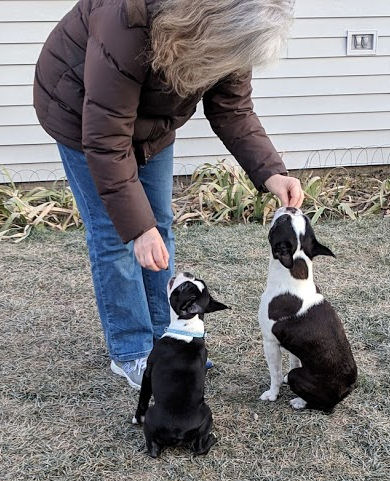
Fran’s 3-year-old Boston Terrier Simon was always crouching when asked to “Stand!” He’s almost ready for competition obedience, but the “Stand for Exam” was holding them back. He associated “Stand” with a weird little half-sit, instead of the proper position. 

He just wasn’t getting it. So Fran found a different word, and a different way of explaining it to him. After only a couple of sessions, his “Station!” looks like a proud show dog stance, instead of a wobbly squat.

Dog training shouldn’t hurt

We do know some old-school trainers who pretend to be positive, and are anything but. They’ll give their dog a collar “pop” correction while saying sweetly “Good dog!” The dog rarely hears “Good dog!” when it gets things right the first time. This dog’s tail is never wagging happily. Instead, you see the slow, steady sweep of fearful appeasement.

Your dog shouldn’t be afraid to get things wrong. They should know that as long as they try, the worst that can happen is there’s no reward. Which is a signal to try again, try something else. Positively-trained dogs keep going. Because it doesn’t hurt to be wrong.

Making a game of dog manners

Spread the love

Dog manners are like classic books. Everyone wants to have read them, but nobody wants to actually read them. Every dog needs to know household manners, but teaching them can be tedious. How many times can you say “Leave it!” or “Off!”

We get it. Teaching your dog to “gimme paw,” “roll over,” or “spin” is fun. It’s not only light-hearted, it’s usually pretty quick. Whereas teaching your dog not to jump on visitors takes time and effort. You’re also starting at a disadvantage – “taking away” something is harder than “adding on.”

Change your mindset

But it’s all a matter of perception. You know “manners” aren’t as much fun as “tricks.” But that’s an entirely human construct. We naturally are more resistant to things we “have” to do, as opposed to the things we “want” to do. Nobody likes to do their chores! 

Your dog doesn’t know the difference. Your dog only knows that you’re paying attention to her. And she likes it! That, however, can change. If your tone and body language change when you approach the “Not Fun” training sessions, your dog will pick up on it and reflect your mood. If you don’t like it, your dog won’t either.

Don’t lie to your dog

You don’t have to pretend you love the Get it! / Leave it! dog training game. You should, however, approach it with the same enthusiasm you show toward the fun stuff. It’s not the game that matters. It’s carving out the time to focus on your partnership with your dog. Every single 2-Minute session adds to the relationship. 

And when your dog shows that he understands “Leave it!” as thoroughly as “High Five!,” celebrate with the same reaction. Have a little party with treats, toys, and tugging! The things that are hard, like dog manners, should be celebrated even harder when they’re conquered. It’s easy to overlook good behavior because it’s what we expect. But your dog will be “good” more if it looks, sounds, and feels better than being “naughty.”

Everybody does it

As competitors in dogs performance sports, there are all kinds of precise positions/behaviors that we practice with our dogs. The vast majority of obedience performance scores are all about “Heeling,” so we do it a lot. 

Torque showing off his nice dog manners

How do you make a game of walking around with your dog? Especially when he’s supposed to be watching you the whole time, exactly aligned with you?

Easily! You start by meeting your dog’s eyes and smiling. This is the best dog in the whole wide world and he’s yours! Then you ask your dog “Do you wanna play with me?” And the tail-wag or wiggling butt lets you know that your dog is ready for any game. Even boring old “heeling.”

Not a marathon

The next step is setting up in absolutely perfect heel position, and telling your dog how wonderful that is. You set off, (leading with your left foot!) telling your dog “Heel!” as you’re about to take your first step. He responds matching you perfectly, tail wagging happily. And after three perfect steps, you break off and celebrate. “Yay, dog!” Here’s a treat! Or a tummy rub. Or a quick fetch your toy!

Three perfect, happy steps are a great foundation. We don’t have to heel a mile. Not even a block. We’d rather do a few steps perfectly than lose the enthusiasm for the game. It also keeps it fresh for us. Perfect heeling is, in all honesty, a pleasure to watch. And a pain in the butt to achieve. It’s also one of the dog classics.

Don’t fix your dog. Start over!

Spread the love

Don’t fix your dog. It’s probably not worth the effort. Instead, reimagine and start over!

In our “throw away” society, we’re used to the fact that it’s often better to buy something new than fix the old, broken thing. We’re not debating the merits of renew, reuse, recycle. We’re tree-huggers from way back. But in this case we’re looking at the issue from a strictly economic point of view. It makes no sense to pay for an appliance repair that costs more than half the price of a new unit. 

Dogs, however, are not things. They are not disposable. Our commitment to our dogs is based on emotion, not economics. Our dogs are worth the investment of our time and energy to “fix” the things that aren’t working. But instead of changing what’s already there – we’re going to reimagine and reinvent. Don’t fix your dog. Start over!

New is easier

When it comes to dog training, it’s much easier to teach your dog something new than to change an already-ingrained behavior. Habit is one of the most powerful forces in the universe and it’s tough to change. Our own habits, as well as our dogs’. But, with patience and consistency, it can be done. We talked about patience just last week with Dogs need processing time, too!

Don't fix your dog. Start over. Fran had to re-teach Tango's release cue. She didn't fix the old one, she started over with Tango's release.

Let’s talk about Tango, Fran’s now-12-year-old Brussels Griffon. He came with a myriad of issues, including overt aggression toward both people and dogs, documented in Fran’s book, Tango: Transforming My Hellhound

Once Tango turned the corner and was able to participate in dog sports, Fran faced an entirely different situation with him. When playing agility, both in training and in competition, Tango wouldn’t move off the start line. His “release cue” – the signal that “stay” was over and it was time to move – was broken. 

Try and try again

Fran went back to the basics of the stay and release training games. Multiple sessions with no substantial change. Tango just wasn’t responding to his long-established “go” command. 

Rather than continue in the frustrating cycle, we realized the word Fran was using had, somehow, become permanently tainted in Tango’s mind. We don’t know what caused it, or how it happened. He’s a dog. He’ll never be able to explain it. 

We fixed it by starting over. Fran chose a new word, “action,” instead of “go.” She started at the very beginning. And it worked.

Avoiding the issue

No, we didn’t fix the problem. But we found a way to work around it and made it go away. It’s much easier to try something new than to fix the broken thing, with dogs as well as appliances. Keep the dog. Toss the training that’s not working. Craft a new game to teach the “right” way to do whatever it is. 

It’s always easier to teach a dog a new skill instead of changing an old habit. Whatever your dog’s annoying behavior is, try to think about it in a different way and devise a new approach to an old problem. Don’t fix your dog. Start over! Try a different approach to the issue.

Creativity is tough

In Tango’s case it was pretty simple, just teaching a different word for a behavior he already knew. The majority of dog training is building our dogs’ vocabularies and pairing those words with actions. Most dogs really want to do what you ask. They just may not understand what it is.

That’s why training games work. In short, focused sessions you can concentrate on a single word/action and phenomenally increase your connection and understanding with your dog.

Stay positive in dog training – results come in time

Spread the love

It’s extremely rewarding to see the results of your training. It’s sometimes hard to stay positive in dog training and have faith that you’re making a difference. Lately we’ve had a couple of wonderful examples of how patience and positivity work. We’re changing lives, especially our own, with the power of positive reinforcement training.

By Simon, we think he’s got it!

Simon, Fran’s 2-year-old Boston Terrier is a nosey fellow. He has to check out everything that’s going on, and right in the middle is where he wants to be. Like most Bostons, he’s also incredibly friendly and wants to run up to everyone for overly-enthusiastic greetings.

Simon, demonstrating his jumping prowess. By staying positive, results come in time.
Simon, demonstrating his jumping prowess.

Our yard is surrounded by a four-foot chain-link fence. Our neighbor was out in his yard and Simon felt compelled to run over to say “Hi! Hi! Hi! Hi! Hi!” And repeatedly jump, bouncing off the fence at about 3.5 feet. 

The neighbor is a very tolerant man, and accustomed to living next door to dogs, so he ignored Simon entirely. Which gave Hope the opportunity to get close, say Simon’s name, and instantly reward when he turned to look at her. We could see him think about resuming the jumping, greeting craziness, but he didn’t. We could actually see him decide. Paying attention to Hope was more rewarding than greeting the man. 

Laying the foundation

Simon’s good choice was something we’ve worked on forever. He’s finally becoming mature enough to make choices. Essentially, Simon is an adolescent with all the decision-making skills of human teenagers. And since he was a puppy, he’s been rewarded for choosing us over anything else. 

Our dogs are always rewarded for coming to us. Always. Every single time. Because we always want them to come to us when called. If they’ve been incredibly naughty, we don’t call, and we don’t say their names. We go to them for the ensuing discussion. Our dogs’ names and “Come!” always have to be linked to something good. (See “Get your dog to come dashing to you every time.“)

We always want to stay positive in dog training. There’s good reason for this. We always want our dogs to come running happily to us when called. Especially if there’s a skunk in the yard. Or the handyman left the gate open.

Positive works on people, too!

It occurred to us this week that the “stay positive” message has worked in our retail life, too.

When our current mail carrier first came on the route, he was not communicative, did his job reluctantly, sometimes didn’t bother showing up, and was generally surly and unpleasant.

Over the course of months, that’s changed. He now comes into our shop with a smile on his face, a friendly greeting, and looks out for us. He even went out of his way to learn a new way of using his equipment to help us get our outgoing packages into the postal system computer faster.

Also a dog person

All we did to change things around was stay positive. Regardless of his demeanor, we greeted him with a smile. Thanked him for everything he did. Gave him treats for his dog. Some days it wasn’t easy. Especially when he “forgot” to come back to pick up our outgoing mail, and we had to rearrange our schedules to go to the post office. 

Over the course of months, our mail carrier has learned that coming into our shop will always be a pleasant experience. We’re never going to yell at him, never take our bad mood out on him, and always going to be happy to see him – even when he’s bringing monthly bills.

You may get the impression that we’ve “trained” our mail carrier to be the service person we wanted. You would be right. And all through our determination to stay positive.