Training multiple dogs at one time

Spread the love

If you have more than one dog, is training multiple dogs at one time possible? Or even desirable?

Yes and no

It depends on what you’re training, how experienced the dogs are, how well they know each other, and how good you are at multi-tasking, and how many people are involved in the training. In other words, maybe.

If you have one person for each dog – absolutely possible! We recently talked about having our dogs run (walk really fast) on the treadmill to get in some exercise when it’s too hot to go out. One of us is “walking” the dog right next to our little training area. The other is having fun with a different dog, playing training games. 

At first, the “walking” dog was more interested in the training games. All of our dogs adore their 2-Minute sessions and thought they were missing out. They learned quickly that rewards come for road work, too. All are now fine with having “entertainment” while they get their miles in.

If you’re on your own, it gets a bit trickier.

To each, his own rewards

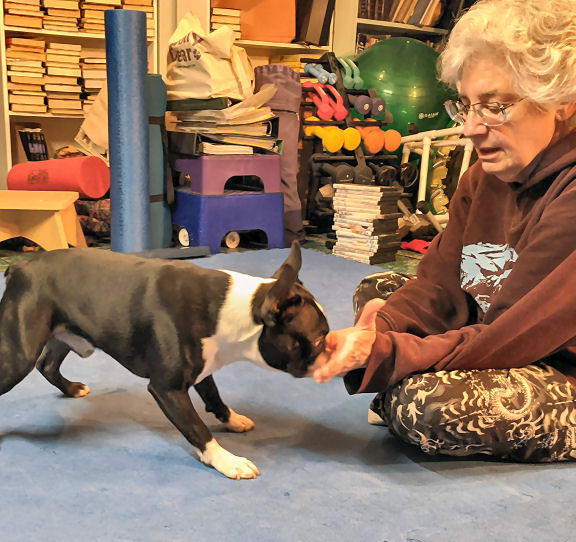
You can start by playing the same game with both dogs. Simple things like side-by-side sits, downs, spins, or even “Touch!” holding out a different hand to each dog. The key is to make sure each dog knows he’s not forgotten, and gets a “turn.” Dogs are generally great at being fair – as long as they get some time, attention, and treats!

All four of our dogs "Line up!" after coming in the house to get out of the crowded entryway.
“Line up!”

One of the group games we play is “line up!” We have all the dogs sit in a line and stay. Rewards are given to each in turn. The game originally came from trying to move all the dogs out of a narrow entry. Because dogs always stand in the most crowded doorway. That’s where the action is – that’s where they want to be.

Instead of saying “Move!” or trying to step around them and kill ourselves, we developed the “Line Up!” game. As they come in the house, we say “Line Up!” and they run over to sit on the kitchen mat. We say each dog’s name as we reward them, so they know whose turn it is. If somebody moves out of line, or tries to grab somebody else’s treat, the game stops. When everybody remembers his manners, the game resumes. 

We’re not entirely sure that “social pressure” works on dogs. We do know that when the game stops abruptly, the “good” dogs give the “naughty” one a dirty look.

Next step

The next step is to call one dog out of line. This lets the dogs know that they have to pay attention. You can either ask them to play a little game, or release them from “Line Up!” Call each dog for a game and/or release. And you’ve trained multiple dogs at once!

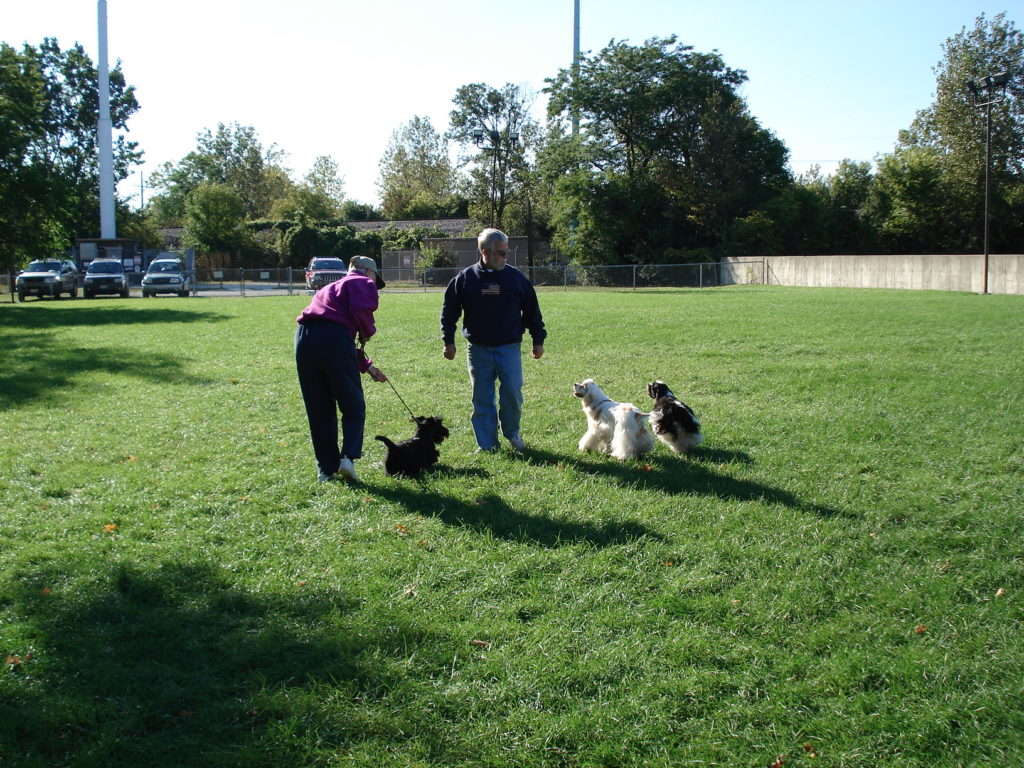
It’s also fun to try little behaviors in pairs. Both Obedience and Rally have “Pairs” competition. It’s a just-for-fun, or “non-regular” class of competition. And it always draws competitors, and audience, because it’s such a joy to watch.

Just hanging out in the yard, we’ll ask a couple of dogs for a simultaneous “Spin!” or “Front!” just because. They love doing it, and we love seeing them so happy and accomplished. These are the tiny little games you play just to have fun with your dog wherever you are, anytime you like. We also sometimes do a group recall for fun – when the dogs are wandering at the other side of the yard, call everybody and see who gets to us first. (“Get your dog to come dashing to you” has some great tips for the recall, or “Come!”)

Scaling up

A friend of ours who’s also addicted to playing training games posts trick training videos on social media. She’ll often have another dog hanging out on a cot in the background. It’s another level of training, and it didn’t happen all at once. 

Our friend frequently rewards the dog hanging out on the cot. It allows both dogs to adjust to the idea that they don’t have to be the center of attention all the time. That you do remember them. And that they’ll be rewarded for remembering the game they’re playing.

Just hanging out on the cot is an active game. Most people who have trouble with their dogs’ “Stay!” tend to think that their dog isn’t “working” when they’re staying. They are. And for active dogs, it can be the hardest game of all. 

Choose one or more

It’s up to you whether you choose to train more than one dog at a time. It’s certainly easier with just one. But two (or more) can multiply the fun!

Dealing with distractions in dog training

Spread the love

There are always going to be real-world distractions in dog training. It’s how you cope with them that matters.

You never know when “SQUIRREL!” will cross your path. But you can prepare your dog to deal with distractions.

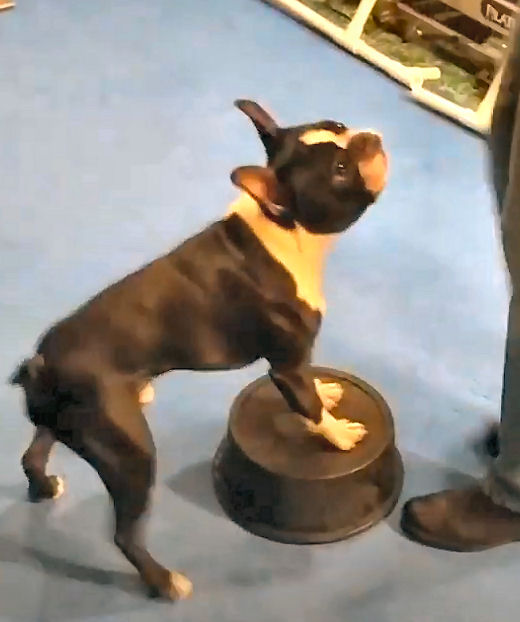
Fran and Simon, her 3-year-old Boston Terrier, competed in his second agility trial recently. It was a familiar environment – the same place they have weekly classes. The obstacles and jumps were ones he knows. And yet – he was completely distracted. Why? There were people in the ring with him! 

In agility, volunteers are dispersed around the field to pick up dropped bars, reset jump heights, etc. to keep agility trials moving efficiently. But Simon had never seen people sitting on chairs in the ring before. So he felt compelled to go and say “Hi!” to all of them.

Distraction dog training

Dogs, like Simon, are going to notice things. That’s their nature. You can’t stop your dog from seeing and hearing the world around them. What you can do is show them how to stay focused despite distractions. 

Fran and Simon are training for distractions.
Simon’s paying attention to Fran instead of the distractions around.

How is Simon going to learn to pay attention to Fran (and what he’s supposed to be doing) instead of visiting? This week in class, she’s going to ask her classmates to pretend to be those trial volunteers. And she’s going to be more fun than people sitting quietly in chairs. When Simon goes to say “Hi!,” those classmates are going to sit still and look anywhere but at Simon. Fran’s going to run away from Simon (triggering his chase instinct and his inherent curiosity), calling him. And when he comes dashing after her, she’s  going to reward him mightily. And then they’ll continue running their agility practice.

The real-world application is the same. 

How to train for distractions

The key is right there. Be more interesting than the distraction. Our students are often hesitant about being noisy, or playing with toys, or over-rewarding their dogs in class. People are taught to not be “disruptive” or make a fuss in public.

Get over it. Your dog isn’t going to pay attention if you’re boring. And, realistically, no one’s paying attention to you, anyway. They’re watching your dog. What they see in your dog is up to you. They can admire the cute, well-trained dog with you. Or they can “tsk” and shake their heads over the poorly-behaving hooligan.

Time & patience

It’s really difficult for people to embrace the idea of rewarding your dog every single time he looks at you. It’s hard to watch your dog’s face and look where you’re going. That’s why you practice in familiar surroundings and straight lines, so you don’t trip and hurt yourself. But that focus on you – rewarding your dog EVERY SINGLE TIME they look at you, is the foundation for all good training. Focus is key.  (Check out the Looky Loo game for more distraction work.)

It doesn’t mean your dog stares adoringly into your eyes all the time, for every step. It means that they check in with you on a regular basis. Because they know it will be rewarded. What gets rewarded, gets repeated.

Calling it something

When you’re building the “check in” habit, you can call it “watch,” “here,” “check,” or whatever works for you. But it shouldn’t just be the dog’s name. Dogs hear their names constantly, with little or no information attached to it. So, more often than not, they ignore it. We have one student who says her dog’s name all the time, despite us hounding her not to. And when he hears it, he tends to look away, rather than at her. Because she’s reluctant to reward. When he does look at her, he gets an occasional “good boy!” even with us yelling “Reward that!” “Cookie him!”

Building the “check in” behavior pays dividends in the real world. If you’re out walking and see “SQUIRREL!” use your check-in and have rewards ready. The better the reward, the more likely your dog will find you more interesting than the distraction. In your dog’s opinion, you should be more interesting than anything else in the world. It’s not hard to do – they already adore you!

Eyes on the Prize

Spread the love

Setting priorities in dog training

When your dog does something unexpected in a training session, how do you react? Do you remember your priorities in dog training? Or do you allow your focus to wander?

Setting priorities in dog training: Torque's priority was to play with the training tool.
Torque’s priority during the training session was to chew the training tool…

Torque gave Hope a lesson in keeping priorities straight. In the middle of their 2-Minute Trainer video of the week, he decided to take off with the training game’s object, carry it off to a corner, and shred it to bits.

So she screamed “NO!” at him, wrestled it out of his mouth, smacked him with it, and crated him immediately. 

Of course not. You can see in the video that she takes a pause to figure out what Torque’s up to. Removes the toy, and attempts to regain his attention and focus. It’s semi-successful, but calls for a change in the plan.

There are two paths forward:

  • Change directions and teach Torque to use pool noodle pieces, not eat them.
  • Use something else for the “Push!” game and get on with life.

Decide what’s important

Is it worth it for Torque to learn not to eat pool noodles? When we think about how often he’ll encounter them, not really. If we used them for anything but dog training games, it might be important. But we have no pool, and he’s never going anywhere without us. The chances of him encountering and destroying other people’s pool noodles in the wild is minimal. So we’re going to make a different choice for his training games.

That’s how you keep your eyes on the prize. Torque showed us the object we were using for the game isn’t a viable option. So we’ll use something else. That’s keeping your dog training priorities in order. We talked about training certain behaviors regardless of the public’s perception of any breed’s intelligence some time ago.

Be ready to shift gears

“Shifting gears” used to be something every driver had to know how to do. Nowadays, most people probably don’t even know the origin of the phrase. But it’s still a good one. Drivers of manual transmission cars had to pay attention to multiple inputs (speed, traffic, signals, etc.) and be ready to literally shift gears to adjust. Constantly. 

Dog training requires that you’re paying attention to what your dog is telling you and be ready to shift gears and adjust. Torque’s theft of the pool noodle was him saying “I don’t know what you want, so I’m leaving.” His repetition of that means “Shredding this thingie is highly rewarding to me, so I’m going to keep doing it.”

Given a choice, dogs will always opt for the most rewarding action. At that moment, shredding the noodle was more rewarding than playing with Hope. Gears have to shift. The game has to get more fun, and the object less so. 

Always communicating

Your dog is always providing feedback on your training. If you pay attention to what their behavior and body language tells you, your partnership will thrive. 

And be ready to shift on the fly (back to car references!). If, instead of a pool noodle, Torque had suddenly decided that books are wonderful to destroy, we would have to address that. If it matters to you, you can make it matter to your dog. You set your own priorities in dog training.

Freestyle dog training game

Spread the love

How do you make up new training games with your dog? Let your dog lead the way with the Freestyle dog training game.

The hardest thing about playing the Freestyle game is letting your dog take control. You don’t decide any part of the Freestyle dog training game, other than when to play and how long.

It goes like this: in a safe space, put out a few different objects and let your dog have fun. There are no “wrong” answers. The only thing you can do to guide your dog is stand next to or look at one of the objects. Anything the dog does is “clickable” as long as he/she isn’t trying to eat it or run off with it.

Boom game

Some dogs are more creative than others. Some dogs make up all kinds of games and behaviors and do things we never would have thought to teach them. Other dogs rely on known games and adapt them to new circumstances.

By observing what your dog does, the things he/she particularly likes, and what he/she does with them, you can develop new games.

Two of our most recent examples:

Booker playing his own Freestyle dog training game, "Boom!"
Booker playing his own Freestyle dog training game, “Boom!”

Boom! Dog training game. Booker (Fran’s 9-year-old Boston Terrier) loves knocking things over. Fran made note of it and developed his “Boom!” game. She puts out a series of soft, vertical objects (foam rollers, yoga mats, pool noodles stuffed onto dollar-store paper-towel holders). And Booker goes through the maze knocking them over one by one. By saying “Good Boom!” he’s learned the word and now will run over to “Boom!” any vertical object. Fortunately, he’s too little to apply the behavior to people.

Fran’s younger Boston, 3-year-old Simon, is a bit of an obsessive/compulsive personality. When he puts his toys away, he tries to stack them neatly. Especially empty tuna cans. He carried the tendency over into his Freestyle game, always trying to stack objects. So Fran picked up some little stacking bowls (did we mention the dollar store is one of our favorite places for dog training equipment?). She was right about his neatnik tendencies – in Simon’s very first “Stack It!” session he caught on. Fran’s only played “Stack It!” with him a couple of times so far. And he doesn’t yet understand multiple bowls can go in the same stack, not just two. He’ll get there. 

Let your dog show the way

Freestyle sessions are also great when you’re out of ideas and don’t feel like playing an old standard. It’s also a great game when you’re tired. All you have to do is stand there, click, reward, and say “good.” 

The hardest thing about Freestyle is resisting the temptation to guide your dog. Our first exposure to dog training was with a trainer who told us “Never let a dog make a decision!” (See our article, “Follow your dog’s Lead.”) When, in reality, we strive to do exactly the opposite. Training is all about teaching dogs to make good decisions. 

Dog training step by step

Spread the love

We’ve all heard the saying that “the journey of a thousand miles begins with one step.” That’s true for dog training, too. This is a journey that we’re on, and since it lasts the dog’s entire life, we all hope it’s a very long one. Dog training step by step means your dog thoroughly understands, trusts you completely, and loves you completely.

Sometimes it may seem like you’re not getting anywhere fast. And you may not be. Steady progress is difficult to measure. Especially when you have a 2-Minute game session that doesn’t go particularly well. That’s one of the beauty parts of the system – even the worst game session is only two minutes long. While we often want the good ones to last longer, we’re grateful the bad ones end quickly.

Baby steps get you there

If you have a dog who loves playing fetch, it’s a great game. If your dog doesn’t understand any part of it, it’s a complex behavior that your dog can learn to love playing. There are lots of moving parts to fetch:

  • Wait while you throw the toy.
  • Run after the toy.
  • Find the toy.
  • Pick up the toy.
  • Hold the toy.
  • Run back with the toy.
  • Drop the toy. 

If you have a non-fetching dog, not a single one of those steps comes naturally to your dog. Every one of them can be taught as a separate game. But if you’ve ever thrown a toy for a dog who sat there and looked at you, you know it’s impossible to teach the entire game at one time. If your dog is a “if you wanted it, why did you throw it away?” kind of dog, you know what we mean.

Keep it small and doable

Torque looks confused - whenever it's not dog training step by step.
Is Torque confused because the step was too big?

When every step is its own game, with a reward for small steps, no one gets discouraged. If you ask too much of your dog, they may disengage. Stress behaviors might include walking away, turning their head, licking their lips, yawning, or scratching. If you see any of those, it’s time to step back and assess the situation. Did you ask too much? Is the step you’re taking too big? Can you break it down smaller? We recently broke down the steps for Tango’s favorite game – “Put your toys away.”

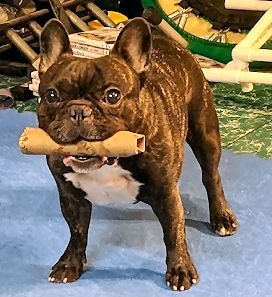
Recently Hope was starting to teach the Utility Obedience exercise “Directed Retrieve.” In this exercise, three gloves are evenly spaced apart at one end of the ring. The dog is supposed to fetch the glove his owner points at. Hope’s French Bulldog Torque knows how to go get stuff and bring it back to Hope. He loves the dumbbell retrieve that’s another Obedience exercise.

Torque was completely flummoxed by the Directed Retrieve. Even though he knows “Get It!,” he was unfamiliar with the gloves, the multiple objects, and Hope’s directional signal. So Hope’s breaking it down. After a few 2-Minute games, Torque will now pick up the glove and carry it. He’s working on dropping it on command. And he’s still figuring out how to tell which one to get. 

Too much to swallow

It’s discouraging to fail. Torque didn’t recognize that “fetch the glove” was pretty much the same as “fetch the dumbbell.” We’ve mentioned before that dogs don’t generalize, and here was another proof. Now each part of the exercise is a separate game. 

If your dog truly isn’t making progress with something you want to teach, think about the smaller steps you can take. The way to keep your 2-Minute dog training games fast, fun, and effective is to keep the steps small. You’ll get where you’re going, whether you take small steps or giant leaps to get there.

You can’t cram dog training

Spread the love

Scenario: You’re hosting a big, buffet-style party in a couple of weeks. Your dog is a counter-surfing expert. Nothing on any flat surface is safe. Sadly, you don’t have time to change that. You can’t cram dog training.

In this case, managing the situation is the best you can do. You can either secure your dog away from the food, or have him on leash and tethered to a responsible person throughout the party. Left to her own devices, your dog will find the most rewarding option. Which would be a festival of party food.

Assigning someone to guard the banquet isn’t ideal, either. That person’s only option would be to reprimand the dog for being naughty. If your dog doesn’t know the “right” choice, they default to what’s most rewarding. In this scenario, it’s a feast.

Crisis training doesn’t work

You can't cram dog training. Simon thinks he can help himself to the salad on the kitchen table.
Simon thinks he can help himself to the salad on the kitchen table.

You can’t train a dog “stay off the counter” during a party. Likewise, you can’t train a dog to “stay” when the delivery guys are currently in and out of your house. If push has come to shove, your option is to manage the situation and the dog. (We talked about setting your counter-surfing dog up for success a while ago.)

Remember there are three ways to deal with dog behavior; ignore, manage, or train. 

If you choose to ignore something your dog does, they’ll keep doing it. That’s okay, since it doesn’t bother you enough to do something about it. 

In an urgent situation, like our fictional party or deliveries, the best option is management. Without a thorough understanding of what to do, your dog may get in trouble. If you need your entire attention on other chaos, manage your dog’s access. Securing your dog in another room or in a crate is a viable management choice. Trying to cram dog training in before a deadline is a losing proposition.

The long-term solution is to train your dog to cope with temptation and excitement. Athletes, musicians, and dancers practice constantly to build their “muscle memory.” Similarly, dogs rely on well-trained responses to decide their actions in somewhat familiar situations.

Set up for success

If your dog is a counter-surfer, set up training sessions to teach them how to react. This is a perfect time for a 2-Minute session. 

Put a handful of yummy food on the counter and stand there. If your dog sniffs at it, paws at it, attempts to reach it in any way, cover it. You can use your hand or a bowl or container. 

When the dog backs off, click (or praise) and reward. If the dog sits, even better! Praise and reward from the handful of food that’s already there. You’re teaching your dog that you are the source of all good things. She doesn’t get to help herself.

It’s an easy concept for people. Ask politely and you’ll get what you want. 

Since we want our dogs to be comfortable in human society, they need to learn manners. Dogs have instincts. Manners must be taught. We empower our dogs by giving them the tools, and manners they need.

Dog Training Game: Drop it!

Spread the love

“Drop it!” is a command, like “Come!” that could potentially save your dog

It happened to us, quite a few years ago. One of our neighbors made profligate use of rodent poison sticks in his yard. Not realizing, or not caring, that wildlife would carry the sticks throughout the neighborhood. Hope’s first French Bulldog, Dax, got hold of one. If she hadn’t known “Drop it!” she may have died that day.

“Drop it!” is almost as difficult as it is important. It requires the dog to give up something of value.

How much they care

The value of the item may be very temporary – they saw something interesting and just grabbed it in passing. Those are the easier ones for “Drop it!”

In the middle ground are things that dogs snatch because you’re interested in them. These are the things, like socks, that your dog sees you interact with. Your dog may not actually be all that fascinated with it, but because it smells like you, and you are “playing” with it, it has value.

The third level is the most difficult to get your dog to “Drop It!” These are the things that your dog adores, wants to keep, and is extremely reluctant to lose possession over.

Level of importance

The mechanics of “Drop it!” are pretty simple. You’ll “trade” something for the object your dog is holding. Ideally, what you’re offering is “better” than what the dog has, so your dog always thinks they’re “trading up.” 

Just like your dog’s degree of interest in the snagged item, “Drop it!” works with a hierarchy of value. For a minimally-important item, your dog may trade it for a low-value treat, like a piece of kibble. For the highest-value objects, the ante has to be higher. Whatever your dog values most should be in your toolkit for this game. The better the “trade” item, the more likely your dog will be to “Drop It!”

That being said, the success of these games rely on being able to control the situation and the circumstances. Fran’s Boston Terriers are amazing at “Drop It!” She played the trading game early and often, and both Simon and Booker know the fun isn’t over when they obey.

Torque is reluctant to play "Drop it" with his ball.
Torque is reluctant to play “Drop it” with his ball.

Torque, Hope’s French Bulldog, is a harder case. He’s great at “Drop It!” for almost anything. And the exceptional things are, in order of importance: 1: balls 2: balls 3: balls. The only thing as good as a ball, for Torque, is another ball. 

Trade goods

If your dog is like Torque, have two or more of the exact same item. Torque learned to “Drop It!” only when he found out that what he was getting in exchange for his precious ball was another precious ball. With the added bonus of being able to chase it down. He will now play “fetch” – as long as there are multiple balls in play.

Trading is a valid way of getting your dog to release something. And if you’re starting from scratch, it’ll work like a charm.

But what if you’re trying to change an already-established pattern? Like stealing socks?

Make it boring

If it’s something you can get hold of, do so. And don’t let go. But also don’t let it turn into a game of tug. If your dog starts to back up and tug, move with your dog, so there’s no tension on the object. When Torque was learning this command, he would back up all around the house, Hope hanging onto the toy. She didn’t allow any tension – if he moved, she moved with him. It was a frustrating non-game for Torque, but he learned.

 If you can, hold the object with one hand on either side of the dog’s mouth so your dog can’t change grip. You can even push it slightly, so it’s even further into your dog’s mouth. Most dogs don’t like that very much. 

While we make every effort to avoid using aversive methods, getting a reliable “Drop It!” command is worth bending the rules a little bit to keep our dogs safe. There’s no punishment, it’s just refusing to engage in the dog’s game. While they may not like it, it’s harmless. And we guarantee that the trip to the emergency vet, endoscopy, and the subsequent bill are things that you, and your dog, will like even less.

The best trainers have bad dogs

Spread the love

It’s easy to train a “good” dog. But bad dogs make us better trainers.

One of the best dog trainers in the world has gotten even better over the last couple of years. Why? In addition to a Border Collie, which most of her dogs have been, she acquired a Boxer mix. 

We follow her pretty regularly online where she has multiple dog training venues, mostly about agility training. And we’ve seen how her training has changed with the addition of a non-traditional performance breed.

Not, by any means, stupid

Border Collies are known for being the “smartest” breed of dog. They are certainly smart, eager to learn, and team with their humans. But that’s what Border Collies were bred to do. The breed was developed for a job that requires human interaction and direction. Border Collies are great at herding sheep. You can watch them in some great online drone videos. They’re tremendous workers. And there’s always a person telling them what to do with the sheep.

Tango, our "bad dog" has made us better trainers.
Brussels Griffons like Tango were bred for pest control. Training him has made us better.

Other breeds, maybe including yours, were developed for other purposes. Terrier breeds are almost all independent workers. Most were bred for pest control. They know their job and they don’t need anybody to tell them how to do it. Partnering with a Terrier requires more effort.

Worth the challenge

Finding ways to partner with a dog not known for being obedient, or a “good worker,” requires us, as trainers, to be more creative. To engage our dogs, we have to create and present games in ways they find intriguing.

That may mean your Terrier needs more motion in the games than a Bulldog. If you’re playing “Put Your Toys Away,” that may mean tossing the toys instead of dumping them in a pile.

That dog may respond better to loose-leash walking games if you have a rope toy and play “tug” as a reward for paying attention. 

Adjust to the dog you have

Training bad dogs, like our own Brussels Griffon, Boston Terrier, and French Bulldog crew, has made us better trainers. The one we learned the most from was the worst dog – Fran’s “Hellhound” Tango. Turning him from an aggressive, nasty little dog into a sweetheart has been a journey. (You can read about our journey with him in Tango: Transforming My Hellhound.) 

Each of your dogs makes you a better trainer. Because each one will have a different way of learning. They’ll catch on to commands and behaviors in their own ways, and lead you to explore all kinds of ways of training.

If you’re ever stumped trying to connect with your dog about a particular game, stop and think. Consider the games where your dog caught on quickly and still loves. How can you use pieces of that success in what you’re working on? (See the 2-Minute Tip: “Build on what your dog knows.”)

Alien species

There really aren’t any bad dogs in terms of training. Every dog can learn. When you consider all the obstacles to communicating with a different species, you’ll appreciate how extraordinary it is that our dogs partner with us at all. 

That communication goes both ways. While you’re seeking ways to explain things to your dog, pay attention to what your dog is telling you. It may not be in words, but you can tell. Eager participation, but wrong choices, mean he’s confused. Turning away may mean fear of being wrong. Offering all kinds of behavior, but not the one you want could be lack of focus.

You don’t have a bad dog. You have the opportunity to be an outstanding dog trainer.

Put Your Toys Away Dog Training Game

Spread the love

In last week’s tip we mentioned that Tango’s favorite training game is “Put Your Toys Away.” We were planning to provide a link to the game instructions – but then realized we’d never written about it. We’ve done videos of the game, but never explained how to teach it – until now.

Put Your Toys Away has lots of parts

Put Your Toys Away is a lot of different dog training games all strung together. And, as with all 2-Minute-Dog-Training games, each part is a different game. It’s only when your dog is getting parts “right” a majority of the time that you string them together.

“Toys” don’t have to be toys

Tango and the Put Your Toys Away dog training game
Tango, putting his toys away

You also have to think about the objects you use for the game. It has to be a lower-value (to the dog) object that the dog is willing to give up. If you have a tennis-ball obsessed dog, don’t use tennis balls. If your dog adores plush toys, use vinyl, etc.

Tango is the only one of our dogs who uses actual dog toys for the game. For one reason – he doesn’t care about dog toys. Never has. And the long-neglected toys we got for him before we knew that are too small for the other dogs to play with. They wouldn’t last a minute.

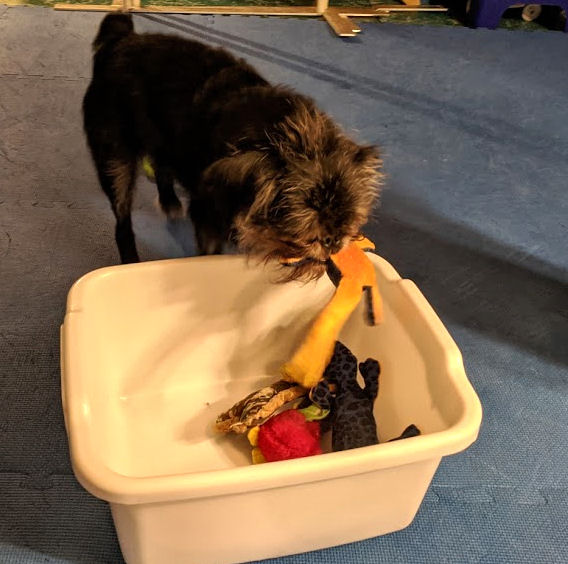
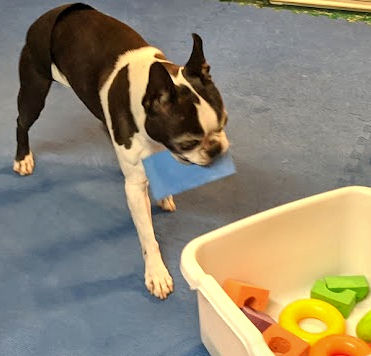
All four of our dogs play “Put your toys away,” but use different objects instead of toys. Booker comes closest with foam building blocks. Torque uses cardboard tubes and toy tambourines from the dollar store. Simon (a.k.a. The Destroyer) has tuna fish cans (with tape around the edge), ring molds, and plastic food containers.

Here’s Booker putting his blocks away.

Breaking it down

Dissect “Put Your Toys Away” into its component parts and treat each one like a separate game:

  • Pick up a toy (object).
  • Hold the toy.
  • Carry the toy someplace.
  • Go to the bin, (box, washtub).
  • Drop the toy in the bin.
  • Leave it.
  • Return to the toy pile.
  • Repeat.

If you try to string together the entire list, your dog may get confused about what you’re actually asking for. You don’t have to play the games in this order. Each part can be a separate game, played in any order.

Never assume

Even if your dog knows how to “take” something from you, it’s a good idea to start from the beginning. Taking an object from your hand is different from picking it up off the floor. If you want to hand your dog individual objects and build the behavior that way – that’s perfectly fine. It’s a game for you and your dog to play together and you can make up the rules. Keep the rules of the game consistent for your dog, but play however you want!

One variation we’ve tried in the last couple of weeks, just to refresh the game, is to actually toss the object and have the dog chase it, then put it away. It’s a variation on the theme that lends more energy than picking up toys from a static pile.

Let us know!

When you’re familiar with the 2-Minute-Trainer method, turning each step into a game should be fairly simple. If there are bits you’re not sure of, be sure to let us know! If we hear that a particular segment is proving more difficult for dogs and/or people, we’ll provide step-by-step guidance. 

This is a game that every dog/person team can play to suit themselves. Whatever objects, receptacles, distances, motions you use, it’s fine. And we’d love to see video of you and your dogs in action! Please post anytime on our Facebook page!

.

Training Games help dog fitness

Spread the love

It’s always great when you have proof. This week we got expert confirmation that training games help dog fitness. 

Tango's training games help his fitness.
Tango’s training games help his fitness.

Fran’s almost-13-year-old Brussels Griffon Tango was sick. Really sick. Spewing out both ends sick. He’s recovering now, so the worry part is over. But while at the veterinarian’s office, the vet said she wasn’t worried about Tango not eating for two days, or a health crisis. Because he’s so fit, his body could cope and recover quickly.

That made an impact. Two sleepless nights and 36 hours of gastrointestinal distress may leave no long-lasting effects because this senior dog is in good shape. Fitness matters, for dogs, too.

Dog fitness plan

It makes sense. Both the body and mind for both dogs and people are “use it or lose it.” Dogs’ bodies are subject to many similar age-related problems as people are. Arthritis, loss of vision, loss of hearing, lessening of balance, etc. But staying active and asking our dogs to do the same can delay or prevent some issues.

Tango’s fitness routine is simple. It takes less than 10 minutes a day. He has a good time, gets treats (when he’s not sick), and even runs over to play his dog training games. If you didn’t know he was almost a teenager, you’d never guess it.

The balance disc “workout” is first every day. You’ll find the details and video in this post: Wellbeing of Dogs. Some days it goes better than others. We didn’t ask Tango to do it when he was sick. And he was a bit wobbly when he got back to it. But he did it happily. He missed the attention, if not the exercise.

Favorite training game

Tango’s favorite dog-training game is “Put your toys away.” 

You dump a bunch of dog toys in a pile. The dog’s task is to get each one, pick it up, carry it across the room, and place it in a box. 

Tango’s never played with toys, but he loves putting them away. And, because Fran puts the box as far away as the space allows, he gets lots of back-and-forth steps in. The first day he was feeling better, he actually trotted back and forth, so happy to be playing his game again.

Mind and body dog fitness

All dog training games work to help your dog’s fitness. Working your brain is just as important as working your body. Tango may not be able to see very well, but he can think just fine. And, while “Put your toys away” may be an old favorite, it’s also important to introduce new games. Challenging your dog’s mind can help keep it sharp.

It’s easy to take old dogs for granted, assuming they’ll be happy just napping away in the sunshine. But to keep them in the best shape, let them nap after they’ve played their training games.