Training “Touch!” Dog Training Game

Spread the love

The “Touch!” dog training game can be a pocket game you pull out and use any time you and your dog are together. It’s great when your dog is stressed, if you’re waiting at the vet’s office. Or if your dog is intently focused on something that’s none of his business, like that other dog on a walk. 

To make this a go-to game, you and your dog must play it often. And your dog has to love it. Absolutely adore it. When your dog values playing this game more than any other stimulus, you can play it to keep your dog’s attention where you want it. That’s when it becomes one of the most useful tools in your dog-training toolbox. 

Tools of the game

“Touch!” doesn’t require much stuff. Just you, your dog, and some treats. Really prime treats. Leftover steak kind of treats. 

This may be a good place to talk about the “hierarchy” of treats. Dogs have preferences, just like people. You may adore fruit. Blueberries may be the fruit you reach for every time. Somebody else (Hope) may be allergic to blueberries and avoid them like the plague. She’d reach for the chocolate, instead. 

We’ve talked before about putting together a “trail mix” of treats for dog training games. This should be a mix of high value (cheese), medium value (Cheerios), and low value (kibble) bits. The examples are our dogs’ particular preferences. You’ll know best what your dog’s favorites are and the tidbits she pushes away.

We know one person whose dog’s favorite thing in the world was shrimp. She went out of her way to get dried shrimp to use as training treats. We’ve also talked about Hope’s Dax, who adored celery. Most dogs love popcorn and you can certainly use air-popped popcorn in the mix. 

When your dog never knows what the next treat will be, it keeps things fresh and exciting for the training games. Use your dog’s unique trail mix for most training games. Use the favorite for introducing a new game, especially one like “Touch!” that you mean to use often.

Getting started with Touch! Dog Training Game

The mechanics of a dog-training game like “Touch!” are simple, but not intuitive. Doing it this way gets the message across to your dog most clearly. Nobody’s watching – if you want to practice the moves before you try them out on your dog, go ahead. 

Remember when you’re playing dog training games that you’re trying to communicate complex ideas to someone who doesn’t speak your language. And doesn’t have a common frame of reference. Your dog wants to play the games and have fun. Be as clear and confident as possible.

Have a bunch of treats in a bowl or small container near at hand, but out of your dog’s reach. If your dog has a tendency to wander away, or disengage when he/she doesn’t understand, put on his/her collar and leash and just let the leash drag on the floor.

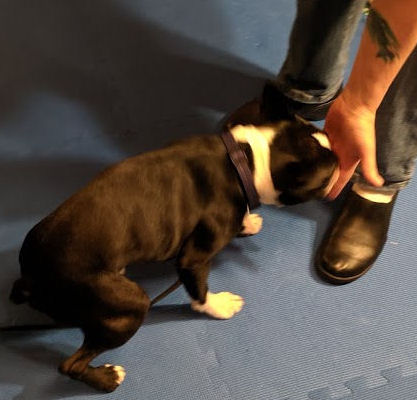
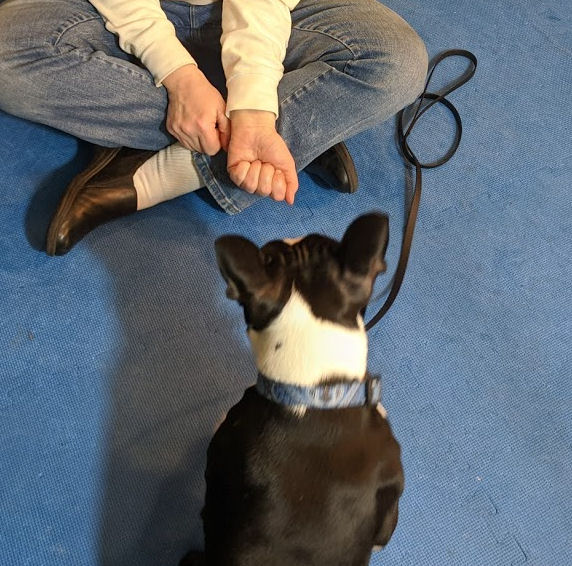
Step 1: Put your hand out to the side, palm side facing your dog. Call your dog’s name. If your dog looks at your palm, touches your palm, interacts with your palm at all, take a treat with the other hand and hold it in the middle of your palm for your dog. You are feeding the treat from the open palm with the other hand.

You’re probably asking why you can’t just have a treat in the palm you want your dog to touch. And the answer is: because we’re not luring the dog to touch. We’re teaching the dog to decide to touch. 

There may come a day when you need to get your dog’s attention but you don’t happen to have a treat handy. If the only way you’ve played the game is with a visible reward, your dog doesn’t know the right choice to make. He/she loves the lure, not the game.

Another important point: don’t reach out to your dog. Let your dog come to you. If you start reaching out, your dog’s natural instinct will be to back up. You don’t want that. Let your dog come to you.

Give it a name

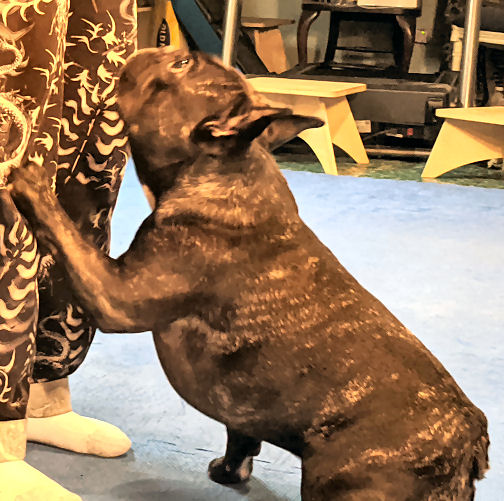
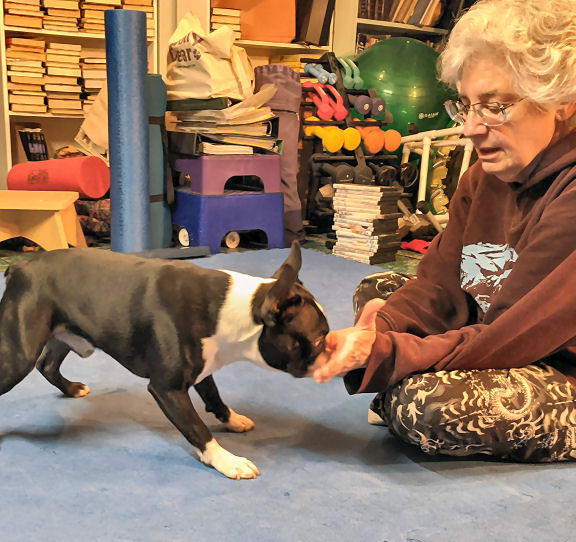
Simon and Hope playing the Touch Dog Training Game.

When your dog touches your palm, you can start calling the game “Touch!” As you’re giving the reward (with the other hand, all the time!), you can say “Good Touch!” “That’s Touch!” “What a good Touch!” As well as the game, you’re also teaching the name of the game. 

Remember to only play for a two-minute session. You can play a couple times a day, but not for long. Since this is such a simple game, your dog should “know” it fairly reliably in a week or so.

Variations on a theme

Once you’ve established your palm as the target to touch for treats, you can change hands, even alternating once your dog understands. Don’t be surprised if your dog doesn’t “get” that it’s the same game when you change. Remember that dogs don’t generalize naturally – it’s a learned behavior. Just because your dog understands “Touch!” with your left palm doesn’t mean she’ll know it with your right, or with your mother’s palm, or anyone else’s. 

You can play the Touch dog training game anywhere. Take the game outside, to the park, to the pet store. In particularly difficult environments be sure to reward heavily and not go too far too fast. If your dog is having difficulty at the park, go back to your own yard and practice more there.

Old reliable

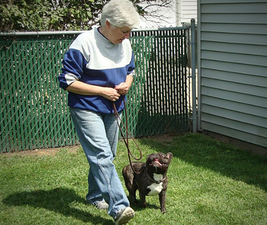
The Touch dog training game is what we use to get our dog’s focus, break his attention from someplace it shouldn’t be, and pass time when we’re waiting. You can alternate palms, play sitting, standing, kneeling, running, walking, wherever. It’s also useful when you’re playing another game, like “Boxey” and need to take a break while you reset. 

Transitioning from one dog training game to another is easy. The more games you and your dog know, the more fun you’ll have.

Boxey Game Part 2: Your dog can be creative

Spread the love

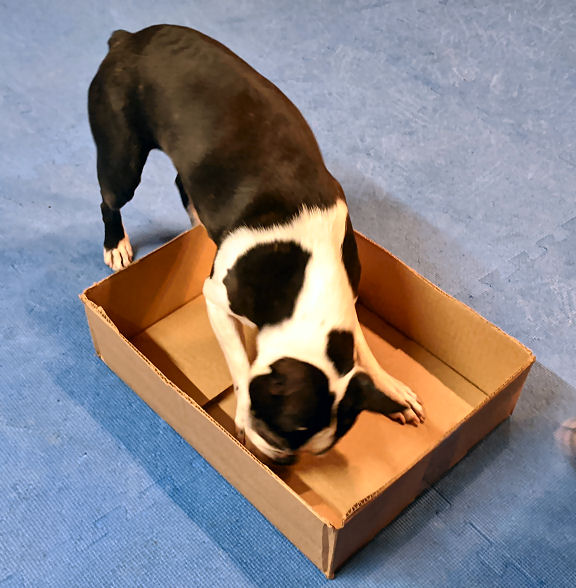
In last week’s tip we talked about getting started with the Boxey game. Now it’s time to take it further and showcase your dog’s cleverness. Your dog can be creative with the right encouragement.

Remember that you’re never allowed to say “NO!” when you’re playing Boxey with your dog. Aside from biting or chewing the box, whatever your dog does with it is okay. If your dog is wildly creative and starts playing volleyball with the box, reward it, name it, and for pity’s sake get it on video so you can make a fortune.

Stop telling your dog what to do

The nice thing about playing Boxey is that you have no particular objective in mind. Most dog tricks or behaviors have an end goal. Our only goal here is to teach the dog that it’s okay to try different stuff. There are absolutely no negative consequences with this game. The worst that should happen is, if your dog absolutely intent on chewing the box, you call it quits for this session and try again later. Maybe with a different box, if that one’s too attractive for gnawing. 

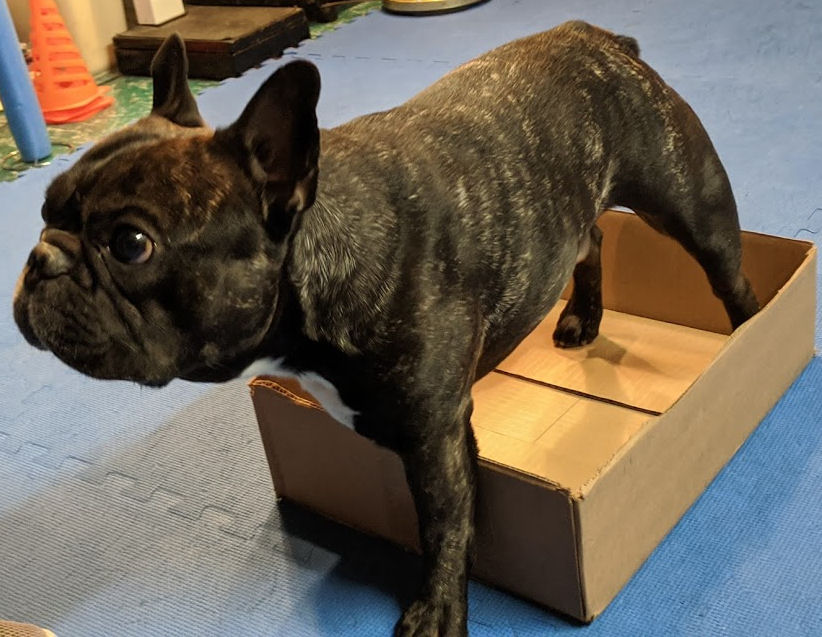
Torque playing Boxey - he's got 3 legs in the box!

The possible actions that your dog may come up with to interact with the box include:

  • Sniff it
  • Nudge it
  • Pawing at it
  • Put a paw in it
  • Put two paws in it
  • Three paws in 
  • All four paws in
  • Left paws in
  • Right paws in
  • Back paws in
  • Backing into it
  • Jumping over it
  • Sitting in it
  • Lying in it
  • Turning it over
  • Turning it on its side
  • Putting something else in it
  • Moving it

Hopefully you’re getting the idea that your dog can be creative with the box however it occurs to him. 

Getting your dog out of the box

Once your dog figures out the box is his/her “sweet spot,” you may have some difficulty getting your dog to get out of the box. That’s one of the reasons we say to only reward the same behavior three to five times. If you keep delivering treats for your dog sitting in the box, you’ll never get him out. 

Speaking of getting him/her out, dogs trained with positive reinforcement can cycle into what we’ve heard called feedback loops. They keep doing the same thing over and over, regardless of whether it’s being rewarded, because they can’t figure out what else to do. There needs to be a way to break the cycle.

One of the behaviors we use to settle our dogs down and get their minds back in the game is the hand touch. It’s a whole other game, which we’ll talk about in next week’s tip. In the meantime, if your dog is becoming box-obsessed, just pick it up and try again another time.

It may take some time

Most dogs spend so much of their lives getting directions from people that it’s hard for them to break away from that and think for themselves. 

But thinking creatively is a great way to keep dogs (and people!) of any age interested and engaged. If you’re reading this tip, that means that you’re interested in giving your dog the best life possible – which means encouraging him or her to use every bit of brain power possible. Dogs are smart. Channel that ability into paths that will delight instead of getting into trouble. It’s better to have a dog that bats a box around than one that chews electrical cords out of boredom.

Some dogs are more creative than others. Among our own dogs, it’s the old guy, Tango, who comes up with the most creative ways to use Boxey. Torque is the least. 

It’s more challenging to play Boxey with a less-creative dog because it requires you to be more patient and think more creatively yourself. As with Torque, if he can’t come up with anything new, we’ll take the initiative and present him with a new “look” – like putting the box on its end instead of its bottom. Or placing it on top of another box. Or hiding a treat underneath it. 

Your dog can be creative. And so can you. Together you’ll come up with your own Boxey variations and your own shared repertoire of games.

Basic Dog Training Games – Game #1: Boxey

Spread the love

Where do you start with dog training games? 

It’s a great question, especially if you don’t have an immediate issue to solve and want to start strengthening your relationship with your dog and build your dog’s understanding.

We’ve talked about training natural behaviors and about training for the whole family, but where do you start?

Start with the basics

This week we started training with a family who just adopted a nice little dog. Huey is a young adult Chihuahua/Terrier mix. He’s a nice little dog. Doesn’t mess in the house. Doesn’t bark in the apartment. He doesn’t have any huge behavioral issues. He also doesn’t know how to do much of anything.

Huey is also a smart little guy. When he gets bored and restless, he finds ways to entertain himself. Like stealing a roll of toilet paper and strewing it all over the house.

Tired dogs don’t look for ways to cause mischief. Occupying a dog’s mind, even for two or three 2-Minute dog training games a day, will make sure you have a tired dog. And a tired dog is a good dog. Remember how tired you were after school tests? That’s what 2-Minute dog training sessions are for your dog. But a lot more fun.

Game 1: Here’s a box

The first step is to teach your dog how to learn. And, as part of that learning, trying stuff is okay. As a matter of fact, trying new stuff is fantastic! No matter what your dog does during this game, you’re not allowed to say “No!” You’re also not allowed to make negative noises. You are allowed to re-set.

The stuff you need for this game is a bowl full of treats, your clicker if you use one, and an open box large enough for your dog to sit and/or lie down in, short enough he/she can step into. It can be cardboard or plastic, whatever you have around.

Get your treats, clicker, and box and call your dog. Put the box on the floor between you and your dog. Don’t point at the box, move it, or call it anything at this point. You can stare at the box, and talk to your dog. “What is that thing? What are you going to do about it?” It doesn’t matter if you’re standing, sitting on the floor, or in a chair. 

Anything your dog does to interact with the box gets a “click & reward!” Looks at it, sniffs it, nudges it, puts a paw in it – all count. The only thing we wouldn’t reward would be chewing or biting it. 

This week you could almost see Huey thinking “What the heck is that? Why should I care?” He ignored the box at first. His mom was patient and just stared at the box. When Huey finally glanced at it, he got a click and a treat, tossed into the box. 

Deliver the reward by tossing it in the box. We’re showing the dog that the box has value. Huey was consistently staring at the box after only three or four clicks.

Next on the agenda

Dog training games - starting with Boxey.
Booker’s an old hand at “Boxey.” Here, he was rewarded for having 2 feet in the box.

Very soon, hopefully within just a few treats, your dog will fall in love with his/her new “goodie box.” That’s when you ask for more. 

“That was good! What else can you do?” If your dog just looked at the box, wait for him/her to move it. Or put a paw in. Anything that “ups the ante” with box interaction.

It’s important to keep progress moving. It encourages your dog to try something different, something new. He/she is trying to figure out what will get the treats. Don’t be stingy, but keep moving along.

This sequencing will teach your dog to keep trying new things, using his/her brain and body to push the limits of what he/she knows further. And you’ll both be amazed what your dog can accomplish. If you’ve never seen a dog smile, we can almost guarantee it will happen.

Next week’s tip will continue “Fun With A Box,” expanding the behaviors that your dog may come up with and how you’re both learning that it’s a team game – your dog gets what he wants when you get what you want.

Everybody play dog training games

Spread the love

Everybody who lives with your dog should play dog training games. It’s the only way to make sure the dog listens to everybody.

“Board and train” programs are popular now, especially with the many inexperienced people who have acquired dogs in the last year. It sounds like a great idea – send your unruly dog away for a couple of weeks and you’ll have a model citizen canine back.

It doesn’t work that way. The dog may behave wonderfully well for the trainer, but unless you’re familiar and comfortable with the methods, gestures, and words used to get the dog to “be good,” the dog obeys the trainer, not you

Dogs are wonderful at keeping things in context. “Mom” always insists they sit and stay before she’ll put their food bowls down. She gives them a “release” word, and they’re free to eat. On the other hand, “Dad” is a soft touch and never makes them wait. They swarm as soon as the food bowls leave the kitchen counter.

Have your own games

Every member of the family can play their own games with the dog. Or you can share. It doesn’t matter. What matters is that the dog has a relationship with each member of the family. Even children can play training games. 

Oftentimes, they’re better dog trainers than adults, because they don’t have the built-in inhibitions that many adults do. Children often feel more free to talk to dogs, get down on the floor, and play games. 

Family dynamics

Dogs understand that they can have different relationships with each member of the family. The crucial point is that each person establishes, and maintains, a relationship with the dog. 

We kind of fell down on the job, here. We are sisters who share a house. But we don’t “share” dogs. Because we compete with our dogs in various dog sports, including Obedience, Rally, and Agility, we have specific goals for many of our training games.

Establishing a strong teamwork relationship with our individual dogs is essential. So the other sister, especially when the dog is young, has a tendency to back off.

Get in there and train

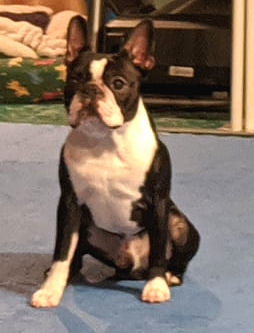
The consequence of this was brought home this week. Fran’s 2-year-old Boston Terrier Simon has no training relationship with Hope. He doesn’t pay any attention to her. None. 

Simon is a smart and good little guy. But there are things he does that are, not “bad,” but really annoying. And he hasn’t listened to Hope at all when she’s told him to knock it off. Here’s a post about another aspect of dogs being annoying.

Play dog training games

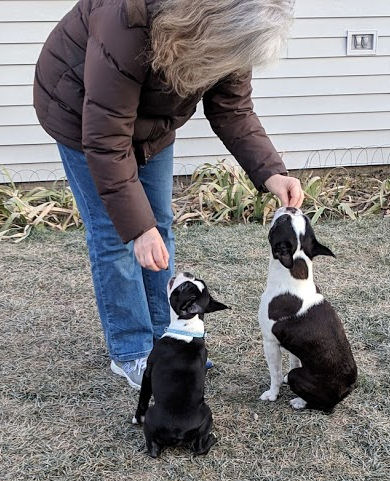
Hope plays a training game with Simon

That changes today. Hope will take over at least one game session a day with Simon for at least a week. Then we’ll maintain the connection with at least one or two sessions per week.

It’s opened our eyes to the possibilities we’ve been missing by training our own dogs exclusively. Swapping dogs will not only help us live peaceful lives, it will build a better relationship with each dog in the house. We’ll also learn to be better trainers as we get to know how each dog plays.

How to help dogs afraid of loud noises

Spread the love
We helped Peanut the Mastiff, afraid of loud noises.

This week we were called upon to help a dog afraid of loud noises. It’s not your typical case. Peanut is a Mastiff. Not a toy dog, not a “lap dog.” Peanut weighs more than we do.

Peanut is about three years old now. We met him when he was a puppy, just twice as big as Hope’s French Bulldog, Torque. Peanut’s always been timid, but puppy class helped and he was doing well with consistent exposure to different situations.

Pandemic shut-down

And then the pandemic struck. Peanut and his family have had limited contact with the outside world for almost a year. For easy-going dogs, it’s probably not as critical an issue. For Peanut, it stopped his progress in its tracks. 

His owners are a lovely, active couple who make sure their dog gets plenty of exercise and goes for long walks daily. They even made sure he got out in the worst weather. On truly bad days, the husband would take Peanut out for a walk and, if they got too cold or it was too sloppy, they’d call for a ride to get home.

Which is where the issue with noises arises.

Two facets of a single problem

Peanut needs a ramp to get up into their car. They can’t lift him – he’s over 100 pounds. One day last week the ramp dropped away from the car and made a loud noise on the garage floor. Peanut was terrified. He wouldn’t go near the ramp again. It took them hours to convince him out of the car.

They just didn’t know how to help their dog. They replaced the ramp with a different one, but Peanut wouldn’t go anywhere near it. 

Wisely, they called for help. A single issue, the dog’s fear of loud noises, has two different training solutions. One to address the ramp issue. The second is changing Peanut’s noise phobia. 

To get Peanut to use a car ramp again, Peanut has to love the ramp. Now it’s a fear object, with all the terror of the noise itself attached to the ramp. 

To get Peanut over being afraid of loud noises, he has to learn to ignore them. 

Learning to love again

Peanut the Mastiff is afraid of loud noises and must learn to love his ramp.
This ramp is free-standing – you can read more about it at GollyGear.com.

The ramp aversion is the more immediate problem, since Peanut won’t be able to go anywhere if he won’t use the ramp. An added complication for them – Peanut has severe food sensitivities and is a lackluster eater at the best of times. Fortunately, he is toy-motivated and loves to play with his toys.

Since this is an intense situation, we’ve set some rules for Peanut. All of his toys, every single one, has been removed from the household and hidden in a bin only the people have access to. Several times a day, they take a toy and stand by the ramp. When Peanut puts a paw on the ramp, he gets to play tug with the toy and person. Only if he puts a paw on the ramp. 

What we’re doing is attempting to transfer the value of something Peanut loves (his toy) to something he avoids (the ramp). Everybody’s going to have to be patient. Overcoming fear isn’t fast. And Peanut’s fear may be more powerful than his love for his toy at first. Ultimately Peanut will learn to love the ramp – he’ll associate the best rewards with it. (Read more on this: https://2-minute-trainer.com/2020/05/01/all-behaviors-are-equal/)

When Peanut is stepping on the ramp with a single paw fairly consistently, the next step will be to wait for two paws. And reward with play. Then three, and four. Then walking consistently.

Small steps

Peanut’s owners may also face a problem when they move the ramp. Right now it’s in their family room while they address their dog’s fear of loud noises. When they make progress, it will have to move to the garage. And the process may have to start all over again. 

We’ve talked before about dogs not being able to generalize. Once people learn to use a spoon, all spoons “work” the same way, regardless of what they look like or where they are. That’s generalizing. Dogs don’t make the same mental leap. A ramp in the family room may not be the same as a ramp in the garage. 

Fear of loud noises

The other part of the issue Peanut’s owners need to address is their dog’s fear of loud noises. Contrarily, we don’t want Peanut to love noise. Instead, he needs to learn to ignore it.

In separate training sessions from his ramp game, his owners are going to make their household much louder. One of them will bang pots while the other plays tug with Peanut. Or yell across the house at each other. Or play loud music, or explosion recordings, or fireworks or thunder. If Peanut learns that noise is just a part of life, his life will be less fearful, more fun, and improve immensely. 

Get loud

If your dog is afraid of loud noises, try pairing noise with things your dog enjoys. If your dog is food motivated, it’s a little easier for you. Just play those loud recordings during your dog’s mealtimes. Even better if you feed by hand and ask your dog to do “stuff” during meals. 

Trying to turn around an established pattern may be difficult, but it’s not impossible. Take it step by step and change the fear into a trigger for something good and/or fun to happen. You and your dog will both be happier if you can overcome the fear of loud noises.

Get your dog to come dashing to you every time

Spread the love
Booker is playing "keep away." He had not learned to come.
Booker playing “keep away.”

Do you have a dog who likes to play “keep away?” It’s frustrating and can be scary – especially if you’re in a heavy-traffic area.

You can get your dog to come running to you whenever you call. One of the best games for recalls (“come”) just turns “Keep Away” around! What do you think would happen if YOU were the instigator of this version of “Keep Away?”

Catch Me If You Can

This game asks that you act against every instinct you have. When your dog takes off running away from you, or dances just out of reach, everyone’s first impulse is to run after the dog, or try and grab him. It’s natural. And it’s wrong.

Instead, you’re going to work with the fact that your dog has exactly the same instinct. After all, both humans and dogs are predators. We share the “chase” reaction. So we’re going to use it.

Playing the game

In a controlled environment, where you know your dog can’t get away from you (indoors, or a fenced area), bring your leashed dog and have a pouch of really top-notch treats ready to use. If your dog is more toy than food motivated, bring the best tug toy your dog loves. If you can hide the toy so your dog doesn’t realize you have it, even better. We’ve been known to stuff toys up under our shirts if they don’t fit in a pocket.  

When you get to the safe spot, without saying anything to your dog, drop the leash and take off running away from him/her. If your dog isn’t paying attention, you can yell his/her name while you run away. 

Really run. No half-baked pretend running, or sideways running to keep an eye on your dog. You’ve made sure Fido can’t get away. All dogs are faster than we are. Get into the spirit of the game. Run!

As soon as your dog catches up with you, grab the dog’s collar with one hand and start shoveling treats into his mouth with the other. Or if you have that toy, whip it out and play tug. Celebrate!

A note about using toys as rewards: The reward is playing tug with you. It’s not getting the toy and playing by himself. Don’t drop or throw the toy. Keep hold of it and offer it to your dog for a game of tug. If you let your dog play by herself, you’ve undone all the good you just achieved. We’re establishing that you are a component of the reward. Without you, there’s no fun game.

Do it again

After a half-dozen treats (or so), or a minute of tugging, start the whole thing again. Take off running, away from your dog. When she catches you, reward with a jackpot of treats, or a game of tug.

Rinse and repeat

That’s all there is to it. Playing this game will teach your dog that coming to you is always a good thing. There will be treats, toys, and you!

You’ll find more fun games that will convince your dog that the only place he wants to be is with you in Book 2: Come!

Dog games: Ring stacking game for dogs

Spread the love

Yes, your dog is smarter than a two-year-old! 

Torque does the ring stacking game

And you can easily teach your dog the ring stacking game, one of baby’s favorite toy games!

All you need is a post, rings that easily fit on it, some treats, and your dog. We recommend a clicker, too, but it’s not essential. As long as you consistently “mark” good decisions, a word (good!) is fine.

Step by step

When you start teaching your dog something new, break the behavior down into little nuggets that can be assembled into the whole behavior. 

With the ring stacking game, start with just one ring. Put it on the floor near your dog. The goal is to get your dog to pick it up, but she doesn’t understand that, yet. Watch carefully. When she looks at the ring, mark it! If she gets close to the ring, mark it! If she sniffs it, mark it! If she picks it up, celebrate! Good dog! Lots of treats!

What if your dog moves the ring with a paw, instead of her mouth?  Ignore it. It’s not what you want, and it may cause confusion if you change the criteria later. Mouth? Yes! Paw? Try again, that’s not what we want.

Next on the agenda

The next step is to have your dog move while holding the ring. The easiest way to do this is for you to start moving as soon as the dog has the ring in his mouth. If he drops it, stop. Wait for him to pick it up again and start moving. 

At this point, you can place the post you’ll be using to stack the rings. When your dog has the ring in his mouth, move toward the post and wait. At first, if your dog drops it anywhere touching the post, reward. We want to let the dog know that the ring has to touch the post. When he has that idea, we’ll get pickier and expect him to place the ring over the post.

Onward! 

We have a total of six rings. We use diving rings because the rings that came with our post were too chubby for our dogs to hold and manipulate easily. Now we toss all six rings down and our dogs, knowing the game, get each one, carry it across, and place it on the post. 

If the ring doesn’t go over the post, just wait. The lack of reinforcement (praise and/or treat) will let your dog know it’s not quite right and, hopefully, he will try again. 

Here’s a successful session in which Torque completed the game in about a minute with all 6 rings:

Torque plays the ring stacking game

Hints for success

Reward for the “same thing” only about three times per session. Looking at the ring is great, but we want to move on after the third time. Picking up the ring is terrific – three times. Then we need more. If you expect your dog to do more, he will!

Keep each session short – that’s why we call it 2-Minute training. Dogs think and process what they’ve learned. The next session, either later or the next day, start with a brief “refresher.” If your dog is stumped, take a step back to the point he/she was successful.

Dogs learn what’s “good” by associating the “thing” with the reward. Try to place your reward (treat) near the post, so your dog knows the post is a good thing. She may not know what to do with it right away, but she’ll be happy to be around it.

This may sound odd, but “show” your dog how the game works. You pick up a ring (you don’t have to use your mouth – you have thumbs!), carry it over, and put it on the post. Dogs do learn by watching. 

Try not to be frustrated or lose patience with your dog. If it’s all brand new, it may take some time to catch on to the ring stacking game. Keep in mind that playing only two minutes at a time, a dozen sessions is less than half an hour. Read about a session a while ago when Torque completely forgot how to play the game.

Remember how dogs learn

Just by watching how your dog relates to the game, you’ll be able to see how he/she learns. Some dogs will get it right away. Others will learn one step easily and have difficulty with another. Just like us, all dogs have unique learning styles.

Part of learning is processing. You may have one completely awful game session. The next time, your dog may be brilliant. Giving your dog time to “think” about it helps them achieve success.

If you do have a session that falls off the rails, just stop and regroup. Your dog is doing the best he/she can, willing to play with you. Be grateful for the wonderful companion you have and try again later. 

How to achieve stress-free car rides with dogs

Spread the love

Do you dread having to take your dog anywhere? Does your dog’s car anxiety stress you out, too? 

Over the past year, most of us have been spending more time at home. We’ve haven’t been going much of anywhere, and neither have our dogs.

Our dogs familiarity with travel and car rides has lessened, and even those dogs who were accustomed to going places and doing things may now get nervous.

Name of the game

Booker and Tango are accustomed to the car and going places.
Pre-pandemic, Booker and Tango frequently rode in the car with Fran to trials and on road trips.

Familiarity is the key. Dogs, like us, get nervous in unfamiliar situations. Car rides with dogs qualify, especially if the only place the dog goes is scary.

Think about it from the dog’s perspective. If the only time he/she gets in the car is to go someplace where scary and/or painful things happen, you’d hate the car, too. Veterinary care and grooming are both necessary for our dogs, but neither is fun for the dog. Hope and Fran knew when they got puppies that as grown-up dogs they would be spending a lot of time in the car – going to obedience, rally and agility trials as well as on road trips, so they translated their crate training from the house to the car.

To turn things around and achieve stress-free car rides, start slowly, from the beginning.

Make it fun

Start where your dog’s anxiety begins. If he/she is nervous getting near the car, walk him her around the car, chattering calmly to your dog and delivering treats. Or play with a favorite toy near the car. Open and close the doors, all the while playing or rewarding for calm behavior. 

Don’t force the dog to get closer, let them take it at their own pace. Coddling isn’t required – it’s not okay to be scared. Speak calmly and encourage exploration, but don’t force it and try not to get frustrated. You know there’s nothing to worry about. The task is to convince your dog that’s true.

Step by step

Like all 2-Minute training games, after a couple of minutes, you’re done for the session. You can come back to it later, but give your dog time to absorb the fact that he/she had fun near the big, scary, noisy thing.

When your dog is fine around the car, have him/her get in it. Again, give treats or play with a toy for a couple minutes. Reinforce for your dog that the car is a positive place.

When your dog can enjoy the treats or toy in the car, hook him/her up to whatever restraint you use in the car and have another play session. At this point, if you have another person who can help, one of you get in the driver’s seat while the other plays with, or gives treats to your dog.

Noisy scary

The next step is to have the dog in the car and turn on the engine. Make sure you’re outside, or the garage door is wide open to avoid carbon monoxide poisoning. Play or treat for a couple minutes. If you don’t have a helper, give your dog a treat-filled toy. Use a high-value food stuffed in the toy – peanut butter or spray cheese work well for most dogs. 

If your dog is able to focus on his/her chew or treat toy, you’re well on your way to stress-free car rides with your dog. Take a short ride around the block and back home. As you’re able to take your dog in the car for longer periods, try going to a park or somewhere dog-friendly and playing a fun training game as we discussed in the post, “Take it on the road …”

Building on success

Stay at whatever step as long as you need to. If your dog is too nervous to take treats or play, stay there until she gets more comfortable. A nervous glance, then back to the game is fine. Rejecting the treats/toy due to nerves means your dog has reached his/her limit and you may even need to go back a step.

When you are able to progress to actual trips, be sure you go fun places where nothing bad happens. Take your dog to a park and go for a walk. Or a pet shop and let him/her choose a new toy. Then straight home.

Accentuate the positive

You can replace anxiety with anticipation if you teach your dog, step by step, that there’s nothing to worry about. As your dog gets used to new things, they’re less scary. If you make car rides routine fun, you’ll have stress-free car rides with your dog.

Start training dog tricks with target practice

Spread the love

Are you intrigued by the idea of training dog tricks and even, possibly going for that Trick Dog title? We hope you are.

Last week we talked about the reasons to do dog trick training: https://2-minute-trainer.com/2020/12/18/dog-trick-training-is-not-only-fun-it-strengthens-the-bond-with-your-dog/

Where do you start? It’s one thing to read a list of tricks and think “my dog could do that,” and another to teach your dog how! 

You and your dog communicate without language. You know particular sounds your dog makes mean something. We all recognize when our dogs act a certain way, they’re trying to tell us something. And we each know our own dogs’ unique traits.

Opening a channel

Sharing a language would really help, wouldn’t it? A first step in creating that training language between you and your dog is to train a basic behavior that will be a common theme for many of the tricks you can train.

One of the most useful is target training your dog. It’s easy, it takes almost no time, and it’s something your dog will recognize and relate to regardless of where you are or what game you’re playing. We use it for training in all of the dog sports for competition. 

Get started with a target

First you’ll need an actual, physical target. We use the white plastic lids from food containers: whipped butter, sour cream, ricotta cheese, etc. We wish ice cream lids were plastic, but they’re not so they don’t hold up.

Torque (French Bulldog) is touching the target with his nose - he'll get a reward for that! Target training is one of the first steps in dog trick training.

Get your target and some treats. Put the target on the floor and if your dog reacts to it in any way, put a treat on the target. If he/she looks at it, sniffs it, licks it, paws at it, any reaction gets a treat. Be sure to put the treat on the target – we’re building value in the “thing.” Don’t hand your dog the treat – he/she already thinks you’re wonderful.  

The actual behavior you really want is for your dog to touch the target with her/his nose. We’ll get picky about that after your dog realizes that the target has value. For now, any interest in the target gets a treat. Five times. Then pick up the target. 

Control the target

It’s important that the dog doesn’t have access to the target when you’re not paying attention. If your dog touches it, and you’re not there to reward the touch, all the progress you’ve made is lost and the target loses value. So if the phone rings, or you have to grab more treats, be sure to pick up the target.

Once your dog catches on to the game, and it shouldn’t take long, you can start changing it up a little. Only reward when the dog’s nose touches the target – stop rewarding for paw touches or looks. Move the target around and see if your dog will run to it. You can even have more than one target and play with your dog moving between them. This is easier if you also have more than one person, or else you’ll be running back and forth with your dog!

Most people are amazed at how easy training dog tricks is. We’re not sure if it’s really easy, or if we have so much fun doing it, we don’t notice. Introducing the target only takes a few minutes. In almost no time, your dog will adore the game and know the “touch” or “target” trick. Training dog tricks really is just this simple.

Target love is deep

Once your dog knows the target game, he/she may find them places you may not expect. Hope’s first French Bulldog, Dax, adored her targets. Her first competition in agility was at an indoor soccer facility. And there were lots of round, white circles on the turf. She checked out quite a few of them! Good girl!

More recently, Hope used the target to introduce Torque to a new trick – “Hide.” She draped a throw over a portable table a few inches above the floor. She tucked the target underneath. Torque was in a “sit, stay,” and watching the whole procedure. He recognized the target right away and was raring to go. When Hope said “Go (his release word) hide!” Torque dashed under the table, touched the target, turned around, laid down, and stuck his face out under the throw. And just like that, Torque started his “Hide!” trick. (See last week’s post!)

Teach the target

We know it won’t take long to teach your dog to “target.” Let us know how it goes! We’re happy to answer questions, and we love hearing about the progress you and your dog are making with your 2-Minute dog training games!

Dog trick training – how to & why!

Spread the love

Why do dog trick training?

So many reasons!

  • It’s fun
  • Grows your dog’s understanding and vocabulary
  • Challenges both you and your dog to learn new skills
  • Deepens your bond with your dog
  • Prevents boredom
  • Provides an activity when you can’t get outside
  • Lets you give your dog focused attention in a short amount of time
  • Makes great videos and memories

Dog “tricks” or behaviors can be anything. Many years ago, it was almost a cliche that the dog went out to fetch the paper every morning. Of course most dogs didn’t really do it, but it was a trick that everyone thought their dog could do.

A cute new trick Torque is learning is "hide."

And there’s always something new to try! Hope and Torque just started working on “Hide!” She draped a blanket over a portable folding table, and put a target under the table. Torque started at normal heel position, and when he got his release cue, he charged right under that blanket to find the target. Click and reward! 

The cutest part was when he turned around and was peeking under the blanket. That’s another benefit of dog trick training – they’re so incredibly cute!

Of course we don’t really think that Torque knows “Hide” after only one session. We’ll see what happens when we try it again. We’ll record next time so you can follow along on his progress. Just like we’ve been sharing Tango’s learning to “Go Bowling.” 

You and your dog can do it

When you and your dog are familiar with the fundamentals (see Book 1: Clicker and Place), you can expand your dog’s repertoire to include any trick or behavior that you can imagine and your dog can physically perform. Lately we’ve seen quite a few videos of skate-boarding dogs. If that’s something you’d like your dog to do, go for it. Thousands of YouTube views await your awesome dog!

Going viral might be fun and profitable, but it’s not predictable. What every single dog can achieve, however, is a “Trick Dog” title. From home. Via video. 

It’s true. You don’t have to leave your dog’s comfortable training space. To earn an American Kennel Club Trick dog title, all you have to do is have your dog perform 10 tricks, each one twice, on video. And, since you’re interested in dog trick training, we’d even bet that your dog already knows a few of the Novice Level tricks, which include things like: 

  • Speak
  • Crawl
  • Fetch
  • Get a named object
  • Get in a box
  • Climb onto a platform or step
  • High five
  • Hold it
  • Jump through a hoop or over a bar
  • Kiss
  • Shake
  • Spin
  • Touch

There are more, but that gives you a good idea of the level of difficulty for the first level of dog trick training. As you progress through the five levels, the difficulty increases – but as you progress, so does your ability and your dog’s prowess!

Dog trick training

 
Of course your video does need to be evaluated, and you need to know someone who can do it. Fortunately, you do! Hope is an AKC CGC and Trick Dog Evaluator, as well as a S.T.A.R. Puppy instructor. If you’re interested in pursuing Trick Dog titles for you and your dog, just shoot us an email (trainers@2-Minute-Trainer.com) and we’ll get you started!