Recognize stress in your dog

Spread the love

Do you know when your dog feels anxious? Do you recognize stress in your dog? If you recognize stress in your dog, you can deal with it.

Not the same as us

There are obvious signs your dog is stressed; panting, leaving sweaty paw prints, shaking. But did you know that lip-licking and yawning are also signs of stress in dogs

In terms of behavior, dogs show stress in one of two ways. Either they “stress high” or “stress low.” How your dog manifests stress depends on his personality.

High stressers

Dogs who get the "zoomies" may be exhibiting stress! These dogs "stress high." By recognizing stress in your dog, you can form a plan to deal with it.

Dogs who “stress high” get super-excited, even being described as out of control. These are the dogs who will get the “zoomies” and act out. They’re not sure what’s going on, and they know they can’t control it, so they have to move to deal with it.

It may seem odd, but dogs who stress high are actually easier to train and work with. The dog is still doing something – he just needs a focal point to expend the energy. When we compete in dog sports like agility, we actually are looking for a dog in “high arousal” who can still pay attention and work with us. It’s fun and fast – just like all the best training can be.

Low stressers

“Low stressers” are dogs who check out. These dogs seem to just shut down when the going gets stressful. These dogs are more difficult to engage and some of their stress may come from fear. Hope’s Dax was a classic low stresser – when things got too stressful for her during agility competition she would simply disengage and go off into a corner. Sometimes Hope was able to get her back in the game by inviting her to do her favorite obstacles. Familiarity is our friend with dogs who stress low.

What you can do

Have a game plan for dealing with stress when it arises

When you recognize that your dog is stressed, having a plan will help both of you. If you have a little routine, or trick behavior, that your dog loves, use it. Hope’s Torque adores the “tap” trick where he touches her foot (or leg) alternately with his two front paws. It’s a game they can play anywhere – including when they’re waiting to have a turn at training class, or even waiting to go into a competition ring. Try to keep it something simple like the “tap” so you don’t need any special equipment or props.

If your dog gets stressed walking through a crowded area, but loves toys, why not teach him to hold his toy while you negotiate through the situation? It changes other’s perception as well. Instead of seeing the hyper-alert dog ready to react, people will see the cute dog showing off his toy. A big, muscular dog carrying a little pink toy is non-threatening and adorable.

Familiarity reduces stress

We just talked to a customer whose dog was not only stressed, but hyper about getting her nails trimmed. And the owner did exactly the right thing. She arranged with the groomer to bring the dog over for “visits.” For a month, she took the dog to “visit” the groomer, who did nothing at first but give the dog treats and pets. Then they progressed to touching the dogs paws. Then they tried trimming a single nail. Now the dog is fine and looks forward to her “mani/pedi” appointments. 

Once dogs understand the rules and what’s expected of them, their stress level decreases. Just as ours does. When we know what we’re in for, we can cope with anything more easily. If holds true for reducing stress in dogs, too.
“Socializing” Isn’t What You Think

Spread the love

Do you like everybody you meet? 

Nah. Us neither.

Do you think you should be friends with everyone?

No way!

Social = Polite

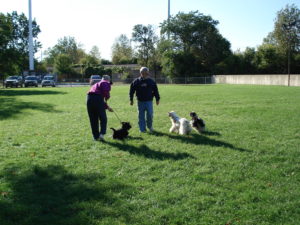
Dogs meeting other dogs

So why is it that we feel pressure to have our dogs “like” every person and every dog they encounter?

They don’t have to – any more than we do!

Dogs do have to learn how to behave politely in their world. That’s what “socializing” truly is. Teaching our dogs to cope with their surroundings without freaking out or behaving inappropriately. 

Social = Calm and Attentive

Dogs are well-socialized when they can remain calm and attentive to you. That means you can walk down the street with your dog, go to the park with your dog, sit in your yard with your dog. And your dog won’t bark inappropriately, won’t jump on people, won’t chase cars (or bicycles, or skateboards, etc.), won’t lunge at other dogs, won’t chase bunnies (or squirrels, or cats, etc.). 

We don’t know where the notion came from that dogs need to be “friends” with the world. Dogs don’t need dog friends. They don’t need to love every person. They need to know how to ignore all the distractions of life so your life together can be peaceful and calm. 

We’ve always said that manners are the “social grease” that keep civilization running. We may not all like one another, we may not agree on everything. But we can all act politely and respect each other’s space. 

A dog who is well-mannered in public is properly socialized. Ignoring strangers – both people and dogs – is perfectly acceptable, socialized behavior. 

Finding the fix

Spread the love

You know how you can overlook stuff that’s right in front of you? Like the time you searched all over for your phone and you were holding it in your hand? 

Traffic jam!

We’ve been suffering with a traffic jam at our house forever. We have a very narrow entryway from the back door of the house. And when we come in from the yard, all the dogs congregate in that narrow entry, waiting for their “go home!” treats. 

Needless to say, with four dogs and two people trying to get into a space that’s not more than nine feet square, it got a little crowded. And a little tense.

Oh yeah, we’re dog trainers…

Then one day we remembered we’re dog trainers. We had to think of a behavior we could teach the dogs that would solve the crowding issue. And get them out of the doorway before bad weather arrives and coats, boots, and parkas are added to the mix.

It was a perfect opportunity to put our own 2-Minute-Trainer system to work. 

We thought about what we wanted to accomplish: 

  • get the dogs to move further into the kitchen and out of the doorway.
  • We pictured what we wanted the result to look like: 
  • all the dogs lined up, sitting on a yoga mat.

We decided what we wanted to call the behavior: 

Line Up!

We implemented the plan on our next entry.

When we called the dogs into the house, we immediately moved over by the mat for the Line Up! We called the dogs over, saying Line Up! As each dog stepped on the yoga mat we told him to “Sit!,” gave him a treat, and said “Good Line Up!” 

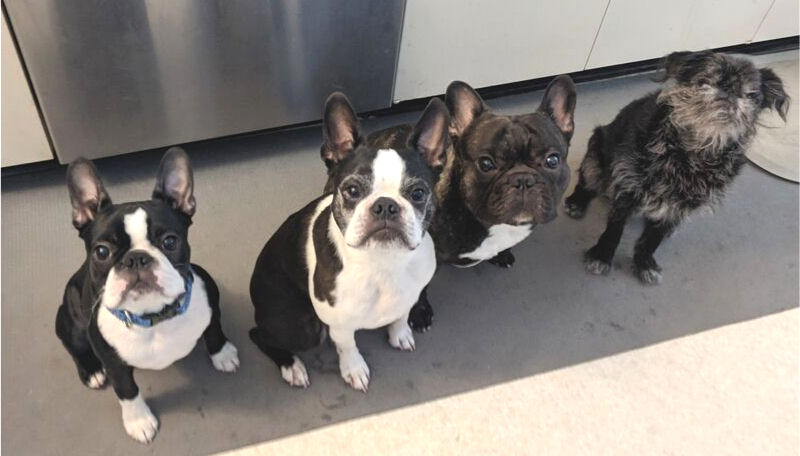
All the dogs lined up, out of the entry way.
Simon, Booker, Torque, Tango

All of the dogs still sitting on the mat got a treat each time another dog joined the “Line Up.” So the first dog on the mat got the most treats! Now all the dogs dash over to the mat when they hear “Line Up!” And we go down the line rewarding each dog multiple times. When everyone’s inside and we’re done, we give our dogs their “release cue” – “Go!”

We solved the problem in just two days. So far we haven’t asked the dogs to maintain a particular order in their “Line up!” behavior, but that would be an easy addition if we want to add it later. 

Dogs love routine and love knowing what they’re supposed to do. Giving them a better choice has reduced the aggravation of coming in the house. Seeing them all lined up, sitting like good boys, lets us enjoy coming home every single time.

My puppy has a temper

Spread the love

He’s great, but …

It’s not easy learning that your puppy, in addition to all his wonderful qualities, has a temper and can be aggressive toward other dogs. Simon just turned one year old. He’s a tiny little thing, but has a HUGE personality and a hair-trigger temper. Once he’s had enough play (usually with my sister’s French Bulldog, Torque), it’s almost as if he says, “That’s enough! I’m done with you!” and turns into a snarling little demon.

It’s my job to fix that. 

Tango, Brussels Griffon

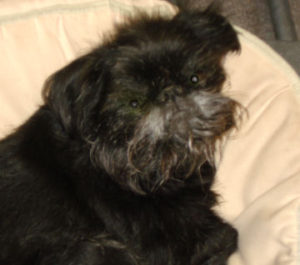
Fortunately (or unfortunately?) I have experience with turning an aggressive dog around. Tango, my 10-year-old Brussels Griffon, is much better now, but when I got him (at 11 months old) was reactive towards everyone. When Tango was young he hated everyone that wasn’t me. Even my sister. Since we live together, that was a big problem. Hope hand-fed Tango his dinner for weeks until he accepted her. He still wasn’t crazy about her, but we could all live together. 

Work in progress

Day after day, week after week, month after month, even year after year, Tango’s training was a top priority. I knew that he could be an excellent agility dog but I didn’t want him branded as aggressive. We had to be able to walk together through crowds, down the street, through a parking lot when I had my hands and arms full of crates, treats, toys, and other paraphernalia. So, while we were going to class for agility fundamentals, I was also training him to be a good pet.

It was essential to keep him focused on me at all times. I was vigilant about our surroundings and noticed what was going on around us at all times. If anyone was approaching, I made sure to start a focus behavior. At first the approaching person / people / person and dog had to be at a significant distance. As Tango started accepting that other beings were allowed to exist on the planet, the distance could be slightly reduced. This was not a matter of days or even weeks, but months.

Focus phrase

A key phrase that I used to keep him focused on me was, “Cute dog!” I did not say anything at first – remember that we were at a significant distance. When Tango looked at me, I’d say our focus phrase and give him a yummy treat. If he kept looking at me, I’d give him another treat and say something like, “Yes, you’re the cute dog!” Eventually I could say the phrase when he wasn’t looking at me and Tango’s eyes would latch onto my face. 

Why the phrase “Cute dog?” Even though Tango is small, I didn’t want people to see him as aggressive. People look at aggressive dogs differently. Their posture is different. But when someone sees a little fuzzy dog and hears that phrase, they’ll have a smile on their face. 

Tango and I competed in agility for quite a few years, and he advanced to the Master level. We walked confidently through crowds at trials and Tango kept his attention on me. I still don’t trust him completely. I’m always watchful when we’re out and about, but he’s worlds better than he was as a puppy.

Phrase that pays – again

So now I have to train Simon to keep his attention on me. I’ll be training the “Cute dog!” cue and I’ll also be doing other small tricks to keep him engaged when we’re waiting for a red light on our walks. 

Those small tricks? Fun stuff for treats, like hand touches, spins, simple position exercises. 

And Simon is learning to come to me when I call him. That’s proving to be very useful when I see him starting to ramp up in his play.

I know that it won’t be done in a day, and Simon may never play nicely with dogs that aren’t in the family, but that’s OK. He doesn’t have to play with other dogs. And there’s no deadline for having a nice dog.