
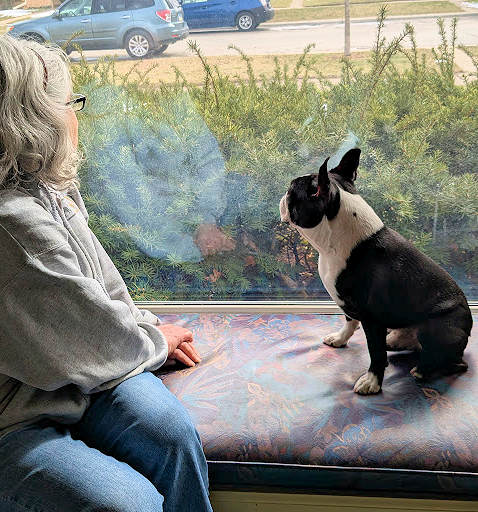
We recently lost a student because we couldn’t solve his number one dog issue, barking, within two lessons.
Guess what? We can’t do that for you and your dog either.
Barking is a behavior that’s hard-wired into dogs. If your dog’s a vocalist, changing that is going to take time, effort, patience, and consistency. It can be done. But it’s a long-term goal, not an instant fix.
There are fast fixes. All of them are cruel. You can have your dog surgically “de-barked.” That involves removal of their vocal cords. They still have all the behavior. The sound is just muffled. The other “fix” usually uses a shock collar. Every time the dog barks, they get an electrical shock. If you’re willing to do that to someone you love, we don’t need you here.
The Instinct Behind the Noise
You already know how hard it is to break a habit. Barking isn’t just a habit, it’s an instinct.
Humans have instincts, too. In a mild scenario, think of someone tapping you on your right shoulder when they come up behind you to your left. You immediately turned to your right, where you felt the touch. You both laughed about it, realizing it’s a mild tease. You can control which way you look, but your first instinct is toward the touch. You’d have to actively think about turning the other way. If you’re expecting the same person, you’ll probably override your instinct. But it’s not automatic.
Barking isn’t a choice; it’s an instinct. Think of it as a low-level alert system that translates to:
- “I see you!”
- “Stranger Danger!”
- “I’m scared!”
If you yell, you’re just barking back. If you ignore it, they’ll bark louder to make sure you heard the “threat.”
Dogs who startle easily, or who are more shy, tend to bark more. They’re telling the world to keep its distance until they know everything’s okay. The more dogs know, the bolder they become. Playing any training game goes a long way to instilling that confidence.
How to play “Sight Seeing”
Playing the “Sight Seeing” training game requires a little preparation and a little more time commitment than usual. You don’t put in much time in a solid chunk. But you have to be available for a few moments at a time for a longer period. Think about a time when you’re home, but not committed to meetings, calls, or household chores.
If you’re like most barky-dog owners, you restrict access to the areas where your dog can see outside and start barking. While you’re playing “Sight Seeing,” you restore access and be ready to move. You don’t need any treats or training tools for the game. Just some time you can afford to be constantly interrupted.
So open the drapes, or pull up the blinds, or, as in one student’s case, take the cardboard off the windows. Then go about your business. You can leave the room, but you must be able to hear your dog, so don’t go far.
As soon as your dog barks at something, come back into the room quickly but calmly and get next to your dog. Ask something like “What? What is it? Is the bogeyman coming?”
Look carefully in all directions out the window. If you see something, say dismissively, “Oh, it’s just the neighbor taking out the trash (or whatever you see).” And go back to what you were doing. If you don’t see anything, look around again and say something like “What? I don’t see anything.” And go back to what you were doing.
Sharing the Attitude
By exhibiting excitement when your dog barks, you’re letting them know you trust them and believe their excitement has a reason. When you let them know there’s nothing to be excited about, they’ll take their cue from your indifference and calm down.
You’re modeling the attitude you want your dog to adopt. If you yell at them for barking you’re telling them that excitement is okay. Dogs don’t understand that stream of words you’re yelling. They just know you’re participating in a mutually loud conversation.
If you ignore the barking, your dog will think you don’t appreciate the urgency of the situation and they’ll probably escalate.
Your goal is to show your dog, in a way they’ll understand, that being the neighborhood watch can be a quiet activity.
Set Limits You Can Live With
Most people can endure about five or ten minutes of this game. Like all training games, it’s best when it’s short and intense. When you’ve had your fill of rushing back and forth, just close the blinds and try again another day.
This behavior modeling takes some time for dogs to absorb. If you want to let the sunshine in, you have a couple of choices. Play Sight Seeing until your dog gets the lesson. Or get blinds that open from the top instead of the bottom of the window.
⏱️ The 2-Minute Recap: The “Sight Seeing” Game
The Goal: Show your dog that you’ve heard their alert and that you’ve got the situation under control.
- Preparation: Open the blinds or drapes in a high-traffic area. Go about your normal business nearby.
- The Trigger: As soon as your dog barks, move quickly (but calmly) to their side.
- The Investigation: Look out the window with them. Use a curious, low-energy tone: “What is it? What do you see?”
- The Dismissal: Identify the “threat” and dismiss it with indifference: “Oh, it’s just the neighbor. No big deal.”
- The Exit: Walk away and return to your task immediately. Do not linger or scold.
- The Limit: Play for 5–10 minutes at a time. When you’ve had enough, close the blinds to “end” the game and give your dog a break.
Pro Tip: If you want the light without the barking, look into top-down/bottom-up blinds. They let the sunshine in while keeping the “neighborhood watch” triggers out of sight!
Hello. Thank you. I have been doing a bit of this with Sunday but now I will do more. He barks, I check it out, but now I will take a bit more time with it. He barks becase. He sees something, when I get there it is gone. But he is a guard dog. So thank you for this.
Will be making an appointment soon. My first on sight training is wed.
Sunday’s a smart little guy. I think he’ll figure it out pretty quickly. Have fun with the trainer!
I learned a lot from this 2 minute training. I will try the tips instead of yelling at my dog! That doesn’t help. Thanks so much!
Yelling hardly ever works, unless the goal is having a “conversation” with your dog! Let us know how it goes – have fun with your dog!
The problem I have is my dog(Piper) will see another dog while we are out on a walk. She starts “huffing” then proceeds to begin baking at the dog. I can’t seem to distract her and she continues to bark toward the dog while we are even walking on the opposite side of the street. What do I do?
It’s great that you’ve noticed your dog’s behavior as she’s getting ready to bark. That’s the time to step in, not after she starts barking. When you see her start “huffing,” do something different. Have a favorite toy for her to carry, turn around and go the other way, play “Touch!”. Interrupting the cycle is the best way to change it. If you want her to eventually ignore other dogs on your walks, you’ll have to figure out how far away they need to be for her to be quiet. You can gradually lessen the size of her “bubble” by keeping her attention with a toy or training games. It’s a gradual process, but you can get there!