An obedience student came up to Hope after class Tuesday to ask for help.
“How do I get R.J. (her 2-year-old Portuguese Water Dog) to stop counter surfing?”
“Tell me what happened, please.”
“We had some people over on Sunday and it was just embarrassing. I put the appetizers on the kitchen table and when I came back he’d eaten almost all of them.”
“Where were you?”
“In the other room with our guests.”
Hope’s student is doing great in her competition obedience class. But she hasn’t learned to transfer what R.J. is learning to everyday life. She did nothing to help her dog understand the rules of the house. R.J. isn’t the problem, his “mom,” Mary is.
What are some of the things Mary could have done to help R.J. understand how to be a good boy?
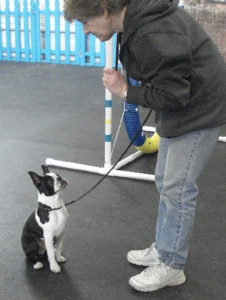
- Put his collar and leash on and hold the leash
- Have him “help” greet guests with a lovely sit (which he’s fully capable of)
- Crated him away from the chaos
- Not put food within reach
- Not walk away, leaving the food within reach
We do understand that a gathering isn’t the best time or place to train your dog. That’s why we play training games every day – so when a scenario arises, our dogs have the tools to understand what we ask of them in any circumstances.
In Mary’s case, just crating R.J. away from the party may have been the best solution. They hadn’t prepared for the party and Mary wouldn’t have been able to do anything but pay attention to R.J.’s behavior. At two years old, R.J. is the equivalent of a human teenager who has no manners and no impulse control.
It turns out that R.J. practices the same bad behavior every single day. Mary said that she puts her coffee on the breakfast table, then goes to get her toast. When she comes back, R.J. is slurping away at the coffee.
Mary’s fault, all the way. Take the opportunity to give your dog a job, especially in a case like this where you are in a familiar environment, doing a routine task that doesn’t require all of your attention. R.J. knows how to sit and stay. Use that tiny interval to practice it! Have some rewards at hand and, when he succeeds, give him something better than coffee.
This is a classic case of the dog behaving in a way that gets him what he wants most. He likes coffee, knows he’s free to get it, and he gets to play a fun game of “keep away” when his mom catches him at it. Because you know she yelled at him and chased him off the table.
Dogs don’t really distinguish between “good attention” and “bad attention.” R.J. knows his “mom” is interacting with him and that’s the best thing in his world. It probably doesn’t matter that she’s yelling at him – she’s paying attention and playing with him.
Will he like it even better when “mom” learns to control the situation and he truly is being good? Absolutely! How about having R.J.’s favorite toy close at hand and rewarding his beautiful sit/stay with a game of tug? Much better! Or having him “help” you get your coffee with a beautiful “heel,” followed by top-notch treats for a reward? Wonderful.
Dogs do what’s most rewarding to them. What does your dog find most rewarding? Food? Toys? Pets? Yodeling with you? Whatever it is, make sure the best rewards are given for best behavior choices.