
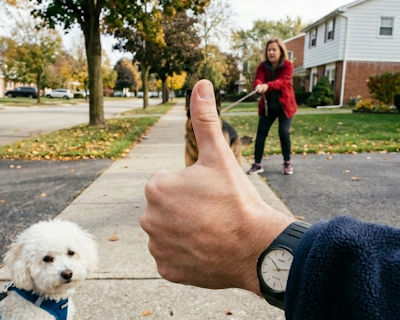
If your dog is triggered by sights and sounds on your daily walks, you need to use your thumb for something besides swiping your screen.
The “thumb trick” is easy. You always have your thumbs with you, so make use of them to help your dog stay calm in the neighborhood. Your new Rule Of Thumb – if your thumb, held at arm’s length, covers the trigger object, you’re far enough away. If you can still see it, you’re too close. Turn around and go in the opposite direction.
If you can still see the ‘beast’ around your thumb, the ‘beast’ is too close for your dog’s brain to handle.
When you’re at ‘thumb distance,’ that’s the perfect time to drop a high-value treat. You’re rewarding the calm observation before the explosion happens
Distance is your friend
No matter what sends your dog into berserker mode, there’s always a safe distance to stay below threshold. It’s going to be different for every dog, so you’re the one who has to pay attention and figure out whether “thumb-covered” is far enough away. Whether it’s bicycles, other dogs, squirrels, people, or even nannies floating by on umbrellas, there’s a safe zone where your dog can watch calmly.
Finding your dog’s safe zone will make your life easier. You won’t have to stay there forever. The goal is making wherever you go part of the safety zone. But identifying it, no matter how tiny, gives you a starting point. And your safety zone is the perfect spot to do a little focus work, like playing the “Touch” game.
Pro Tip: Your most difficult task in expanding the zone will be constantly scanning the environment. The more triggers you can avoid, the calmer your dog will be. You don’t have to be perfect, but every time your dog loses their cool is a step backwards. It’s definitely one of those “two steps forward, one step back” situations.
72 Hour Adrenaline Rush
A single doggy meltdown produces a rush of hormones, specifically adrenaline and cortisol, that can take up to three days to leave the dog’s system. That’s 72 hours when your dog is more stressed, overly stimulated, and hyper-aware.
In our neighborhood there’s a pair of German Shepherd Dogs that react negatively to every person and dog, whether we’re walking by their house or they’re passing ours. These dogs are always super-charged because they never, ever have a chance to flush the hormones from their systems. They are living in a permanent state of high alert.
That’s why you want to avoid those triggers as much as possible for as long as possible. Aside from the chemical change to the dog’s body, you want to develop emotional calm as a habit. Dogs are allowed to watch, notice, and pay attention to their surroundings. They’re not allowed to lose their sh** about it.
What is Trigger Stacking?
Trigger stacking is when a dog experiences multiple stressors within a short period of time, without an opportunity to recover. Think of it like a bucket filling up:
- A trip to the vet…
- A squabble over a toy…
- A canvasser ringing the doorbell.
- The bucket overflows..
Note: some trainers intentionally “flood” dogs with triggers in the (mistaken) belief it will “desensitize” the dog to those triggers. What it really does is cause the dog’s brain to shut down and send them into “fight or flight” mode.
Give your dog time to regain their equilibrium. If you keep them below threshold using the Rule of Thumb trick, your chances of actually reaching them multiply exponentially.