Impulse Control Training Game: Whatcha Gonna Do?

Spread the love

What would life look like if your dog was able to make good decisions? If they pondered the options and chose well? If they actually thought about consequences and opted to be “good?” 

How much better would your partnership be if you didn’t always have to regulate your dog’s behavior? 

It’s all possible. There’s a bit of effort and a lot of patience required. But you can do it!

Impulse Control Training Game

The best training game to teach your dog impulse control is “Whatcha Gonna Do?” It’s a variant of the game “It’s Yer Choice” developed by renowned trainer/agility competitor Susan Garrett. We’ve tweaked it a bit over the years. We’ve found that despite the long-term gains the game brings, few people are willing to stick with it to reap those benefits. 

It’s worth it, especially when you only play for a couple minutes at a time. The tiny time investment has a tremendous payout. But the initial steps may be painful. (Please note that other games can be found in Book 4: Impulse Control.)

Steps of the game

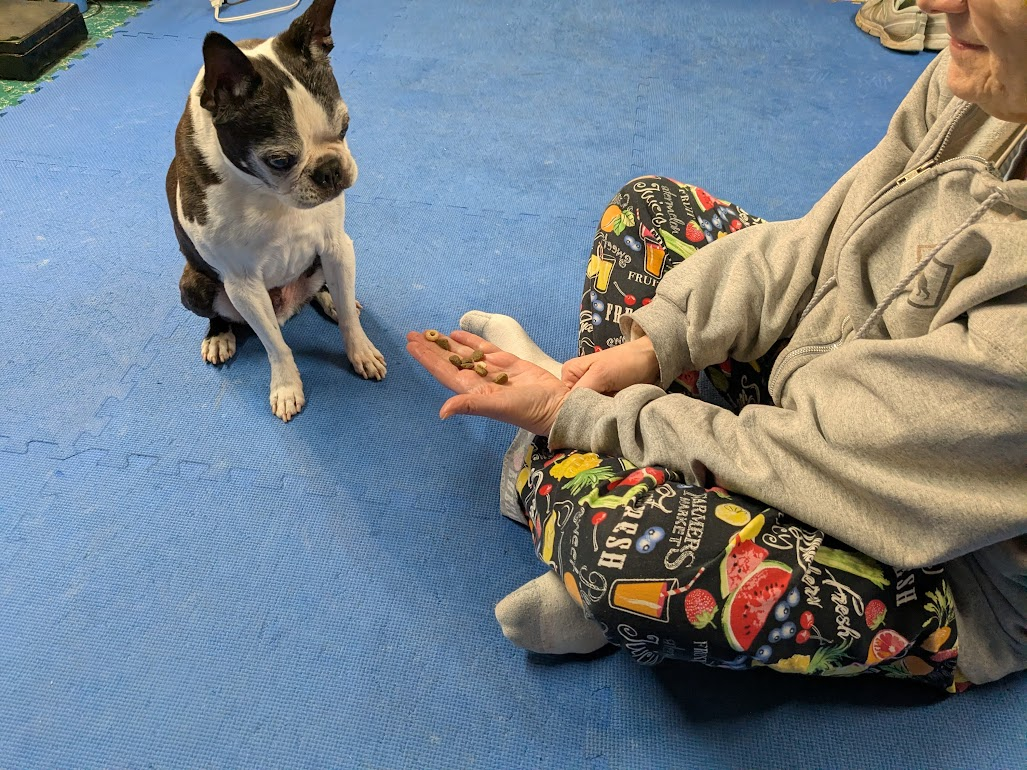
To play “Whatcha Gonna Do?” all you need is a bunch of treats and your dog. Sit on the floor with your dog in front of you. Grab a handful of treats in your fist and hold your fist, palm up, in front of your dog, below their eye level.

At this point your dog is going to nibble on your hand. Paw at your hand. Start gnawing on your hand. It’s not going to be fun. It will be slimy. And it might hurt, especially if it’s a puppy with those needle-sharp teeth.

You don’t say anything. You especially DO NOT tell your dog what to do. The whole point of teaching them impulse control is so you don’t have to monitor their every action. If you give up now, you’ll be policing their every action for the rest of their life. 

You may, however, squeak in pain if your dog’s nibble is very painful. But if you’re not in danger of losing a digit or some blood, keep your mouth closed. 

At this point, you want to quit. It’s not working, it hurts, and your hand is all gooey. This is where many people give up. Don’t give up. Don’t say anything. Impulse control training games are worth it.

What’s the goal

Some dogs stay at this stage for quite a while. You may not accomplish anything at all the first time you play Whatcha Gonna Do? But you might. The first inkling of thought is when the dog takes a break.

At the first tiny interruption in the dog bothering your hand, they glance away, they hear a sound outside, they have to yawn, you reach into your fist with the other hand, grab a treat, and give it to your dog. Give the treat at arm’s length. This gives your dog the seed of an idea to step away from the hand.

Even if your dog stops bothering your treat hand for the tiniest fraction of a second, reward it from the other hand. At some point, after the dog gets an initial treat, they’re going to start wondering how to get more of those yummy nuggets.

Some dogs catch on quickly and start backing off, leaving the treat hand alone. Others are blessed with dogged persistence and take a while. But every single dog can learn to leave that treat hand alone. They can, eventually, understand the underlying bargain of dog training. They get what they want when we get what we want.

Don’t give up

Whatcha Gonna Do? isn’t designed to play for long. Forcing your dog to think is tiring for both of you. Giving them the freedom to choose, without you directing their action, stretches both of your limits. Regardless of progress, or lack thereof, stop playing after five minutes. Tomorrow’s another day.

In time, your dog will recognize the start of the game. When you grab some treats and sit on the floor, they’ll happily back off while you reach into the treat hand and reward them. That’s when you start the next step – open your hand.


The reason your treat hand is palm up is so that you can, in time, sit there with a whole handful of treats, clearly visible to the dog, and have them wait to be rewarded, like Booker in the still photo (after he’s practiced the game for a little bit). When you first start opening your hand, chances are your dog may lunge in to try to get them. Slam your fist shut, as in the little video below. Don’t say anything. Not even a “whoopsie!” The whole point is demonstrating to the dog that their decision, good or bad, drives the action of the game.

Whatcha gonna do in practice

Eyes on the prize

Eventually, when your dog understands the game, you’ll be able to sit there with an entire bowl of treats on the floor, and your dog will do all kinds of cute things to get you to give, or toss, a treat to them. Dogs trained with positive reinforcement have an entire repertoire of tricks they’ll run through. Each time your dog does something that isn’t bothering your treat hand, reward it. 

Dogs always do what’s most rewarding for them. Playing Whatcha Gonna Do? teaches the dog that the way to get rewarded is to control their impulses. Being a rude jerk gets them nothing. Thinking and acting politely gets them what they want.

Variations on a theme

Once your dog understands that being a nuisance gets them nothing, you can use “Whatcha Gonna Do?” in other contexts. If your dog is a counter-surfer, set up the training game. Be prepared to cover whatever’s drawn their attention up there and wait. When they give up and have four paws on the floor, toss a treat into their corner of the kitchen. Whenever your dog’s being rude, you can apply the principles of “Whatcha Gonna Do?” to the situation. Impulse control training games are worth it: when you require your dog to act thoughtfully, they can and do live up to expectations.

Stop Playing Detective: Why Your Dog’s “Why” Doesn’t Matter

Spread the love

You can’t look in your own ear. It’s impossible to go faster than the speed of light. And you’ll never know “why” your dog acts the way they do.

Say your dog is afraid of men wearing hats. Especially if it’s a rescue dog with an unknown history, people might assume the dog was abused by a man who wore a hat. Maybe. But you’ll never know. And it doesn’t matter. 

Addressing the dog issue

There are three ways to cope with whatever issue your dog may have. 

You can ignore it. If it doesn’t matter to you that your dog pulls like a tugboat, it’s nobody else’s business. Your dog, your house, your rules.

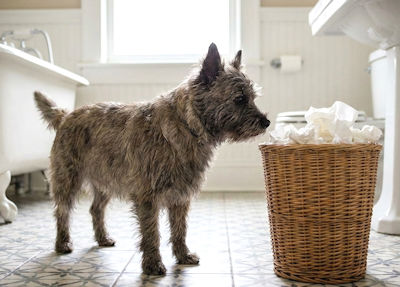
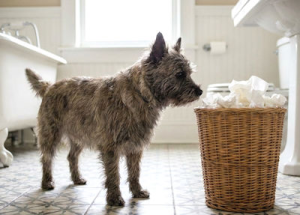
If the problem is a minor annoyance, but not worth a lot of effort, you can manage it. We know someone whose dog always emptied the bathroom wastebasket. She managed the issue by keeping that wastebasket empty. It was a little disconcerting the first time she dashed in to empty it as soon as we vacated the room. That was how she handled the situation. We stopped using that wastebasket, too.

The third, best, most long-lasting, and most difficult way to cope with dog issues is by training them away. If it’s important to you, it’s worth it. If, like us, you live where everyone wears hats all winter, you don’t want your dog freaking out every time you go out all season long. 

Familiarity breeds disinterest

Since we don’t know why the dog does what they do, you have to treat the symptom without looking for the cause. That doesn’t mean it can’t be cured. It just means the process may involve some trial and error.

If our friend had wanted to fix her dog’s basket-emptying obsession, the first step is to figure out if it’s the “what” or the “where.” If the dog ignores the wastebasket when it’s in another room, it’s the where. If the basket is equally interesting in the living room, it’s the “what.”

For the where, you take your dog in the bathroom and play “Get it / Leave it.” For the what, play the game in the living room with the basket nearby. You can add on to the game by dropping something in the basket when you say “Leave It!” 

Once your dog knows the game and how to “Leave it!,” the problem will dissipate. It won’t be interesting any more. 

Cultivate boredom

Your reaction to your dog’s naughty behavior is a major factor in whether it happens again. If you, like our friend, react immediately, the dog figures it’s a fun game that gets your attention. If you ignore the tissue on the floor and leave the vicinity, the dog fails in the bid for attention. 

It may result, in the short term, with your dog eating some tissue. Unless it’s an excessive amount, figure “this, too, shall pass.” (Empty the basket when the dog isn’t around.) 
You’ll never know the “why.” It’s very human to look for cause when there’s an effect. It’s why puzzles are big business and mysteries are popular. But your dog will never be able to tell you “why.” 

Save Your Dog (and Your Nose): Why the Recall is the Only Command That Truly Matters

Spread the love

“Come!” is absolutely crucial

When you call your dog to “Come!” on cue, it isn’t just a good idea. It can save your dog’s life. It can also save your nose.

From the memory files:

Case #1: A friend unexpectedly knocked on our door. We corralled most of the dogs, but Booker (who’s special in a not-so-good way) slipped out and was headed for the street. As he was bouncing back and forth, clearly in play mode, a car was approaching. We couldn’t panic, but we had to get him back to safety. Against every human instinct, Hope ran, fast as she could, away from Booker, calling his name. As dogs reliably will, he chased her right into our fenced yard.

Case #2: Hope had Razzmatazz out for last-outing-before-bedtime. As they reached the backyard, Hope spotted a skunk in the yard. First instinct? Panic! Thinking mode: Yelled “Come!” and started running back to the door. Snagged Razzy as soon as he got close enough and the tomato-juice supply went untapped.

Rule of the Recall

In dog training, the “Come!” command is called the Recall, so that’s what we’ll use. There are two kinds of Recall; the Chase Recall and the Stationary Recall. 

The one absolute rule, regardless of which you’re using, is Never Call Your Dog To You For Anything They Don’t Like

If your dog hates getting a bath, never call them into the bathroom for a bath. Go get them. Lead them in. 

It’s a trust thing. If you only ever call your dog for happy, fun things (training games, meals, walks), they’ll know good things await. If they can’t rely on that being true, they have no reason to do what you want. 

Start With the Chase

Dogs are hard-wired to notice and pursue motion. It’s why a bunny in motion attracts their attention. A bunny frozen in place (instinct on display) will probably not be noticed. It’s why Hope ran away from Booker when he slipped out of the house.

To play the Chase Recall game, put your dog in a Sit/Stay. If your dog doesn’t have a reliable Stay!, have someone hold the dog. (Check out this article for getting an unbreakable Stay!) Turn your back and walk away. When you’re about half-way to the other side of the room or yard, break into a run and yell your dog’s name. When they catch up to you, celebrate and reward heavily. This is a great opportunity to use a tug toy as a reward. It reinforces the fun of coming to you.

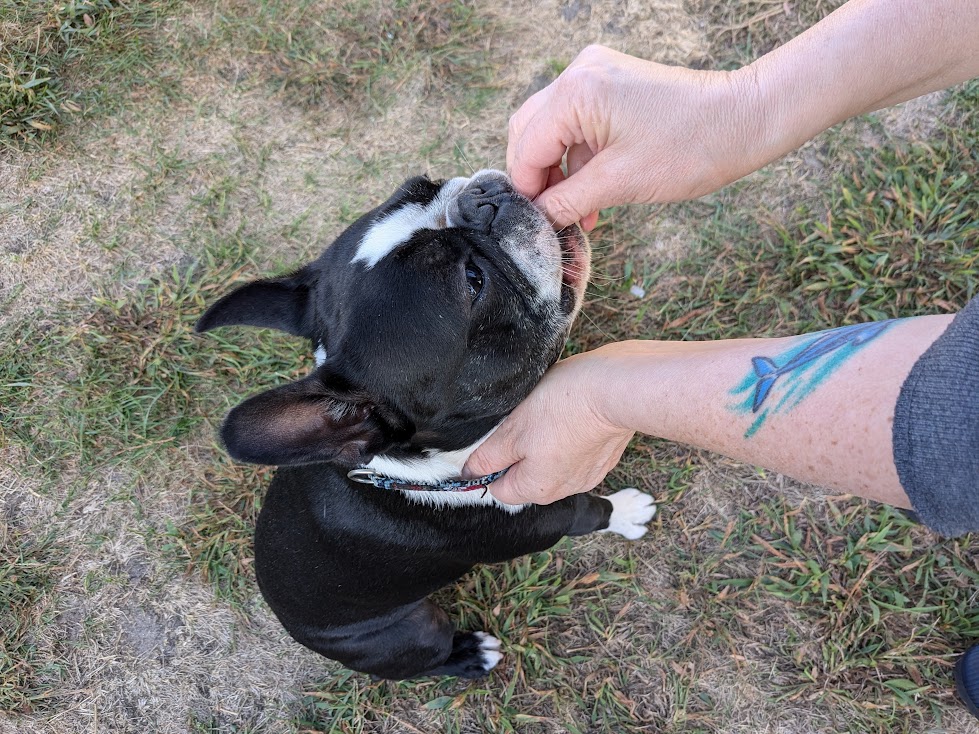
Simon the Boston Terrier playing the Collar Grab Game

For an extra measure of security, when your dog reaches you, grab onto their collar or harness and immediately release it. (Simon is playing the Collar Grab game with Fran in the photo.) This teaches the dog that it’s not a big deal. And lays the foundation of getting hold of them when you really need to. Like when there’s a skunk loose in your yard.

Stationary Recall

When your dog is reliably coming at speed, try the Stationary Recall. Put your dog in a Sit / Stay and confidently walk away. With your back to the dog. If you’re hesitant, walking backwards, or keep repeating, it tells your dog you don’t really mean it. 

When you get a few feet away, turn around and call your dog. The more enthusiastic you sound, the faster your dog will run to you. When they get close, tell them to “Sit!” This builds the habit of politely greeting people. When they do, celebrate with treat rewards or a game of tug. 

Always Be Happy They “Come!”

Just like you’ll never call your dog for unpleasant things, always be happy when they arrive. If  you call your dog 99 times and they don’t come, but they do on the 100th attempt, you still celebrate. It’s a complete command-killer to greet them with “Where were you?” Even if you’re a bit frustrated, put it aside and celebrate the little win. You’ll know the cue needs more practice. Make a mental note and put it aside. Play with your good dog.