Are you a dog-control freak?

Spread the love

How much of a control freak are you with your dog? 

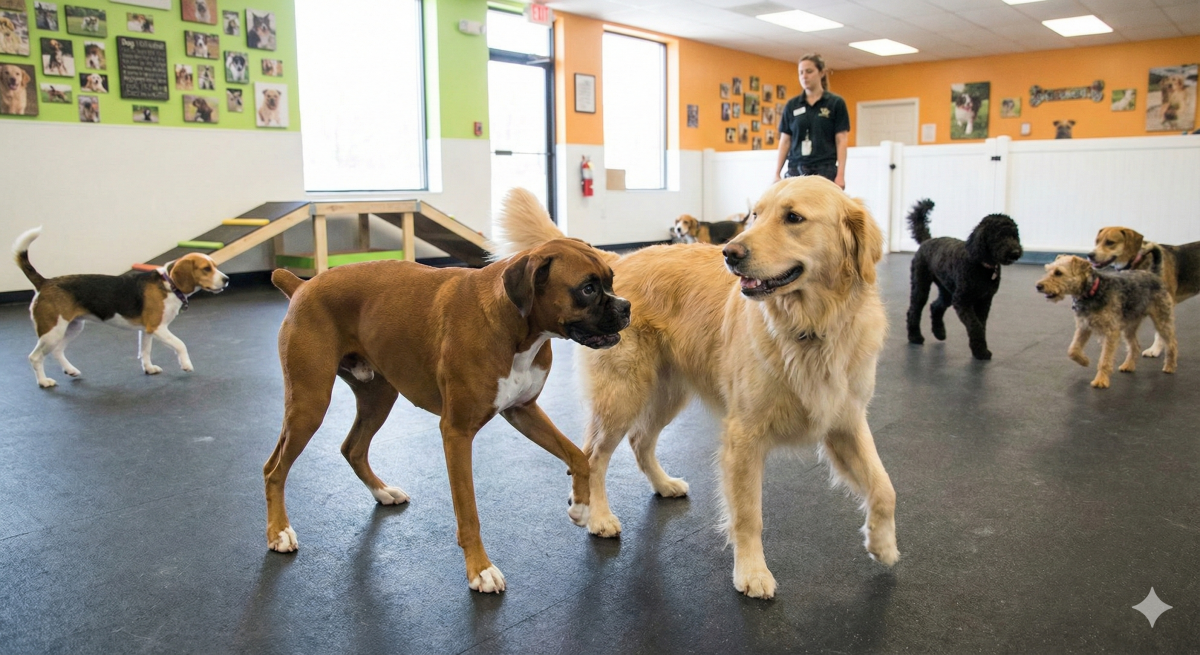
As the dog trainer associated with a doggy day care facility, the staff sometimes asks Hope to consult with a dog owner that has some issues in the play group.

Not long ago, she talked to the owner of a dog that was, putting it mildly, inappropriate with other dogs and staffers at day care. While the play supervisors had repeatedly mentioned the problems to the owner, the dog’s person dismissed their concerns. 

Not a fun phone consult
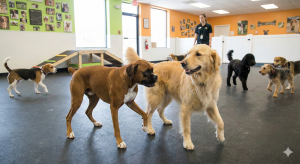
The dog repeatedly charged at and nipped other dogs, even staff, trying to get somebody to play with her. They weren’t casual invitations, and the dog wouldn’t take “No!” for an answer. The dog clearly had no idea of manners.

When Hope finally was able to speak with the owner, his answer was “She always does what I tell her.”

And that, right there, is the problem. If you always tell your dog what to do, what happens when you’re not there? 

Banned from daycare

This particular owner clearly had no interest in training his dog to learn impulse control or manners. He thought it was adequate “training” that she obeys him. It didn’t concern him that the rest of his family couldn’t get the dog to obey. It didn’t bother him that the dog has no manners in day care and doesn’t listen to the staff. The dog was banned from play groups.

The kind of blind obedience this man requires from his dog may suit him. Decades ago it may even have been the norm to be a dog control freak. Now, it’s not good enough.

Giving up control

Letting your dog exercise some autonomy makes life easier. Teaching them to make good decisions, giving them credit for controlling their impulses, frees you to enjoy your time together. It’s stressful to always be the one making every choice for everybody. 

There’s no helping the control-freak man. We tried, and were unable to convince him of the benefits both he and his dog would experience. His repeated response was “She does what I tell her.” 

We agree that it’s easier to just tell your dog what to do. A friend of ours had major difficulty guiding her dog into making good decisions, rather than telling her all the time. This particular dog has major confidence issues. Both dog and person felt safer with the owner giving orders all the time. But that wasn’t helping the dog’s timidity.

Confidence boost

It’s scary ceding control to another being. But, with children and dogs, letting them make good decisions boosts their confidence. When your dog knows what’s expected of them, even when faced with unfamiliar situations, they’re more likely to demonstrate good judgment.

It’s hard giving up control and allowing the possibility of mistakes. It helps the dog’s confidence when errors are overlooked rather than punished. They try, and try again, mostly because it’s fun to finally get it right.

We couldn’t help the day care dog. Our friend, on the other hand, won High In Trial in Obedience with her dog last weekend. Patience pays.
Dog Training Game: Put On Your Collar

Spread the love

There’s one training game we use each and every day, multiple times each day. It’s not particularly exciting, or fun. But it has saved us a ton of aggravation. That’s “Put On Your Collar.”

It’s a simple thing. Just getting the dogs to stand still while we put on their collars or harnesses. Our dogs tend to be backer-uppers. When we approach them, they back up. Which is fine, as long as we’re trying to get somewhere. When we’re getting ready for a walk, it’s not so great. We would grab their collars from the wall hooks and, instead of coming near for us to put it on, they’d back up. 

It’s not like they don’t want to go out. Unless it’s pouring rain, they’re all eager to explore the great outdoors. But they’re reluctant to have their outside “clothes” on. Truthfully, we don’t know how common the issue is because we’ve never really talked about it with either our training club buddies or our students. We suspect it’s fairly common, but have no proof.

Born of necessity

We were tired of chasing the dogs around to get collars on. It’s not like any of them object to wearing collars. They were just excited to go out. Which, especially with Boston Terriers, means they start doing zoomies around the house. A house which has a circular path through the rooms, making it impossible to catch a zooming Boston.

A word of warning: Don’t start training “Put On Your Collar” when you have somewhere to go by a certain time. It’s a patience game. Yours may be tested to the extreme.

Lots of waiting

Most people have a phrase they use to let their dogs know it’s time to go for a walk. Around here it’s “chewannagwout?” which starts a stampede for the door. Our dogs’ collars and leashes (hooked together) are on coat hooks by the door. 

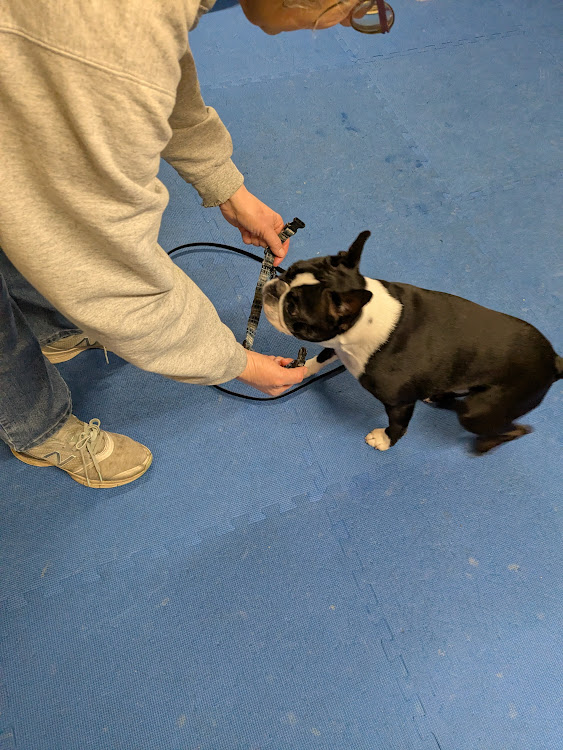
To start playing “Put On Your Collar,” just pick up your dog’s collar, open it, and hold it out. The goal is for your dog to come to you, stretch their neck out over the collar, and wait for you to fasten it. 

The hardest part is waiting for your dog to do it. Don’t move. If you take steps toward your dog, they’ll back up. That’s the “Keep Away” game, even if it’s only a step at a time.

Your dog has to come near enough for you to fasten their collar. Say “Collar!” and hold it out. If they don’t, within a few seconds, just hang the collar/leash back on the hook. And do not lure your dog to come closer. It has to be their idea.

Our dogs just about melted down when the collars went back on the hooks. If yours does, too, pick up the collar, open, and hold it out again.

Be willing to do this multiple times over your short training session. Since you probably won’t make it out the door the first time, make sure your dog doesn’t have to eliminate before you start. 

Reward every tiny step

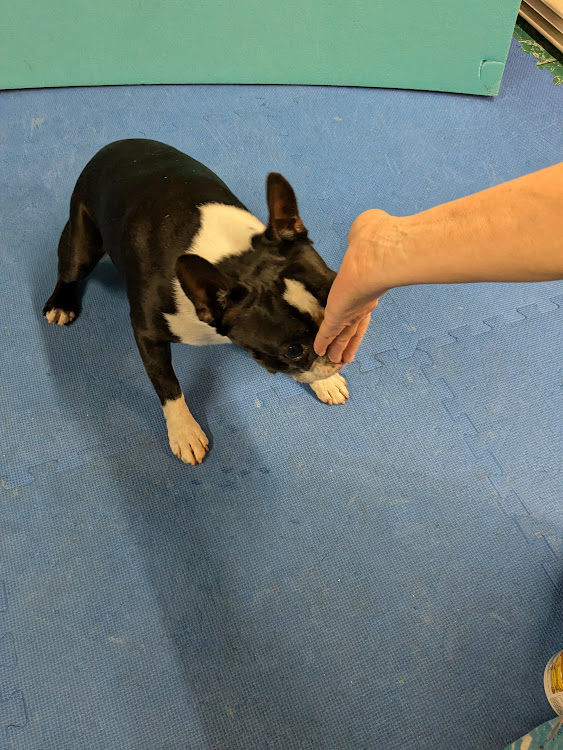
Simon stretching his neck to play Put On Your Collar.

It shouldn’t be too long before your dog actually hovers with their neck over the collar. Reward that little step. If your dog is truly reluctant, start rewarding them for staying in the vicinity, rather than running off. Small steps turn into complete behaviors. Reward for staying, for extending their neck, for waiting until the collar is fastened.

Be sure you use the word “Collar!” or whatever word you choose. Dogs like knowing what’s going on and familiar words and actions enhance communication. 

When you return home after your walk, use “Collar!” again to take it off. Build the association between the object and the word. If you use a harness instead of a collar, the progression is the same. Reward for coming close, staying there, and every step involved in putting on the harness. You’ll use this behavior multiple times every week, if not daily. It’s worth the patience it takes to teach.

Knowing Isn’t Doing: Why Your Dog Training Fails

Spread the love

It’s a sinking feeling when you’re watching your dog training student get out of the car and get dragged across the street to class by her dog. Especially when it’s the last class session.

Not one to hold back, we asked Cheryl if she’d been practicing her Pattern Walking, and how the dog, Katy, was doing with it.

Imagine our surprise when Cheryl told us that Katy was really good at it. 

Next question: “Why aren’t you using it?”

Answer: “I didn’t think of it.”

Knowing and doing 

Almost every training game we teach has a practical purpose. Which we explain along with the mechanics of the game. 

None of it does any good if you don’t use it. One of the subtler goals of 2-Minute Training is for you to get in the habit of training. Just a couple of minutes, whenever you have them. Treat containers in every room. Talking to your dog, expecting them to listen and be happy to play with you.

None of it works if you don’t use it

Raise your expectations

Your dog already loves playing with you. They love those couple minutes of attention. And they’re probably using what they know, if you expect them to.

It’s all about building good habits as a dog owner. When it’s time to go for a walk, expect your dog to come and sit for their collar and leash. Until they do, nobody’s going anywhere. 

You don’t chase them around the house. You tell them what you’re doing. “Wanna go out? Good! Sit! Good! Collar!” And hold it open, ready for them to extend their neck and hold still. If you enforce the rules every single time, your dog will abide by them, every single time.

Stick to routines

Cheryl’s going to establish a routine for getting out of the car. Katy must wait for her release word to get out of the car. She has to wait for permission to go. And she has to walk politely as she’s been taught. Not pull like a tractor.

It’s totally Cheryl’s fault. If she doesn’t expect her dog to behave politely, and teach her what that means, she deserves what she gets. None of it works if you don’t use it.

Training games are designed to be fun. You’re supposed to have a good time interacting with your dog. But it’s up to you to use the games to make life with your dog easier for both of you.

Your Dog’s “Reactivity” is Just Exuberance: Time to Learn “Touch!”

Spread the love

We heard from a long-time friend this week, reaching out for training after acquiring a new dog. We actually met her at our dog training club, so we know she knows how dog training works. But, like anyone with a new dog, there’s so much to teach it can get a bit overwhelming.

No matter how many dogs you’ve owned, it’s always a good idea to either take class or follow guidance from an expert. We always take new family dogs to somebody else’s class. It helps you focus on the things that are important and set your priorities.

First things first

Our friend’s new-to-her dog is a four-year-old French Bulldog retired from the show ring. We also know the breeder of the dog, so know that she’s had a great life. Her issues at the moment are pretty common for a retired show dog. She’s fine in big, noisy, crowded venues. But she has no idea how to act on a walk around the neighborhood. 

The dog is, in our friend’s words, “ is dog and people reactive when we are out in the neighborhood.” Further questions revealed that the dog is noisy and overly-excited, but not aggressive. That description could apply to at least half the dogs out there. 

Side Note: Watch your language

Unfortunately, while we’re all using the word “reactive” correctly here, it’s time to stop using it to describe your dog. The outside world interprets “reactive” as aggressive. Because the meaning has been changed, unless your dog truly is a biter or fighter, don’t use it. People hearing it, even some trainers, will make assumptions about your dog that may escalate the situation. Excitement isn’t aggression. Barking isn’t aggression. Reactivity is now synonymous with aggression.

We tell our training classes to use “excited” or “exuberant” to describe their dogs instead. It conveys joy and happiness, rather than anything darker. 

Action plan

The first training game we’re going to play with our friend’s dog is “Touch!” It’s the most useful game for getting your dog’s focus back on you and away from whatever is causing them to misbehave. Before you use it this way, the dog has to love the game. It doesn’t take long for dogs to learn it and love it. If you start today, in three days your dog will be nose-bopping like crazy.

The next part of using “Touch!” out in the wild requires a bit of effort from you. If your dog has already spotted something fascinating, it’s too late. Even if your dog adores the game, it can’t compete with squirrel watching. You have to keep scanning the area, trying to locate possible trouble spots before your dog sees them. As soon as you do, move backwards a step or so, stick out your hand and say “Touch!” The added benefit is that you start moving away from the distraction. With luck, your dog will never know they missed the bunny running across your path.