Develop some “cookie people”

Spread the love

Some dogs are people-oriented and love everybody. Other dogs love a select few and are indifferent to anyone else. And then there are dogs who actively dislike anyone outside of their family and friends circle. These dogs can be challenging to live with, difficult to exercise, and impossible to bring anywhere with you. These are the dogs who most urgently need Cookie People.

The last kind of dog is also the one that might get labelled as “reactive.” While they may react rudely to strangers or unfamiliar situations, please don’t call them reactive. That word is often used interchangeably with “aggressive,” and that’s not the reputation you want your dog to have. Instead, if you must call them something, try using “excitable.” It conveys the same message, without the negative layer of meaning.

Toning down the conversation

Your dog falls into the “excitable” category if they bark at people for no reason, pull toward (or away) from strangers, and offer anti-social behaviors in new situations. In most cases, it’s probably fear-aggression. The dog is trying to act tough so no one knows how frightened they are. But we’ll never really know why. Instead, it’s up to us to teach the dog how to greet the world calmly.

One of the best techniques for chiseling away at the fear wall is to enlist an army of “Cookie People.” This may be well outside your comfort zone, but it’s necessary for your dog’s wellbeing. It’s easy enough. Just stick a bag full of your dog’s favorite treats in your pocket, leash up your dog, and go face the unsuspecting public.

Confronting strangers

The goal is to convince your dog that people are harmless. That means getting out there and talking to at least one person every day. While it can’t be the same person all the time, you should, at least for the first day, pre-arrange the encounter.

Meeting a new Cookie Person.

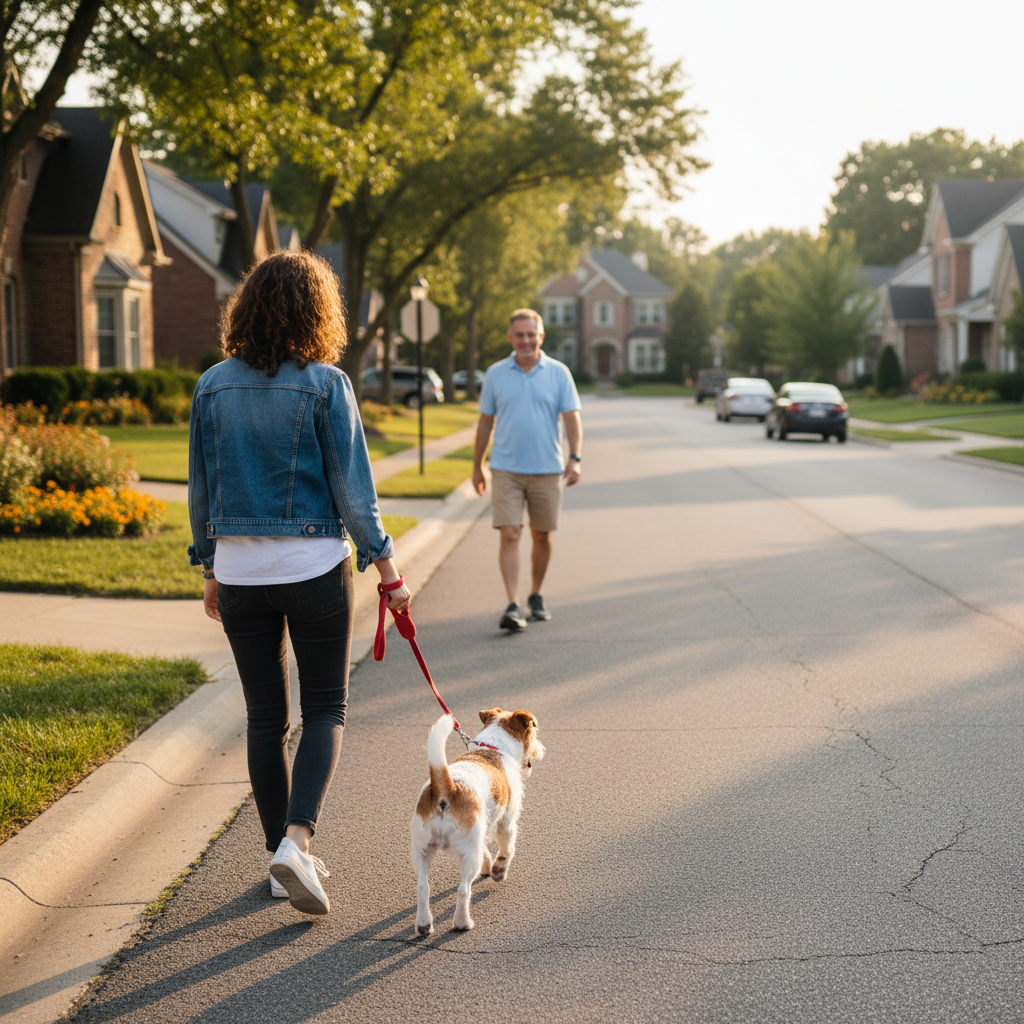
Call a friend and arrange to meet them somewhere in your neighborhood at a specific time and place. The friend should know the “script” for your encounter, which looks like this:

You and your dog are walking in the neighborhood. Up ahead, you see the fake “stranger” headed in your direction. 

When you are within a few feet of each other, you ask the “stranger” if he/she will toss cookies to your dog. 

The “stranger” agrees. You ask him/her not to look directly at the dog, just please toss a few treats (at least four, as many as 10) on the ground close to your dog. While tossing the treats, have a chat with the stranger, both of you ignoring the dog. 

When the treats are all tossed, you and your dog say “goodbye” and continue on your walk, as does your fake “stranger.”

Rinse and repeat

If your dog is visibly upset, or won’t eat the treats, don’t push it. Don’t let the dog get close to the other person. Until their excitability is resolved, there could be trouble if your dog jumps on someone or causes them to trip. 

If the dog won’t eat the treats today, try again tomorrow with better treats. This is an exercise in behavior modification and requires the treats your dog loves more than any others. 

If, on the other hand, your dog was successful at disregarding the other person and enjoyed the treats thoroughly, it’s time to grow the behavior. Prepare to start confronting total strangers.

Socializing right

This socialization game is one we always play with new puppies or foster dogs in our lives. The pandemic caused some modifications in the original game, but it still works. We used to ask people if they would toss treats to our dog. When they agreed, we would just hand them a few treats. Nowadays, we pre-package a few treats in little plastic bags to give people who agree

It’s surprising how many people are willing to do you a favor, especially when you have a cute dog at your side. Since you aren’t asking for any interaction between the person and the dog, even some people who don’t like dogs will help you out. People who love dogs may be more of a problem. They may want to greet your dog, pet your dog, or deliver the treats by hand. Don’t let them. If you have to, admit that your dog is afraid of people and their behavior isn’t reliable. Make it clear that you’re in control. If the person tries to convince you they know better,, thank the person and leave. The last thing you need is someone putting pressure on your dog. If the person is too pushy, the dog may feel trapped and lash out.

Keep at it

Try to “meet” a few people every week. The more people who toss treats at your dog, the more your dog will be convinced that people are worth knowing. 

We know that introverts are going to find this difficult. You can do it. Most people will be sympathetic and help. In the situation we know best, Fran’s dog Tango collected dozens of treat-tossers before he was at ease in new situations. Now, at 16 years old, he still adores some of his original Cookie People.
Your dog can control his impulses

Spread the love

If you think your dog is demonstrating impulse control when they sit motionless waiting for their food, you’re wrong. 

You’re also wrong if you think impulse control is greeting guests with all four paws planted on the floor. 

Both of these examples are trained behaviors, not impulse control. They’re both excellent things to teach your dog. But neither teaches the dog impulse control

What is impulse control?

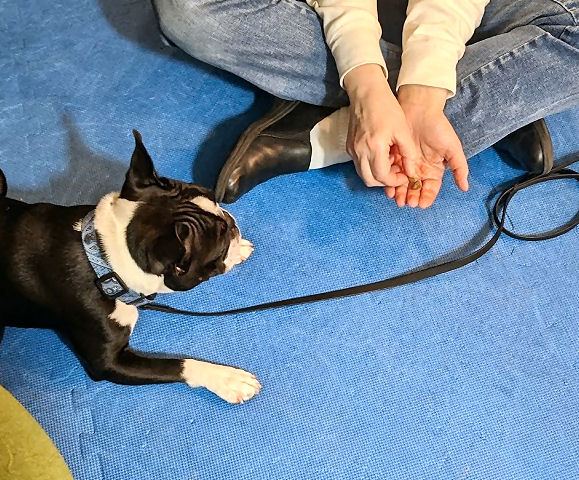
Simply put, impulse control is the ability to think before you act and make good choices. In the examples, the dog has no choice. They’ve been taught what to do in each scenario and they’re doing it. They’re not “choosing” to be good. They understand what they should do and do it.

Years ago it was considered good dog training to tell your dog what to do at all times and make them do it. Our first mentor in training said “Never let a dog make a decision. They’ll always make the wrong one.” Fortunately, he’s changed since then. Now we know that good dog training is teaching dogs how to make good decisions. Impulse control is at the heart of good decision-making.

Ready for anything

Trained behaviors, like waiting to be released before eating, are perfectly fine for things that happen all the time. Mealtimes probably happen about the same time, in the same place, and in the same order every day. It’s an entirely predictable sequence that both your and your dog know and one that works for you.

Impulse control is the valuable tool your dog will need when confronted with different, unexpected, and unpredictable circumstances. Dogs’ innate instincts tell them they have two options, fight or flight. Dogs taught impulse control know that their first reaction isn’t necessarily the right one.

Give them the tools

If your dog acts without thinking it’s time to teach them the skills they need to make good decisions. A good place to start is our e-book Impulse Control. 

Just this week we taught the game “Whatcha Gonna Do?” to our competition Obedience class. One woman, who has a Labrador Retriever, was convinced her dog would never catch on. He continued to lick and nibble on her hand, not trying anything else. But it only took about five minutes before he got the idea. She was ready to give up after three. Impulse control training may test your patience, as well as your dog’s. But many worthwhile things in life aren’t easy.

It may not be the fastest, most entertaining training game you play with your dog. But it may prove to be the most valuable training you ever share with your dog.

Dog Training Game: What’s That?

Spread the love

‘Tis the season for weird stuff to start showing up on your walks with your dog. Pretty soon (if not already) there will be inflatable, blowing-in-the-wind gigantic purple spiders on roofs attached to ginormous white webs. Eerily-lit monsters and vampires will pop up on lawns. Not to mention glowing orange pumpkins and creepy sounds emanating from unseen speakers. 

As soon as your dog starts getting used to all that, it changes. Taking their place will be cheery, flashing lights and inflatable snow-people, accompanied by relentless songs of the season.

It can all be a bit intimidating and scary to your dog, especially if it’s the dog’s first rodeo. If your dog already knows the “What’s That?” game, they’ll be more likely to take it all in stride.

Getting to know stuff

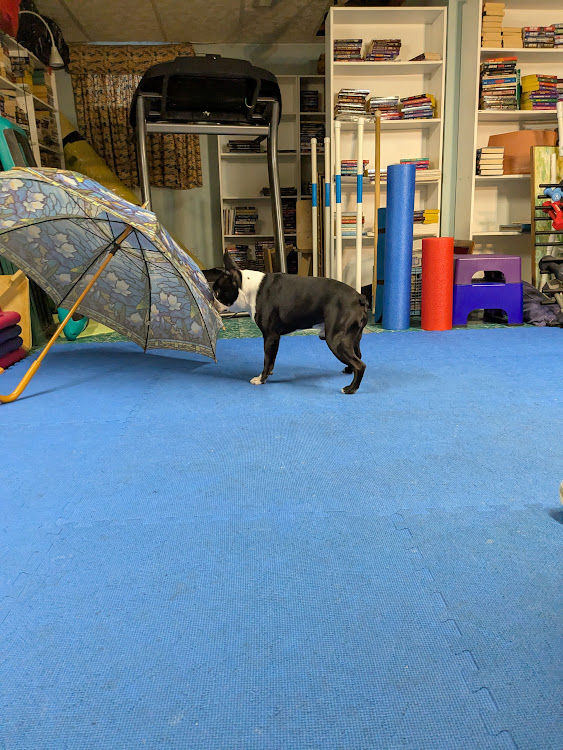
Simon playing the What's That game with an umbrella

To teach your dog the “What’s That?” game, start by grabbing all kinds of stuff from around the house. Anything the dog’s never interacted with before is fair game. Try to find things that differ in size, material, texture, sound, scent – anything will do: noise-making children’s toys, aluminum containers, cardboard boxes, scented candles, metal pots with lids, umbrellas, storage bins. You get the idea. 

Put your dog on leash so they can’t leave the area. Put one of the objects down and see how your dog reacts to it. If they’re curious, encourage them to get closer and check it out. Use the phrase “What’s That?” and look at it yourself.

One distinct difference between this game and the  “Pick It Up” game is that the rewards come from you, as the dog is looking at you.

Timing and placement

Dogs learn through the timing and placement of rewards. When you want your dog to actually interact with the object, as in “Pick It Up,” the reward is given near or on the object. This lets the dog know “Yes, I do want you to do something with that thing.”

For “What’s That?” the goal is to get the dog to notice, but then ignore the object. It’s not a toy or a game piece. It’s not scary, but it’s not all that interesting, either.

Curious, not scared

Once the dog is calm around whatever the object is, either try with another object, or just walk away with your dog. You’re sending the message, “Nothing interesting here. Let’s move on.”

Dogs get startled by different sights and sounds. It’s okay for them to react, as long as they recover fairly quickly. Once your dog is used to hearing “What’s That?” you can use it whenever they spot something that causes a reaction. It lets them know you see it too. And you’re not impressed. If it’s no big deal to you, your dog will know they don’t have to worry about it.

Distance is your friend

When the odd decorations, lights, and sounds start appearing in your neighborhood, be ready to play “What’s That?” on your outings with your dog. You can’t get close enough to sniff the giant roof spider, but if you look at it with your dog and speak calmly, they’ll take their cue from you. 

If it is something your dog can approach, go as near as your dog is comfortable and let them watch, listen to, or sniff whatever it is. When they look at you, reward and resume your walk.

If the dog’s reaction is more extreme, just move a comfortable distance away and let them watch. In time, they’ll realize it’s not a threat and relax. Move closer gradually, letting the dog adjust.

By the time the holidays arrive, your dog will take the season, with all its sounds, sights, and smells, in stride.

Dog Tricks 101

Spread the love

An accomplished Obedience competitor we know once told us, rather huffily, that she doesn’t teach her dog tricks. Like it was beneath her dignity. Fast forward to now. Her current dog, a very soft and rather timid being, loves learning tricks and knows a bunch of them. When the dog wants attention doesn’t bark or paw at her mom. She “sits pretty.” And no one can resist that. Especially not her mom.

Why teach tricks? Because it’s fun! There’s no pressure to achieve anything. It creates joy for you and your dog. It not only brings the two of you closer in synch, it deepens understanding and trust between you. And, as important as any other factor, it increases your dog’s confidence. Dogs love knowing stuff. And they love knowing they know stuff. 

All dog tricks fall into one of two categories:

The dog has to manipulate an object in some way.

Or

The dog has to manipulate his/her body in some way.

Get a move on

Of the two, getting the dog to move on their own is probably easier. Luring works for getting dogs to move where and how you want them. Luring introduces the motion for everything from “Puppy Push-ups” to  “Spin!” All of the dog-motion tricks start with a lure to familiarize your dog with the action.

From there, it’s a matter of practicing with a consistent name for the motion and/or a unique hand signal. Dogs can learn either or both. If you want your dog to know the verbal and movement cues separately, start with both and as your dog becomes proficient, separate words from motion. Use the verbal command sometimes, the hand signal other times. Most dogs will show a preference for one kind of signal over the other. Notice which your dog responds to more quickly and consistently. 

When your dog is familiar with the trick, whatever it is, you can start “fading” the lure. Try it without holding a treat sometimes, making sure to reward your dog immediately after completing the trick. Your dog will start to understand that the reward will always be there, even if they don’t see it before they start. 

Tricks with props

Without hands and opposable thumbs, dogs’ interaction with objects is more limited than people’s. But that doesn’t have to limit your imagination – or your dog’s. 

French Bulldog and Target Training

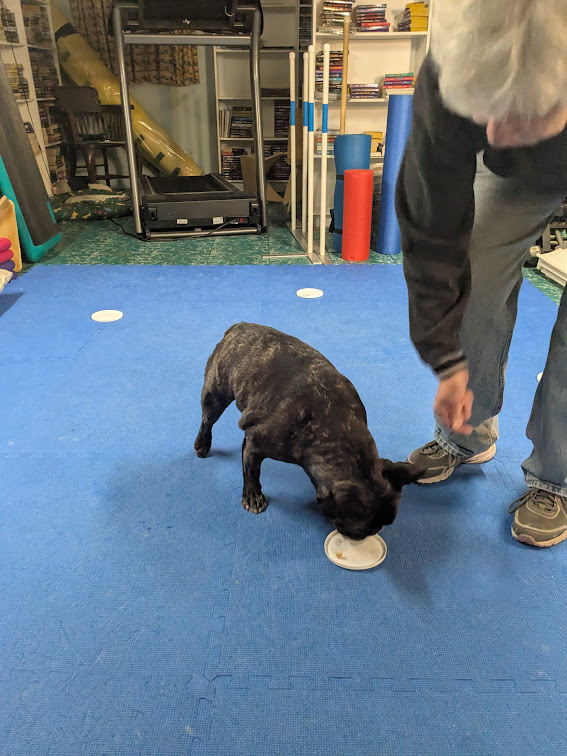
If there’s a trick with objects you want your dog to learn, the process is pretty simple. Just present the object to your dog and reward the interaction you want. If your dog isn’t used to checking out new objects, it may require some patience. Even with something dogs enjoy as much as Target Training, it may take a few sessions for the dog to figure out you want them to bop it, not pick it up, chew on it, throw it around, etc.

Just be patient. Dogs learn by the timing and placement of rewards. Generally speaking, they figure out pretty quickly what gets them “paid” and what doesn’t. That doesn’t mean you can’t talk to them, encourage them, and tell them how wonderful they are. When they do figure it out, you’ll see how happy and proud they are.

Nothing in particular

If you don’t have a particular behavior or trick in mind, you can always let your dog’s actions direct the game. Like the Boxey game, if there’s no right or wrong answer, the dog has the opportunity and freedom to be creative and try new things. Your dog may create an entirely new game. Even if you and your dog are the only ones who know the rules, it’s still a game worth playing.

By all means take video of your training game learning sessions as well as the finished products. While you may want to show off your dog’s brilliance on social media, the recordings you’ll cherish most will probably be ones where you’re just starting your games and learning together. The accolades are nice, but the most precious memories will be the ones where you and your dog goofed around and had the most fun.