Muzzles are good management

Spread the love

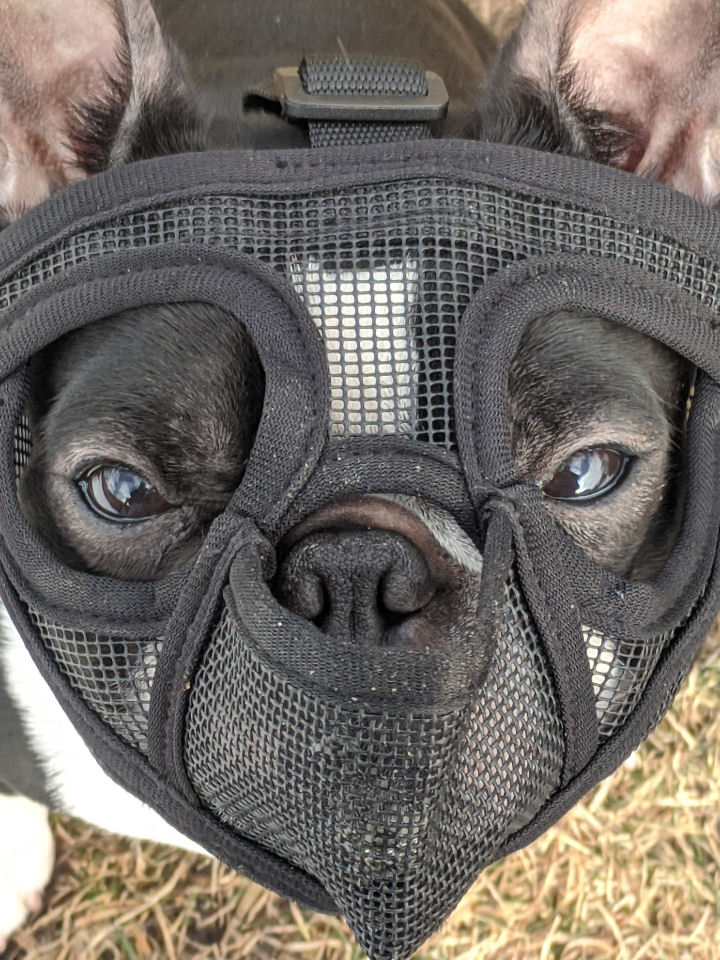
What do you think when you see a person walking around with a muzzled dog? Are you wary? Do you grab your dog and cross the street? Thinking needs to change. In fact, muzzles are good management.

Sadly, the stigma attached to using a muzzle for your dog prevents many people from using one of the least intrusive, most useful dog management tools ever. Using a muzzle prevents your dog from starting any trouble and insures they won’t contribute to any they find. 

Everyday wear

Take the case of a dog from our “Impulse Control” class. He’s a young dog, a medium-sized terrier. Let’s call him Sam. Sam is the first dog of a very nice young couple, and he does great in their apartment. He does okay on walks. He’s nipped two people in the elevator. That’s a problem. And a pretty big one.

Sam isn’t a mean dog. He’s a young, scared dog who doesn’t get the distance he needs to feel safe when he’s in an elevator. The absolute cardinal rule for fear-aggressive dogs is “distance is your friend.” The fear reaches a boiling point when the dog is trapped and unable to move away. 

Sam’s people have to take the elevator. Sometimes they’re not going to be able to wait for an empty car, or be able to ask other people not to get in. Everybody’s got places to go and schedules to keep. What they can do, to make sure that everyone, including Sam, is safe.

Muzzle your dog

We started muzzle-training the dogs in impulse control class. Every dog should be accustomed to a muzzle – you never know what circumstances may require it. If your dog is injured, they will also be frightened. And they might lash out at people who are trying to help. Emergency vets and technicians routinely muzzle dogs – you can’t know how much pain a dog is in, or how it will react. Most dog owners, fortunately, don’t know how their dogs would react to an injury. Muzzles are good management – even the calmest, most well-behaved dog might react poorly to a perceived threat – especially if the dog is in pain. Plus, a muzzle means that your dog won’t pick up strange objects in the backyard.

The first step in muzzle-training is like any other game. Get the dog familiar with the object and reward interaction with the thing. Looking at it, sniffing it, pawing at it, taking it in their mouth – all are steps in familiarization. Reward each interaction. Ideally, put your hand through the muzzle to reward your dog, so the muzzle becomes part of the interaction. 

Over the course of a few 2-Minute sessions, accustom the dog to the muzzle. Depending on the kind of muzzle, you can put your hand through while giving your dog treats. Start asking your dog to stick his nose/muzzle in the muzzle. If you don’t have one, or if the dog needs time to get used to the muzzle, use a plastic glass or cone and ask your dog to stick their nose in. Reward in or by the thing to build value in the interaction.

If your dog is skittish, don’t even try putting the muzzle on until your dog has made friends with it. We want dogs to believe that muzzles are no big deal. Because they’re not. Or at least they shouldn’t be. Muzzle-training your dog means you care about everybody’s safety in any situation. It’s “what if” training that we hope your dog will never need.

Not always everywhere

In Impulse Control class, we had no muzzles, so we used plastic cones to simulate something for the dogs to stick their faces into. Once they figured out that treats were involved, they were shoving their noses in as far as they could go.
Every dog should be muzzle-trained. Muzzles are good management.

Sam’s parents have the task of finding a muzzle that works for them and their dog. (For a description of various types of muzzles, see “Every dog needs a muzzle.”) They asked if they had to use it all the time. The answer is yes. And no. Since Sam’s issues are in enclosed spaces, he needs to wear it in the apartment building and elevator. Once they get outside, it can come off. They can achieve the distance from other people/dogs/objects that Sam finds scary. 

The elevator trip back home also requires the muzzle back on. And, if friendly neighbors are sharing the ride, by all means ask them to give Sam treats. 

Defy dog logic

We’ve had people who say “I’m not giving a dog treats for growling at me!” That’s a complete misinterpretation of what’s going on. You’re not rewarding the growling, or reactive behavior. Instead, you’re proving to the dog that you’re not frightening and you’re a nice person. All people are nice. 

That’s the message dogs should get from all strangers. Especially dogs who are somewhat fearful. The objective is to reassure them that you’ll keep them safe. They have nothing to fear. Not even fear itself. And muzzles are good management. 
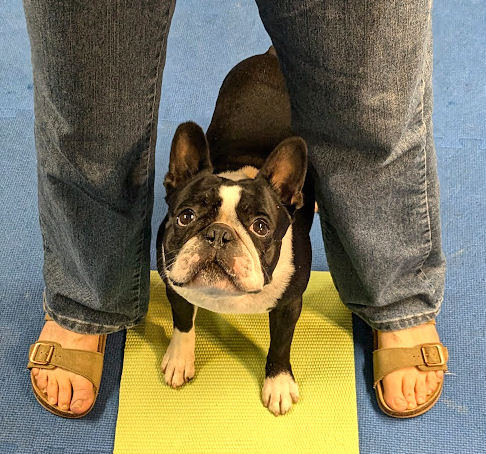
Make it easy on your dog. Expect perfection.

Spread the love

It’s not being mean to expect perfection from your dog. It makes it easy for your dog to understand exacly what you want.

We have a friend with both French Bulldogs and Border Collies. Our friend makes us absolutely crazy because she holds the different breeds to different criteria in training. She expects the Border Collies to be perfect. The Frenchies can get away with “meh” performances. So that’s what she gets from them.

Every dog is capable of great things in whatever training you choose. Whether it’s reaching elite dog sport performance or becoming the perfect couch cuddler, it’s up to you. But you’ll do your dog a huge favor if you expect perfection.

“Good enough” isn’t

Have you ever asked your dog to “Sit!” and thought “eh, good enough” when the dog lies down? If so, you just confused your dog. The dog was showing you they don’t understand the word. Instead of clarifying it, you fed the confusion. 

There's no middle in dog understanding. There's yes and no.

Unlike people, dogs don’t have a sliding scale or understand there’s an acceptable range. Dogs understand “yes” and “no.” “Maybe” is an alien concept. That’s why dogs often behave better for the “strictest” person in the family, rather than the one who’s “nice” to them. They understand what the “strict” person expects of them. Niceness is confusing.

That doesn’t mean you yell at your dog or order them around all the time. It means that you teach them what you want from them. If it truly doesn’t matter to you if your dog sits or lies down, reward whatever you get. If you actually want them to “Sit!” teach them what it means. Accept and reward only an actual sit position. If the dog lies down, wait and look at their butt. Don’t repeat the command. Just wait. As soon as they rise into a “Sit!” reward. 

Keep it simple

A key to understanding dogs is recognizing that they love patterns and routines. That’s why people who say “Sit” three times (many do) when they’re teaching their dogs will always have to say “Sit” three times to get their dogs to do it.

Clarity and precision are largely disregarded and underrated. With people, you can easily clear misunderstandings with more words. You don’t have that option with dogs. While they can understand hundreds of words, they’ll only know one meaning for each one. And you’re the one who decides what each word means for your dog.

If you think you’ve confused your dog about something, it’s often easier to start over with a new word than fix the mistake. You may never know why a particular word has become “poison” to your dog. Fran had that happen with Tango. He stopped understanding his release word, which was “Go!” He didn’t. 

He couldn’t tell us why. Fran could only deal with what was true. So she started over again with a new release word, “Action!” It’s still working just fine.

Dog Training Game: Paws and Boots

Spread the love

All dogs know the stuff that’s important. That doesn’t mean all dogs know the same stuff. What I think is important to teach my dog may be nothing at all like the stuff your dog knows. That’s okay. Every dog is trained to their owners’ level of comfort. If it matters to you, you’ll teach your dog. We think the dog training game Paws and Boots belongs in everyone’s repertoire.

If you don’t care, that’s fine. One of our current training students doesn’t mind that her dog jumps up on people. There’s absolutely no reason to train this dog not to do it. If you don’t mind, it doesn’t matter. 

There is one exception. Every dog owner should care about their dog’s physical well-being, fitness, and body awareness. Like all training games, it’s fast and fun. This one also can make a difference in your dog’s life, extending their comfort and mobility even into their senior years.

Building the foundation

Dogs are a lot like people. When they’re young, strong, and healthy some take advantage of their physical prowess and build healthy habits that last a lifetime. Others are couch potatoes by nature and consider most movement optional and exercise a dirty word. 

Whatever you choose for yourself, you should claim a place in the “Healthy Habits” camp for your dog. Muscles and joints are “use it or lose it” features. Making a game of exercise now sets them up for an active and thriving old-dog life.

Play Paws and Boots

Most dogs know they control their front legs and paws. Some use their front paws for much more than just walking. They’ll paw at you for attention, use their front paws to move stuff, even rearrange their bedding with front paws. The vast majority of dogs don’t know they also have back paws. Most have no idea they control their “boots,” too.

To play “Paws and Boots” you need something low, 4 to 6 inches, that your dog can step up on. An inflatable balance disc, a large rubber feed bowl, a short stool, even a cushion will do. 

The first step is the easier one. Get your dog to put their front feet on the stool (or whatever you’re using). Like all training games, the dogs learn better if it’s their idea, so be patient. Stare at the stool and reward any interaction with it. If the dog looks at it, reward. The next step may be sniffing it, or pawing it. Reward about three or four times for each level of interaction, then wait for more. Get really enthusiastic with your praise when your dog uses their paws. 

When the dog is putting two front feet on the stool, start naming it. Most people say something like “Paws Up!” 

Around you go

Once your dog has two feet up on the stool, put pressure on them by moving into their space, even nudging their side with your leg. This is one of the few times we’ll advise holding a treat with the hand further from the dog. With both of you facing the stool, if the dog is on your right side, hold the treat in your left hand, with your arm across your body, close to the dog. As the dog curls their neck toward your treat hand, they’ll move their back legs away from you. Continue all the way around the stool, both directions. 

It may take a few sessions to get all the way around. Your dog doesn’t understand what you want yet and may keep dropping down to the floor. Try again, praising every time the dog puts front feet on the stool.

Boots are harder

Tango working "Boots Up!" on the balance disk

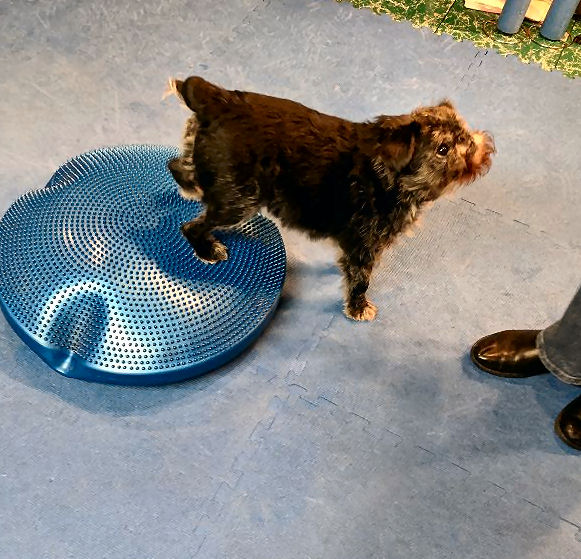
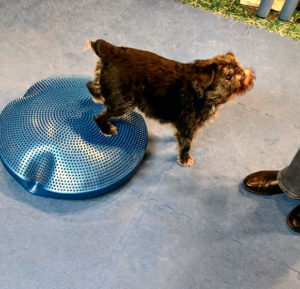
It’s more difficult to teach dogs their back feet, or “Boots” are under their control. The easiest way to start the Boots portion is to have your dog walk across the stool and stop them with boots up. If they come off the object, just try again, repeatedly walking them over and getting them to stop with boots up. Be sure to repeat the phrase “Boots Up!” when they’re in the correct position so they understand that’s the objective.

When they understand “Boots Up!” it’s time to move them around the stool. For this portion of the game, stand facing your dog and take small steps to either side to encourage them to move their feet. Again, it may take a while for the dog to learn what “Boots Up!” means. Be patient. It’s an exercise for a lifetime, not a deadline.

What’s this game good for?

Spread the love

There’s a puppy owner in Hope’s class who asks this question at the start of every single training game. Class has just begun, so we’re still on the fundamentals. Every game, at this point, has real-world application and importance. When we get farther along in the session, occasionally there will be a game that’s just for fun. That’s valid, too. Especially if it helps you see how smart and creative your dog is. And how much they enjoy playing training games with you.

Pick and choose carefully

There are a ton of training games and you should set priorities. The issues you have with your own dog are the ones you should emphasize in your training. But that doesn’t mean ignoring all the others. Change is the one constant in life. The game you may not need today may be vital in the future

One of our obedience club members pulled Hope aside last week to discuss an issue that’s recently cropped up with her dog. The dog has been through our Beginner classes and is now in Rally class. They’re at a level to compete, but the person isn’t quite ready to take that step yet. 

She told Hope that her dog has recently started playing “Keep Away” when she’s getting ready for a walk before she leaves for work. The dog sees her reaching for the harness and leash and immediately gets the zoomies and plays her version of “Catch Me If You Can.”

The dog is just being naughty. She doesn’t mind the harness. She loves going on walks. But she knows that the walk is the last thing before her mom leaves for work, so she’s playing and delaying. Dogs are pretty smart that way.

That was then, this is now

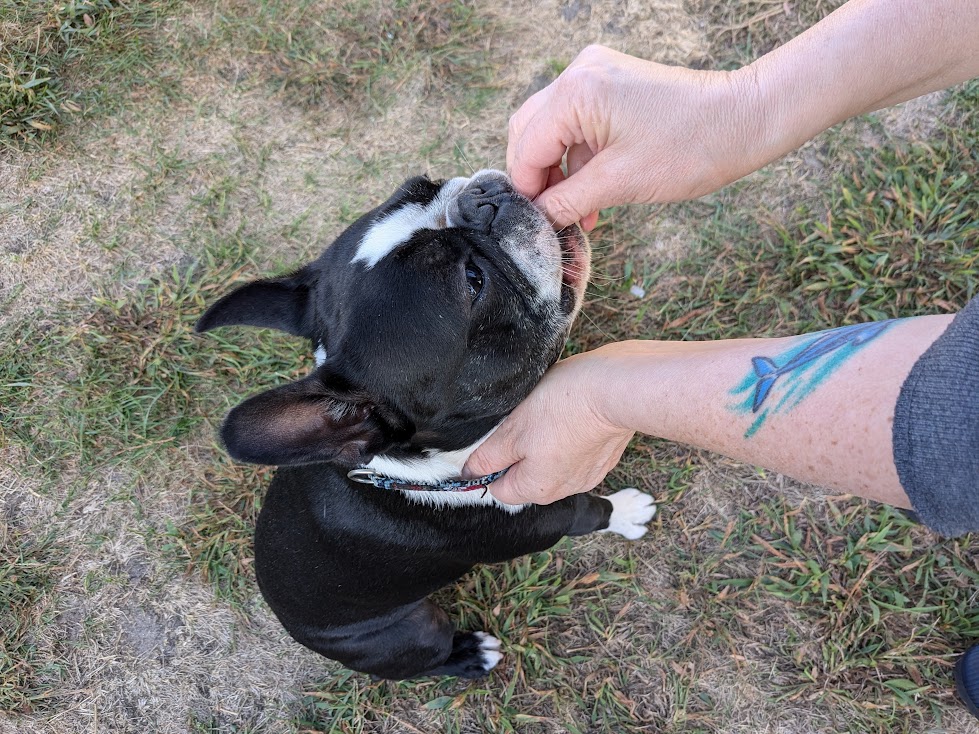
Hope listened and said “That’s an easy one. Just go back and play the Collar Grab Game for a few days. She’ll be back with the program in no time.” 

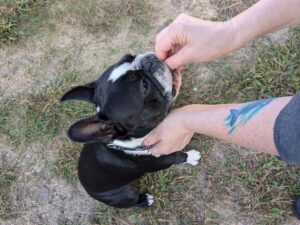
Simon the Boston Terrier playing the Collar Grab Game

Her reply: “We never practiced that. I didn’t need it then.”

She’s probably right. Back when her dog lacked confidence and was afraid of the world, the dog saw her as her one safe port in the storm. She’d come whenever called. Things have changed. The dog is now happy, confident, and knows lots of stuff. But she doesn’t know the fundamental Collar Grab game because she never learned it.

That’s not as big a problem as you might think. When they were first learning dog training games, the dog knew almost nothing except how to bark and hide behind her mom. Now she knows how training games work. Games are always a chance to have fun together. And get treats. This dog is all about the treats. 

There’s a game for that

Whatever your dog’s behavior issue might be, there’s a training game for that. It’s never too late to teach them. And it’s certainly never too late for them to learn. So, go back through your training notes and ask yourself, “What’s this game good for?” and see if any apply to your current situation.

When a new dog enters your life it’s easy to feel overwhelmed by the mountain of things the dog needs to know. The mountain is even steeper if you’ve had the dog for a while and simply chosen to manage the things that are problematic. It’s easier to close the bathroom door than teach a dog not to rummage in wastebaskets. 

That’s fine! You should always solve real problems before dealing with the little things. But when your dog has learned the basics and knows their role in the household and family, it’s time to play a little catch up. 

Keep a pending file

We always say what issues games are designed to fix and explain why they’re useful. If it’s not something you currently need, but you recognize the value, just make a mental note that there’s help available. 

You can always revisit training games, pick up new ones, and replay favorites, especially if when you ask “What’s this game good for?” you find one that fits. Your dog will always be up for another game, whether it’s a life lesson or something just for fun. Playing training games is an ongoing investment in your dog, keeping them happy, engaged, and well-behaved.