Dog Training Game: Sniff It Out

Spread the love

There are lots of dog sports that encourage dogs to use their superior sniffing abilities: Tracking, Barn Hunt, Scent Work, etc. Dogs’ amazing noses are also used for law enforcement, customs, even disease detection.

Whether or not you have any ambitions to try your luck with any of these dog sports, you and your dog can still have fun with at-home versions of sniffing games. It’s also a great way to expend some doggy energy when the weather isn’t cooperating outside. 

The “Sniff It Out!” game feels like cheating. There’s almost no training involved. Most dogs catch on quickly. Then the challenge becomes resisting your dog’s begging to play it again.

How it works

The first step for “Sniff It Out!” is deciding what scent your dog will be searching for. Any stinky thing is fine, as long as it’s not a normal part of your dog’s environment. For the Scent Work dog sport, the essential oils they use are Anise, Birch, Clove, and Cypress. You can use whatever you have around the house, as long as you know it’s not toxic for dogs. Don’t use artificial scents of any kind. You don’t know what chemicals are used in their manufacture, and you don’t know how your dog will react if they get a snootful.

When we first started playing this with our dogs, we had some nutmeg, lemon, and cinnamon essential oils around. We used an ordinary cotton round, put a couple of drops of scent on it, let the dog sniff it, asked someone else to hide it, and let the dog “Go Sniff!” 

At first, confine the “hunt” to a single room, with limited distractions. When introducing the game, leave the scent object out in plain sight. As soon as the dog goes over to sniff it, praise (or click) and reward. Do it again, each time moving the scent object a bit farther away and less visible. 

You’ll be able to tell when your dog connects the dots and starts using their nose. They may pick their head up, look around while sniffing, and move back and forth across the area to zero in on the scent. Try not to look at the scent object or stand right next to it. Let the dog “find it!” 

Variations on a theme

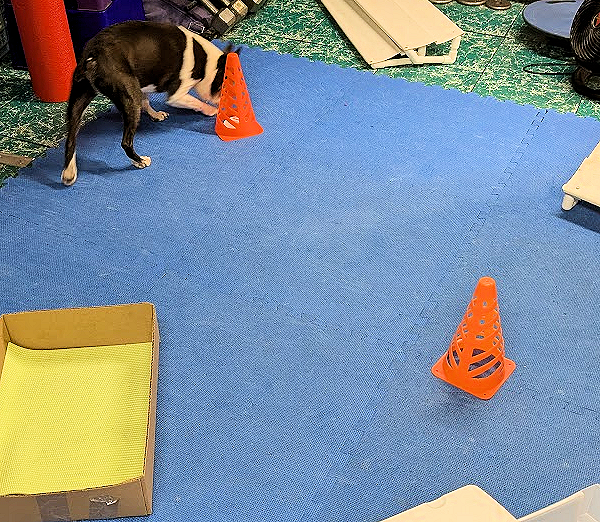
We have a particular area of the basement where we play training games. To challenge the dogs in this limited space, we scatter all kinds of objects around – bins, bowls, cones, broad jump boards. You can place the scent object inside things, under things, higher than the dog’s nose. Dogs’ scenting ability is up to the task, wherever you hide it.
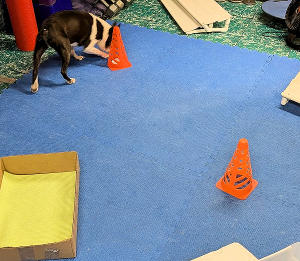
If you’re concerned that your dog may grab the cotton round and eat it, you can use real food and put it in a bowl or dish for your dog to find. It’s a simpler version of the game that Booker, Fran’s 13-year-old Boston Terrier loves. Fran puts a dab of peanut butter on a target (a plastic lid) and uses that as his scent object. (In the photo, Booker’s target is under the cone that he’s pawing.) He’s so enthusiastic about playing “Sniff It Out!” that Fran has to take him someplace where he can’t see Hope hide the target. Booker would “cheat” if we let him.

Keep it fresh

Booker loves “Sniff It Out!” and would play it all day, every day if he could. As your dog grows more confident in the rules of the game, expand the search area to different rooms, levels, and scents. When you start the game, be sure to introduce your dog to the odor you’re using so they know what they’re looking for. 

Letting your dog use their instincts, ability, and brain for “Sniff It Out!” is a triple win. It’s also a game you can play with your dog when winter weather keeps you trapped indoors.
​The Doggy Paycheck: Why Your Pup Won’t Work for Free

Spread the love

Positive reinforcement training is based on one single premise: dogs will always, without exception, do what is most rewarding to them.

The focus of your training has to be making what you want the most rewarding option. Your choice has to be, in the dog’s opinion, the best thing available.

To convince your dog, you have to build a history. If your dog always gets rewarded for doing what you want, they’re more likely to continue doing it. They get their doggy paycheck every time they do what you want.

If, however, your rewards are inconsistent or absent, the dog has no reason to do what you want. There’s always something interesting to do. It may or may not be what you want them to do.  The environment is your biggest competitor. If a squirrel is a $100 bill and your treat is a nickel, the squirrel wins every time.

Hierarchy of rewards

One of the first lessons of reward-based training is figuring out what’s valuable to your dog. You may want your dog to love the expensive, organic, healthy treats you bought. But you can’t make that love connection happen. In our classes we always have extra treats available for our students. The treats we provide aren’t healthy, good-for-dogs, or expensive. They’re the junk food french fries of dog treats. Because they work. Dogs love them. 

We’re not saying  you have to buy junk dog treats. We’re saying you have to find the rewards that your dog would (virtually) run through fire to get. Don’t be surprised if it’s something weird. One of our dogs would kill for celery. Another thinks celery is poisonous. It’s not our choice, it’s the dog’s.

Transfer of value

Let’s use Torque, the celery fiend, as our example. If he always gets celery when he does Puppy Push-ups, before long he’s going to get all excited to do them. In his little doggy brain, that incredibly yummy treat is paired with Puppy Push-ups. The value of the treat is associated with playing that awesome game. And he loves doing it.

Once your dog has made that pairing, your reward delivery can become more random. But it can’t go away forever. If it does, the behavior will, too. 

Think of it this way: You love every single aspect of your job. Your work is fascinating. Your colleagues are awesome. You even get a catered lunch every day. Are you still going if you don’t get paid? Of course not. Your bargain with your employer is to complete assigned tasks in exchange for compensation. 

Your dog gets the benefit of the same deal. Their task is to be a good dog. Their compensation (doggy paycheck) is the rewards you provide.

Just for the fun of it

You don’t have to reward your dog constantly for just being good. If they’re doing something you didn’t ask them to do, just a pat or a “good dog!” is fine, if you notice it.

But if you’ve told your dog to do something and they do it, that good behavior should be acknowledged. That’s good training and living up to your side of the deal.

Saboteurs Can’t Ruin Your Dog

Spread the love

A post this week on one of our obedience/rally groups had someone ranting that their family was undermining their dog training. She constantly told her family members how she wanted to train her dog, showed them what to do, explained how to do it. And yet they refuse to comply with her wishes. Are you afraid that your family will undermine your dog training?

It’s actually pretty common. Playing training games with your dog is important to you, but may not have the same value for other people around you. 

That may frustrate you no end. But, in the words of a song, you have to let it go. 

It doesn’t matter

That’s easier than you might think for one important reason. Every person in your household has a different relationship with your dog. And there is nothing they can say, do, or try that can change that.

Dogs always have the closest relationship with the person who trains them. We’ve even heard from long-time dog owners who marvel at the difference between their previous pets and their current training partner. Training changes everything.

Stay ahead of sabotage

It is possible for other people to “poison” the cues you’ve used for your dog. “Stay!” is one of the most difficult behaviors. If other people don’t stick to your “Stay!” criteria, it may become compromised.

Fortunately, It’s easy to fix with a work-around. Let the other people continue to use “Stay!” and get sloppy performance. You switch cues and never say “Stay!” again

If you’ve used “Stay!” forever, it will take a conscious effort on your part to switch it to something like “Park it!” The other people certainly won’t make the attempt, so leave the word “Stay!” for them.

You start back at the beginning, using the cue “Park it!” (or whatever word you like). Stick to your criteria. And don’t tell the other people your new cue. They may hear it but we’re pretty sure they won’t give it much thought or bother switching.

Between You and Your Dog

No one can sabotage your training. One notable example for us was a couple with a challenging Chow Chow mix. The woman was on board with training and really enjoyed playing the games with her dog. The man was resistant and did not. 

Since the dog adored the man, her behavior deteriorated when he was around. He doesn’t expect much from her and that’s what he gets. Not much.

The woman, on the other hand, saw how her dog loved playing training games and how she blossomed with training. Next week they’ll be attempting to qualify for their first Novice Rally leg. 

Secret Language

You may have heard that twins often develop a secret language only the two of them know. You can do the same thing with your dog, your training partner. No one can undermine your dog training or your relationship with your dog. You don’t have to worry about the saboteurs.

Dog Training Game- 4 On The Floor

Spread the love

Dogs always do what’s most rewarding for them. Our “job” as dog owners is to make what we want the most rewarding option.

One of the most common rude dog behaviors is jumping on people. For dogs, it gets them exactly what they want: attention. Dogs don’t really care if that attention is yelling at them, or batting at their feet, or even shoving their chest. For your dog, who loves you, any attention you pay to them is wonderful. That’s unconditional love.

Change is hard

To get your dog to stop the behavior, you have to make something else more gratifying than jumping. It’s time to play “4 On The Floor.”

With a bunch of really yummy treats in hand, walk into the room where your dog is hanging out. Get your dog all excited, by whatever means necessary. Talk excitedly, jump around, pretend to throw a ball, whatever gets your dog to perk up and pay attention. 

When the dog is standing, lean over very close to your dog and start feeding high-value treats. One after another. Be sure you don’t stand up, you don’t want your vertical motion to trigger your dog’s jumping. Let your dog know the cue for standing there getting fed: “Good 4 On The Floor.” “Nice 4 On The Floor.” “I like your 4 On The Floor.”

Use whatever cue you want for the behavior. We use “4 On The Floor” because it describes what we want and everybody knows what it means. It is longer than most dog cues, so choose one that works for you.

Watch carefully

Your dog may get all excited and start to jump up. If they show signs of jumping, freeze in place. Stop rewarding and wait. If your dog does jump on you, try not to move. Don’t say anything. Ignore the behaviors you don’t want. It’s tough, especially if you have a big, powerful dog. But be patient.

When the rude behavior gets the dog nothing, chances are they’ll go back to what they were doing – standing there and getting treats. As soon as the dog has four feet on the floor, go back to rewarding and praising, giving your dog the cue you’ve decided on. 

Dogs catch on quickly

Simon demonstrating 4 On The Floor

After just a couple of times, your dog should start recognizing the cue “4 On The Floor.” When you’re pretty sure they have the idea, recruit someone the dog knows to help out. If the person is okay with it, have them do exactly the same thing, bending over and repeatedly rewarding. If the person can’t, or won’t, then you bend and reward as long as the dog has “4 On The Floor.”

You’re building a new behavior that the dog will find more rewarding than jumping. They get the attention they crave, as well as many treats, for behaving politely. It becomes the most attractive option for the dog.

Expand the experience

When your dog is pretty good about staying off of people at home, add on by having someone come in the front door. Entries and exits are the most likely times for dogs to jump on people, so it’s up to us to make it normal to greet people with all four feet on the floor. 

Once your dog is proficient at entries and exits, it’s tempting to take it for granted. If you completely stop rewarding, the dog will revert to behavior that’s more fun for them. You won’t have to reward every time, or multiple treats all the time. You do have to randomly reinforce good behavior to maintain it. Dogs live in hope that something good is coming their way. If they’re good, make that wish come true. At least every once in a while.

Warning! Playing Dog Training Games Will Change Your Life

Spread the love

A cautionary document for the unsuspecting dog owner.

We feel obliged to issue this warning for anyone contemplating a training journey. There are consequences—both intended and corollary—that will change your life forever.

Your perception of dogs will change. Your expectations will change. You will laugh. There might be crying. You will definitely have fun.

The results of 2-minute training are wide-reaching. You’ll look at neighbors and think, “They could use 3-Step Pattern Walking.” You’ll visit a friend and “fix” their dog’s jumping habit in five minutes.

You’ve been warned. Here is what to expect:


1. The “Telepathic” Velcro Bond

If you thought you were best friends before, you ain’t seen nothing yet. 2-Minute games create a learning partnership that feels like a psychic connection.

  • The Downside: If you had a “Velcro dog” before, they’ll now take residence practically inside your skin.
  • The Cost: Be prepared to buy an extra dog bed for every room, including the bathroom. If your dog is particularly dexterous, you’ll have to buy them a phone so they can text you every 10 minutes.

2. The End of “Days Off”

If you play training games right after breakfast, be prepared to play every day at precisely the same time. Even on weekends. Even on holidays.

Pro Tip: The only way to avoid your dog’s absolute devotion to the schedule is to randomize your training program.

Even then, when your dog determines “It’s time!”, prepare for incessant nagging. Don’t look them in the eye. Nothing will make you cave faster than those soulful, puppy dog eyes.

3. The “Puppy Push-Up” Chaos

You’ll have to contain your laughter when your dog’s excitement spurs them to show you every trick they know the second you ask, “Do you want to play?” It’s adorable when a dog starts doing Puppy Push-ups with no prompting. Steel yourself! If it’s not what you asked for, it doesn’t get the reward. No smiles, no laughter, and definitely no scritches.

4. The Inevitable “Brain-Dead” Days

There will be days when your dog looks at you like they’ve never heard the word “Sit!” before. You know they have. You have video evidence.

  • The Reality: Some sessions are write-offs.
  • Plan B: Play fetch instead. It’s a poor second, but some days it’s all the brains your dog’s got.

Is your addiction complete?

Your social schedule will change. 2-Minute training will change your life. You’ll realize you have more fun with your dog than most people you know. When you start thinking, “I could be home playing with my dog,” the transformation is finished. Ready to start your own “addiction”? Sign up for our 2-Minute Newsletter!