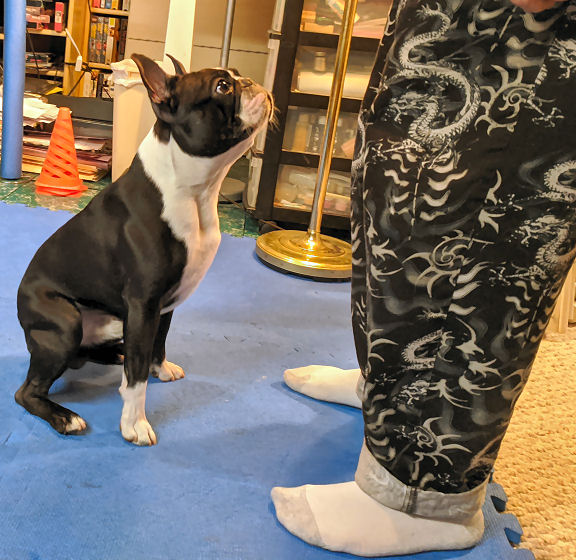
Seeing your face signals your dog to stop. Don’t believe it? It’s easy to test. Invite your dog to run with you. You’re both going along together, facing the same way. If you suddenly stop and look at your dog, they’ll stop, too. And stare you in the face.
When you have a conversation with another person, it’s considered polite to look at them. Dogs are the same. Your dog always wants to see your face.
In some ways, that’s a wonderful thing. Doesn’t everyone make funny sounds to get dogs to look? And if we get the adorable head tilt, we keep doing it.
Not always what we want
There are times, however, that you don’t want your dog to stop and look at you. You’d think that calling your dog to “Come!” is easy and natural.
It’s not. If you’re standing still, facing your dog, and call them, they may not move an inch. They can see you, but your face is a stop sign.
Motion triggers motion
When this happens, most people will sweep an arm back, encouraging the dog to move. It usually works. It also means that your dog doesn’t have a reliable recall.
In Obedience competition, the rules require you to stand absolutely still when you call your dog. You can’t do any of the things that come naturally. You can’t back up a step, pat your leg, move your head. Any handler motion when a verbal command is used is considered a “double command” and not allowed.
This exercise, done correctly, demonstrates that your dog knows the word and what to do when they hear it.
Good to know
Most people aren’t competing in Obedience. They just want their dogs to come when called. The easiest and fastest way to teach that is the Chase Recall. Your motion spurs your dog to move.
It’s true with all dog behaviors. One of the most difficult parts of “Stay!” for dogs is sitting still while you walk around. Most dogs will either swivel on their hindquarters to keep watching you, or get up entirely.
Take advantage
Knowing that your dog always wants to zero in on where you’re facing, you can use that to direct your dog’s learning. When teaching “Place!” you stare at the dog bed. Your interest in an object will make it intriguing for your dog.
That’s the principle that lots of our games are based on. The ones that involve manipulating objects start with you staring at the object. The ones that require the dog to move somewhere start with you looking there.
We tried it today. One of the behaviors we teach our dogs is to walk sideways. When facing each other, the dog’s natural tendency is to move their front legs in line with us, but their back end tends to go crooked. Today we tried the behavior looking at where we’re going (to the side) rather than at our dog. It works.
Watch where you’re going
When we were learning agility handling, one of the first things we were taught was that dogs will follow your shoulder. They go where your shoulder indicates. If you’re running or walking straight ahead, keep your shoulders square. If you’re moving to your right, that’s where you orient your upper body.
Your dog is attuned to every move you make and is keenly aware of your body language. If you can’t figure out why your dog is moving a certain way, check yourself. You may be giving them a signal you don’t intend. Like looking straight at them when you want them to keep moving.