Big Dreams, Small Steps: The Secret to Dog Training

Spread the love

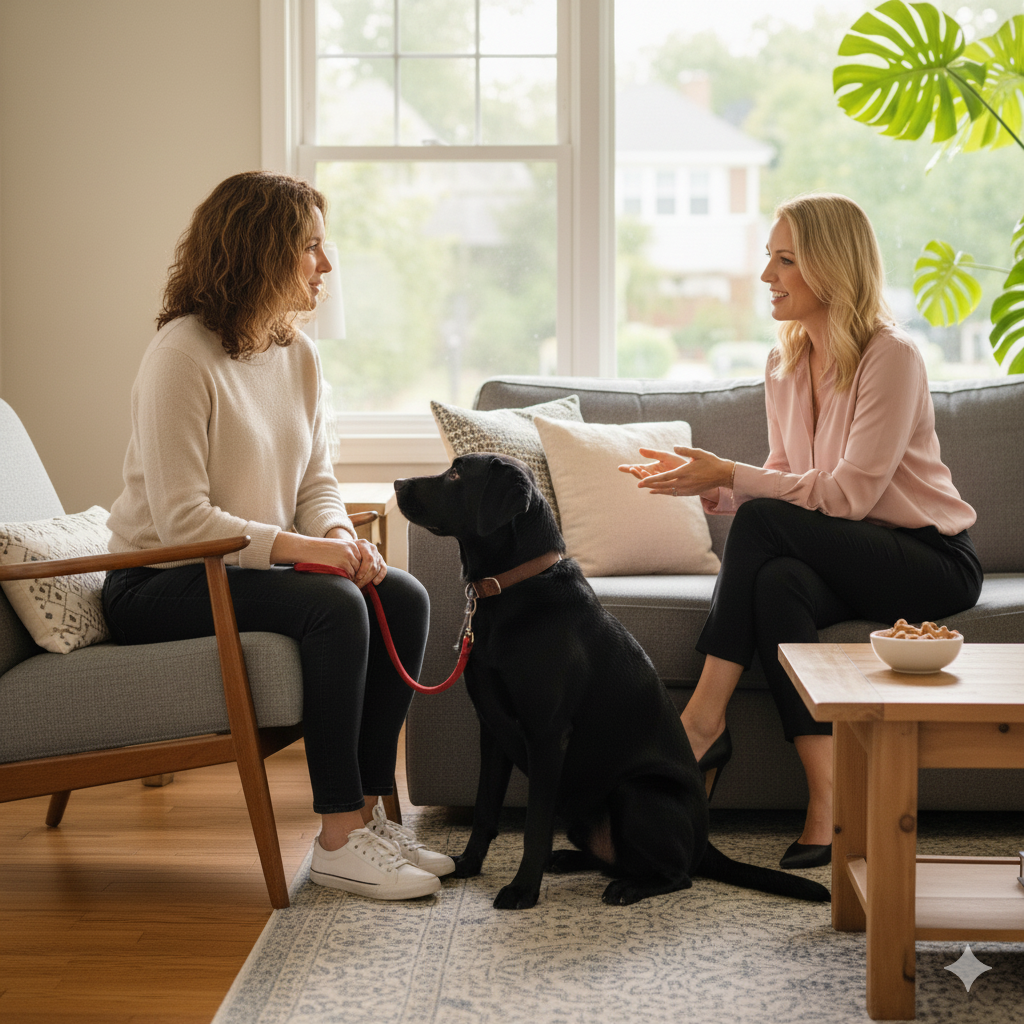
There are big, beautiful dreams to achieve in dog training: “I want my dog to be a Rally Obedience Champion.”

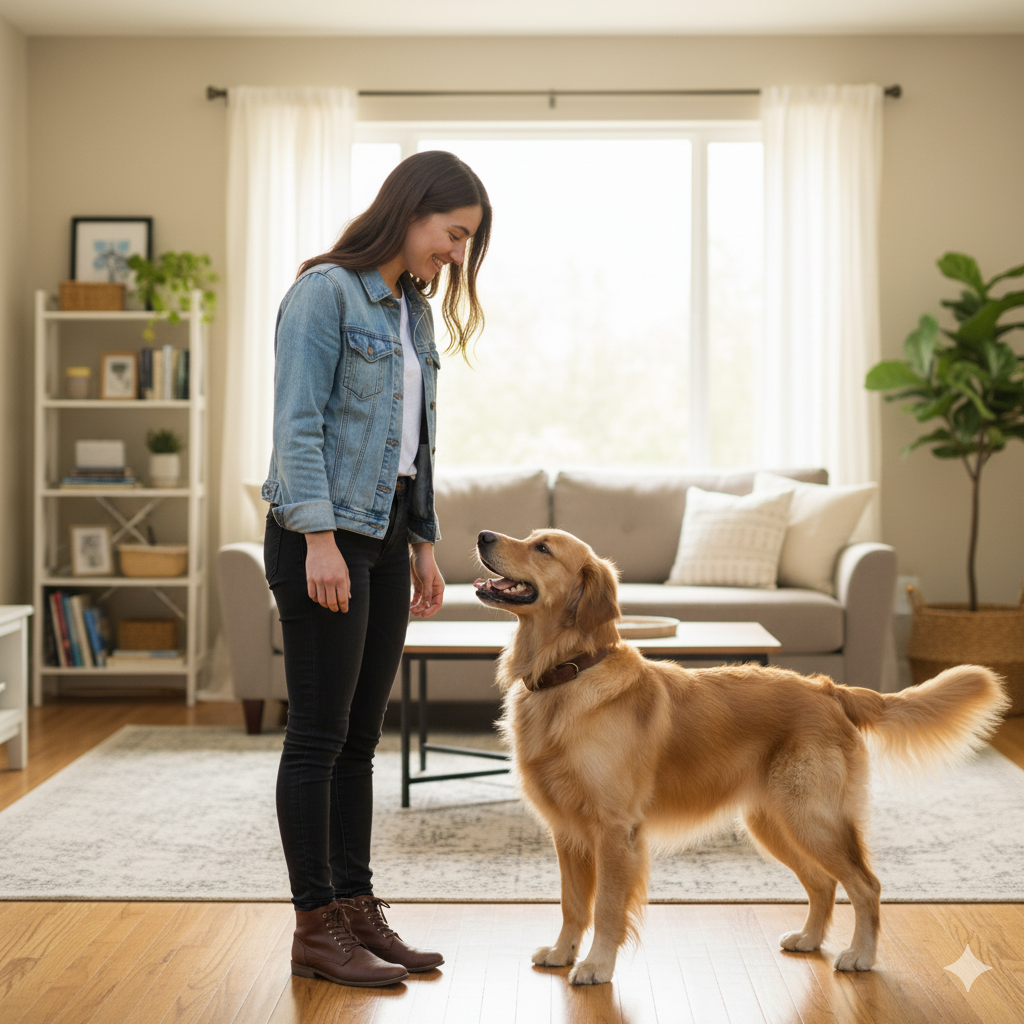
There are also lovely little dreams: “I want my dog to greet my holiday guests politely.”

You and your dog can achieve whatever goals you want. Both of those dreams are achievable. The key is recognizing that every little step, every two-minute training game, is taking you closer to the prize.

Destination is motivation

Aiming for a specific goal gives you a reason to find time for training. It’s also a yardstick to measure your progress. It helps to set a deadline for yourself.

While playing training games with your dog is always fun, adding a bit of pressure to achieve a goal makes it more likely you’ll do it. Everyone’s schedule is crammed with things we have to do. It’s important to carve out some time for the things you want to do as well. 

Set up for success
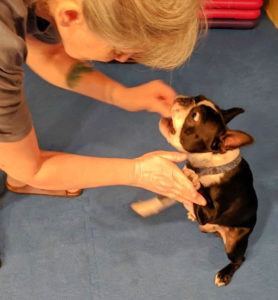
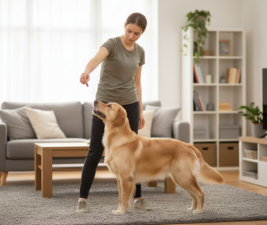
Say you’re hosting a gathering in a month and want to show off your dog’s new trick – “Shake Hands.” 

The first step is planning for a few mini-training sessions every day. At your dog’s meal time, use the first five pieces of food for training treats. Set up containers of training treats everywhere in the house you spend time. Use commercial breaks, waiting for your popcorn to pop, or even bathroom breaks as training opportunities. That destination is motivation for you and your dog to keep up the short training sessions.

Unexpected benefits

Your relationship with your dog will change if you make tiny training sessions part of everyday life. They’ll listen better, be happier, and become more confident. Shared communication will improve. And you’ll make great strides in achieving both big and little dreams. 

When we start a new session of classes, we always ask our students what they hope to achieve in the class. The nebulous goal we hear most often is “a well-behaved dog.” Which looks different to everyone. Set specific goals and you’ll achieve not only that target, but the fuzzy “good dog” one as well. 

There’s no wrong way

Your dog training journey will be filled with both triumphs and hiccups. No path toward a goal is always smooth. You may even find that your original goal becomes unimportant. 

That’s all okay. Dog training, in short, fast, fun bursts, is really all about having a great relationship with your dog and having fun together. Making it a habit will benefit both of you. Your dog will get the biggest life. And you’ll have the best dog. 
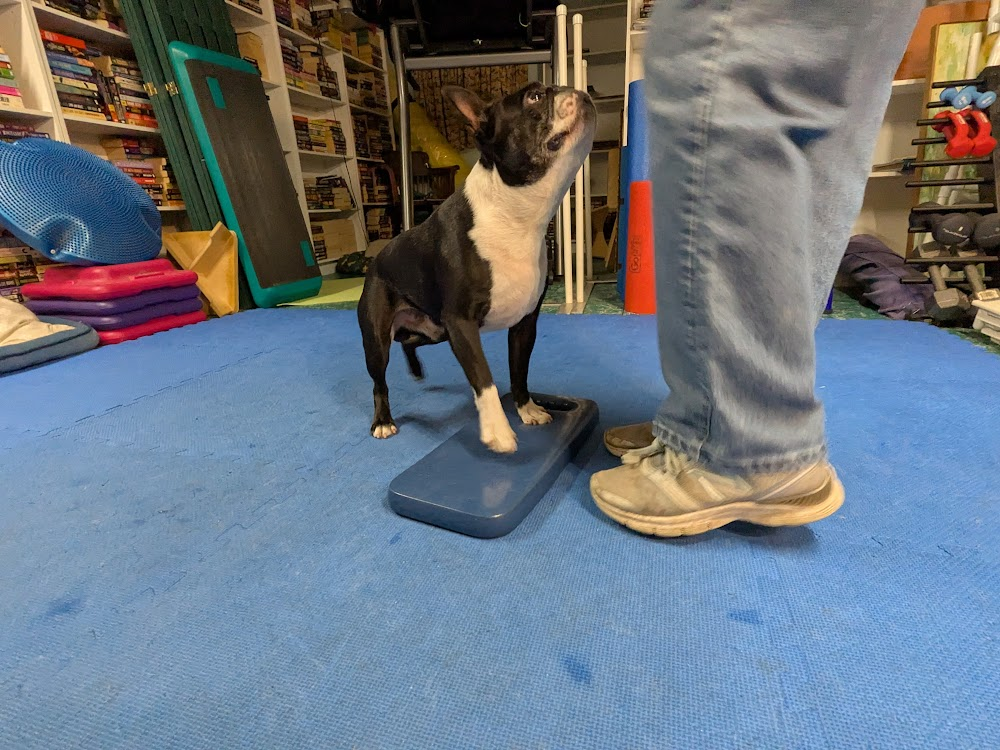
Dog Training Game “Stomp”

Spread the love

“Stomp!” evolved from our involvement in the Dolphin Research Center in Grassy Key, Florida. One of the cognition studies we saw in action was getting the dolphins to “imitate” what another dolphin was doing. The first dolphin was given a specific behavior to perform, like a circle spin. The second was instructed to “imitate.” The trainer never asked the second dolphin to do a circle spin, just to do what the first dolphin did.

Dog And A Dolphin

Much of modern-day dog training can be traced back to Karen Pryor’s ground-breaking book “A Dog & A Dolphin,” so we’ve always figured anything a dolphin can do, a dog can do, too.

Coming up with new training games is part planning, part evolution, and part learning to follow where the dogs lead. Sometimes it doesn’t work out. Our attempts at color discrimination haven’t panned out. Every once in a while we come up with a new idea and try it again. But it’s been shoved to the back burner.

We started thinking of ways to translate the dolphins’ imitation behavior to dogs. We’ve seen many instances where dogs learn by watching each other. And we know that our body language matters – a lot. But would they imitate us, too?

Give it a shot

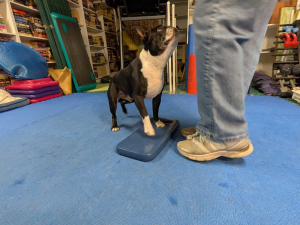
Teaching our dogs to “Stomp!” was as simple as having them stand in front of us and alternately stomping our feet. At its core, it’s marching in place, with an audience of one – your dog.

As soon as they lift a paw, name it and reward it! You can call it whatever you like: March!, Stomp!, High-Stepping!. What’s crucial is the timing. It’s important to mark the behavior and immediately reward it.

That’s really all there is to the dog training game “Stomp!” Demonstrate it for your dog. Invite them to join the party. Once they understand the goal of the game, you can stretch out the rewards so they continue “Stomping!”

Copying what people do

Dogs will copy what their people do. The recent social media “Hands In Challenge” proved that dogs with little or no other training would imitate their people’s actions. Try it for yourself. The videos are mostly adorable. Whatever their dogs can do, yours can, too!

Doggy Dressage – Why Your Dog Needs Fancy Footwork

Spread the love

According to the search engine that knows everything and tells all, dressage is “a classical training system that develops a horse’s balance, flexibility, and obedience to create a partnership where the horse responds to the rider’s subtle cues with harmony, confidence, and attentiveness.” 

“Harmony, confidence, and attentiveness.” Wouldn’t you love to describe your relationship with your dog that way? You can get there. The recipe is simple –  train in brief sessions with intense focus. Fancy footwork, like “Sideways,” “Back,” “Spin!” and even “Stomp!” parallel dressage. These tiny little behaviors zero in on small things and add up to so much more. The result is knowing how to communicate with your dog through words, motions, and actions.

Step at a time

In day-to-day life there may not be much call for doggy dressage. But it’s fun and useful for Rally or Trick Dog competition and titles. It’s also a great way to teach your dog body awareness and be sure they’re using all the muscle groups in their legs. Establishing a habit of lifelong fitness for your dog will help as they age. After all, Newton’s First Law of Motion tells us: “A body in motion tends to stay in motion.” Isn’t that what we all want, for ourselves and our dogs?

The first part of Doggy Dressage was last week’s 2-Minute Tip, “Sideways.” This week we’re going to go over a couple different ways to teach your dog “Back Up!”

Back Up! 

If you already know the training game “Whatcha Gonna Do?” you have the tools in place for starting “Back Up!” If not, you should. It’s the best impulse control game we know. But don’t worry. We’ll muddle through without and jump into “Back Up!”

Sit on the floor with a bunch of treats your dog can’t get to. When your dog is in front of you, toss a treat between their front legs, aiming for the floor just under their chest. When the dog reaches down to get it, they’ll back up to get it. Say “Good Back!” or “That’s Back!” etc. Make sure they hear the word as soon as they act it out. Do it again. A single session may be about 10 treats gently thrown under the dog. 

Back up from a standing position.

If your dog aces this and is already across the room, backwards, get them to come back by offering a palm to play “Touch!” 

Most dogs take a few sessions to catch on. That’s okay. This method of teaching “Back Up!” is preferred because it’s not dependent on you moving with the dog. The dog is taking independent action and being rewarded for it. You can ultimately transition to a standing position.

Another way

The way most people teach their dogs to “Back Up!” is using a wall. Stand with the wall at your side (either side is fine) and the dog between you and the wall, facing the same way you are. 

With the hand closest to the dog, hold a treat at a level with the dog’s muzzle and move it straight back, moving your feet along with the backwards motion. At first you’ll only be looking for the slightest backward motion, just a few inches. Give your dog the words “Good Back!” as they’re moving that way. Try to hang onto the treat (yes, your dog is probably nibbling your hand) until the dog has actually moved a bit back. 

Gradually increase the distance “Back!” your dog goes before being rewarded. When you switch from luring to rewarding this behavior, use the same arm position to cue your dog. Please don’t flutter your hand in the dog’s face. It’s just annoying to the dog and anyone watching. 

More fancy footwork ahead

We hope you’ll tune in next week for one of our favorite stupid pet tricks – the Stomp!

Walk This Way! Teach Your Dog the Fun “Sideways!” Game

Spread the love

Why does your dog need to walk sideways? The short answer is, they don’t. The good answer is that it increases body awareness, balance, and works some muscles your dog may not usually use. The best answer is that it’s fun!

Part of the package

Dogs (and people) have these great machines for doing all kinds of things. Bodies are pretty amazing. They function automatically for lots of things, like breathing and digesting. But there are some things they may not do unless they’re taught. Like building a strong core to keep us upright and functioning. And using legs for stuff other than walking or running.

Teaching your dog the Sideways! game goes along with games like “Paws & Boots” to get your dog moving in ways they may not do on their own. 

Easy does it

All you need for “Sideways!” is some treats and your dog. It certainly helps if your dog knows a “Stand!” command, but it’s not crucial. 

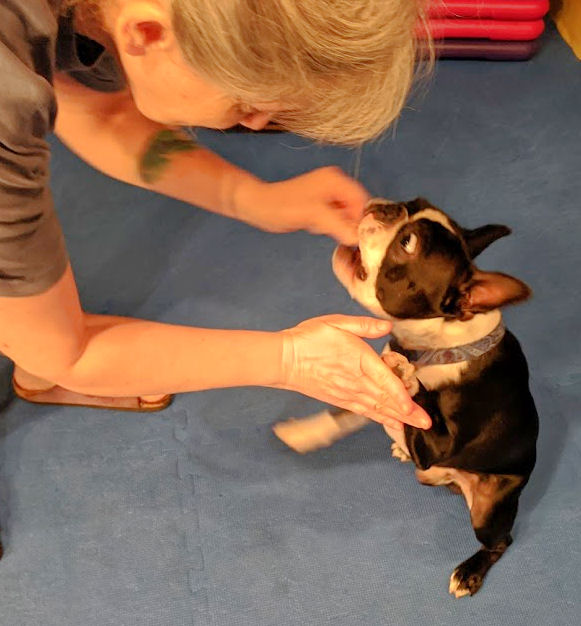
A woman standing perpendicular to a dog, which is also standing to demonstrate the positions for "Sideways!"

Stand perpendicular to your dog with one foot under their chest and your other foot in front of their front feet. Have some treats in the hand closest to your dog’s face. Show them the treat while you gently contact your dog’s ribs with your leg as you move slightly forward. This puts pressure on the dog for the sideways motion. 

You can say “Sideways!” as you shuffle forward to keep your dog moving in that direction. Don’t try to cover much territory. You’re just trying to familiarize your dog with the idea that they can move to their side.

After a few steps sideways, go around to your dog’s other side and do it again. All one-sided training like “Sideways!” should be done on both sides. 

Build on success

Just like us, if the dog is using “new” muscles, they may be sore the next day, so don’t try for any real distance at first. If you just get a couple of steps, that’s fine for an introduction. 

Take note of your arm position when you’re playing “Sideways!” Once your dog catches on, you shouldn’t need to lure, but you can use that same hand/arm signal as a cue for your dog. Most dogs like going “Sideways!” so it’s both fitness and fun at the same time.

Holiday Dog Dilemma: When Your Dog Isn’t Party-Ready

Spread the love

“We can’t host Thanksgiving for the first time in decades!” One of our trainees was almost distraught at the thought. She loves her adopted rescue dog, but knows the dog isn’t party-ready. She has a holiday dog dilemma.

The dog is fearful around strangers, and will bark and snap.

She is helping the dog overcome his fear-aggression but realizes it’s a process that probably won’t meet her Thanksgiving deadline.

Dogs not invited

We love dogs and truly think the world would be a better place if everyone agreed with us. But we do recognize that dogs are only a part of our lives. Everyone has multiple priorities that require our time and attention. Family is first. And family traditions, like Thanksgiving, take precedence over dog training.

Just because dogs are members of the family doesn’t mean they have to be included in every family event. Especially when it would cause tremendous stress for both you and your dog.

Always another option

If our trainee’s event was only a single afternoon, it would be fine to confine the dog to a room far away from the festivities. If the dog is comfortable in a crate, use it. Turn on the television or a radio, give the dog a special treat, and leave the dog alone. 

With a more extended event, if people are coming for several days, you can think about boarding the dog. There’s plenty of time between now and the holidays for you to check out boarding kennels  near you, both their reputation online, and their physical facility. If possible, you can even book your dog in for a “practice” night. 

Teaching party manners

Our student is relieved that she can continue both her family Thanksgiving and her pursuit of better socialization for her dog. Her goal is for her dog to be part of the festivities at home next year and avoid the holiday dog dilemma.

She’ll achieve this by building her dog’s army of “Cookie People,” both in her neighborhood and at home. She can enlist friends and neighbors to come over specifically for short dog-training sessions. It only takes a few minutes and does the dog a world of good to meet new people at home in a non-threatening way.

The objective isn’t for your dog to love everybody and be their best friend. It’s equally stressful if your dog jumps on your guests and won’t leave them alone. 

The ideal is for your dog to say “Hi!” politely and then resume normal behavior. The dog shouldn’t be the life of the party.