Dog Training Game – Under

Spread the love

Our obedience club recently had a “Tricks Title” evening. Hope and another club member, also an AKC evaluator, were the judges for the event. To get a Tricks title, the dog and person have to perform a specified number of tricks, depending on the level.

For the first (Novice) level, the tricks are mostly things that just about any dog already knows. If you aren’t familiar with the AKC Tricks program, it’s fun and you can get the title with a video submission. Getting that title certificate in the mail is special – proof that your dog can do things most don’t. 

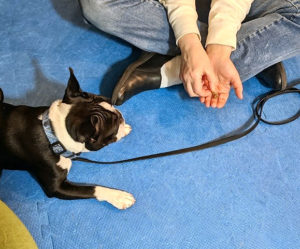
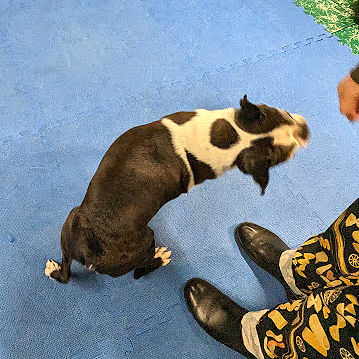
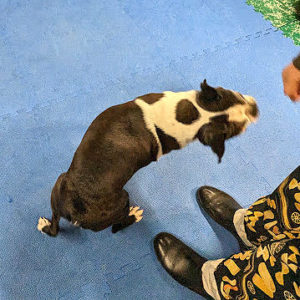
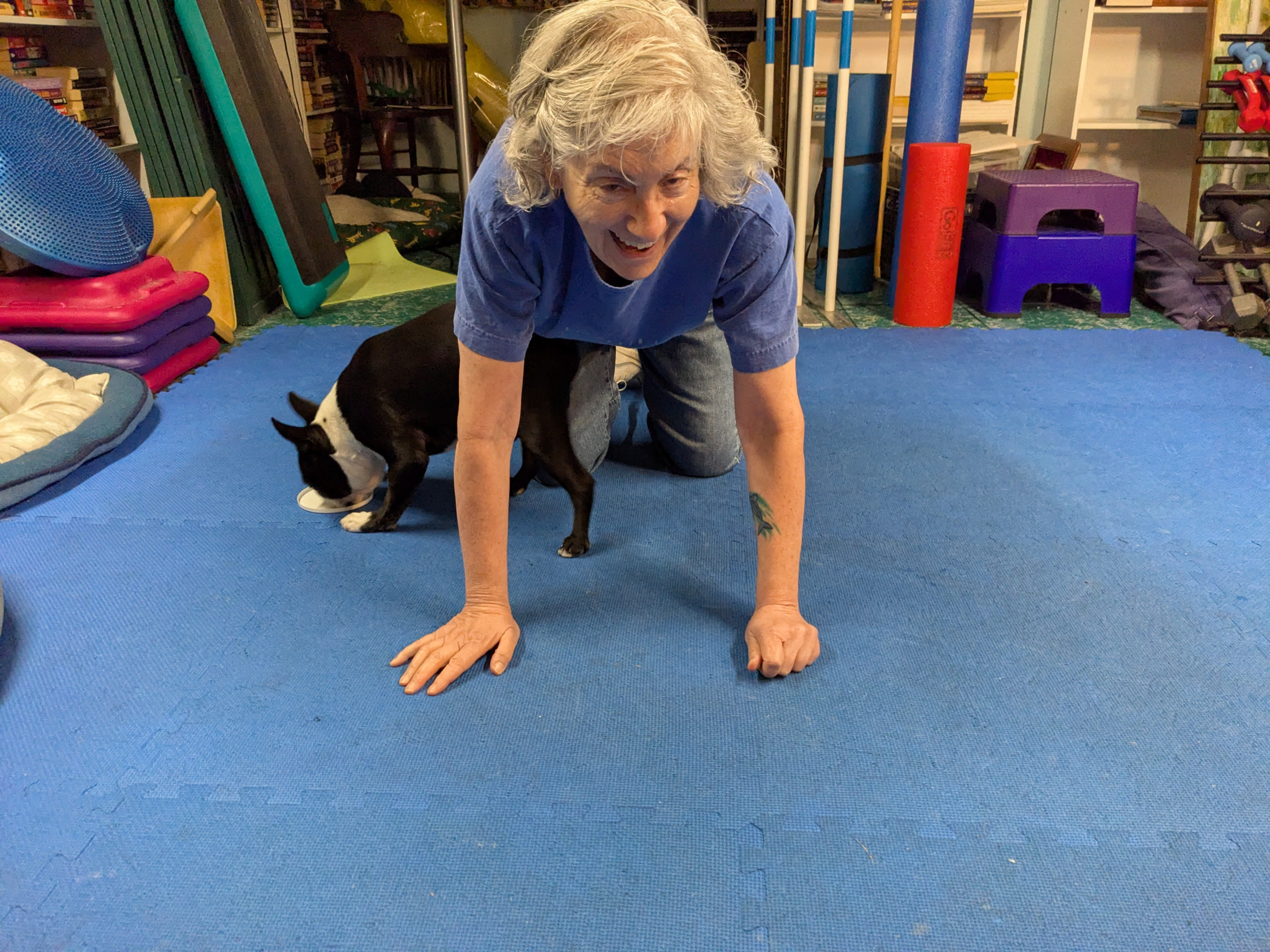
One of the tricks we saw that evening was “Under” – the person went down on hands and knees and the dog ran under the person’s chest.

Seems simple, but it’s not

We hadn’t thought of doing that with our dogs, so the next morning we tried. Not one of them did it. As a matter of fact, the dogs tried everything they could think of to go around, behind, or even between our arms to figure it out.

You never know what behaviors will stump your dogs. This one didn’t seem confusing, but it was. We just had to find a way to explain it in steps our dogs would understand.

Hitting the Target Game  

The Target Game is fun by itself. It’s also the gateway to all kinds of behaviors and tricks for having fun with your dog.

We use it for many behaviors, from teaching dogs to go over jumps, to the “Stay!” and release, to the Obedience “Go Out!”
With our dogs in a “Sit, Stay!” we got down on hands and knees, putting the target on the floor opposite to our dog. We keep it within reach, so we can put a treat on the target when the dog touches it. 

For all of our dogs, the Target worked. The first time. They watched the set-up, and dashed “Under!” us to the target. 

Did we really mean it?

Just because the dog does it once, doesn’t mean they know it. Once the dogs went “Under!” in one direction didn’t mean they understood it from the other side.

It also took a few tries to convince them we really meant it. Again, they tried to go around our legs to get to the target, or in front of us, or between our arms. 

We’ll never know why our dogs were reluctant to go “Under!” us. But a few repetitions, rewards for getting it right, and a little patience has put a new trick in our repertoire. 

Just for fun

Adding tricks like “Under!” is just another way to expand your bond with your dog and enrich their life. In just a couple minutes at a time, your dog could be on the way to getting mail!
Practice always shows

Spread the love

When we were little girls and took piano lessons, it always amazed us when our teacher knew when we hadn’t practiced. We were tone-deaf to our week-to-week improvement or lack thereof. But our teacher knew. Just like we can tell which participants in our classes play training games with their dogs. Practice always shows.

Unlike must-do homework and work projects, both piano lessons and dog training are things you do for fun and enrichment. There’s no accountability for neglecting practice. Except that you’ll never play Carnegie Hall. Or your dog will never walk politely on leash.

Just like we couldn’t tell whether we were getting better at playing the piano, you probably don’t see much difference in your dog’s behavior with a couple weeks of training games under your belt. But if you had a recording of your first time playing any training game, you’d be astonished by the difference.

Minimal investment, maximum return

The one game that most people do practice is “Puppy Push-ups.” We’re not sure if it’s because we start every class with the game, or if people (and dogs) just like it. But by the third week of class, every dog in every class we’ve ever taught is reliably understanding all three commands: Sit!, Stand!, and Down!

And yet, it seems that most people don’t even bother teaching their dogs this elementary training game. If they did, we’re pretty sure our TikTok video of it would be ignored, rather than having over a million and a quarter views. 

Training games are easy to fit into your day. Focus on just one or two at a time. Figure out where you’ll probably play (near the couch, in front of the screen), stash a container of treats nearby. When a commercial starts streaming, call your dog over to play. Or just open the treat container. That should get Fido’s attention!

Pick your battles

Trainers have a saying that “Every dog is trained to their owner’s level of comfort.” It’s up to you to decide the aspects of dog behavior that are important, interesting, and fun for you and your dog. You may not care if your dog knows how to “Spin!,” so don’t bother with it. But you do want your dog to sit politely to greet guests in your home. That game moves up to the top of the list. 

At the start of classes we’ll ask our students “What’s your dog’s best training game?” The answer is always the one that’s most important to that person. That’s the one they chose to play. And it’s the one their dog is best at. The practice and the proficiency go hand in hand.

Don’t complain. Train.

Dogs’ naughtiest behaviors often become the stories and anecdotes that build family legends. Like our first dog sneakily swiping a steak from the kitchen table while we were all standing there watching him. Or the auntie who darted into the bathroom as soon as you emerged to take anything/everything out of the wastebasket before her dog nabbed it. 

But you don’t really want the funny stories. You want a dog who understands the rules of your household and is a full participant in family life. Pick a game. Any game. Start with one. Before you know it, you and your dog will have a concert-worthy repertoire.

Training Game: On and Off

Spread the love

Sometimes we invent training games for dog sports, like Obedience or Rally. Some games are just for fun. Others, like “On and Off” are for keeping our dogs healthy, fit, and moving.

Hope’s French Bulldog Torque is now 10 years old. He’s been showing some instability in his back legs. Many Frenchie people have commented about it on our videos, asking if he has IVDD (Intervertebral Disc Disease), which is fairly common in French Bulldogs. It’s not that. Instead, Torque’s hips are the problem. 

Torque has always been front-heavy. It’s just the way Frenchies, and all broad-chested dogs, are built. To compensate, especially because we play dog sports, Hope has taught her dog hind-end awareness. He knows how to back up and plays “Paws & Boots” regularly.

Losing ground

A few months ago, Torque began slipping going up a flight of stairs. We figured he’d strained something, so didn’t think too much about it. Until it became months of carrying a 30 lb. dog up and down, multiple times each day. So the wheels started to turn. What could we do to help him regain his thigh muscle tone and strength? The “On and Off” game was born.

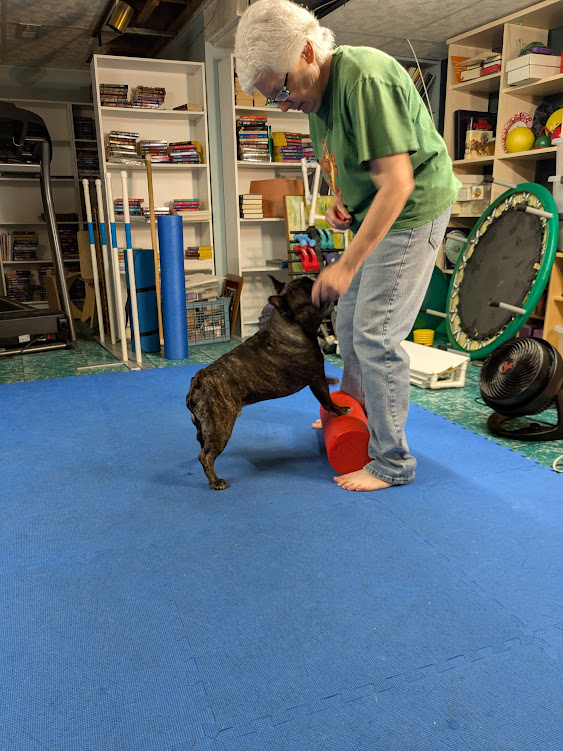
We use a foam roller for this game. Hold it steady between your feet. Because it’s foam, it’s a slightly unstable surface and requires the dog to engage their core during the game. A strong core is important to keeping your dog fit and healthy, just as it benefits people.

Like any exercise focusing on a particular muscle group, aim for a gradual increase in the number of repetitions. If your dog has weakness in their hind end, or is older, don’t overdo it, especially at first. Just like people, dogs can get sore if they start to use any muscle that’s been unused in a while.

Just like it sounds

Holding the roller between your feet, invite your dog to put their front paws on top. Reward for success. If your dog doesn’t know “Paws Up!” or a similar command, you can lure this behavior at the start. Just hold the treat slightly above the dog’s nose and move it up and toward you. The dog should follow the movement of the treat. When the dog’s two front paws are on the roller, give the dog the treat and name the behavior. We call it “On!” but you can certainly use “Paws Up!” as you might for the Paws And Boots training game. 

Have you taught your dog a release word? If so, you can use that to let your dog know it’s time to step off the roller. Or you can use “Off!” It’s a natural extension of the “Off!” game you taught your dog to stop them jumping on people.

Just a bit more

Repeat the “On and Off” a few times. Aim for five or so repetitions at first. If you’re trying to build up your dog’s hind end strength, try to add one or two repetitions each time you play. A couple times a week should be sufficient.

After less than a month of playing “On and Off,” we’re pleased to report that Torque is more confident going up stairs now. He’s only doing a couple at a time, but it’s better than none. Especially if you have small dogs, a full flight of stairs may be the equivalent of a three-story building to a person. Reward for any progress and each step forward. 

Positive reinforcement works on people, too

Spread the love

We were fans of the tv show “The Big Bang Theory.” One episode featured a classic example of positive reinforcement training.

If you watched the show, you know that the primary characters, Leonard and Sheldon, were scientists. Sheldon, in generous terms, wasn’t adept at social interaction. In this episode, Leonard, his girlfriend Penny, and Sheldon are watching TV. When Penny talks over the program, Sheldon gets annoyed. He gives her a glare and she promises to be quiet. He offers her a chocolate. Penny’s phone rings and, after a glance at Sheldon, says she’ll go into the hall to talk. Sheldon offers her a chocolate. 

Sheldon’s applying positive reinforcement to get what he wants. Leonard notices and says:

“Sheldon, you can’t train my girlfriend like a lab rat!”

Sheldon replies “Actually it turns out I can.”

Not a new concept

While most sources attribute positive reinforcement to B.F. Skinner’s development of operant conditioning in the 1930s, the concept is much, much older. Ever heard the proverb “You catch more flies with honey than you do with vinegar”? Ben Franklin’s Poor Richard’s Almanac cited it in 1844. 

Positive reinforcement is one of the quadrants of operant conditioning. Explaining the other three would dive deep into weeds most people would rather not explore. If you, too, are nerdily interested, there’s lots to find. Have fun!

The point is that positive reinforcement works on people as well as dogs. Everybody is more interested and eager if they know their efforts will be appreciated. Sometimes that’s a simple “thank you!” or “well done!” And sometimes it’s a piece of chocolate.

Getting where you want to be

Research has proven that positive reinforcement works better for learning and retention than punishment-based training. “Reward-based dog training offers the most advantages and least harm to the learner’s welfare,” according to the American Veterinary Society of Animal Behavior, which says there is no evidence that aversive practices are necessary for dog training or behavior modification.

It’s also true that positive reinforcement training requires time and patience. Having a background in correction-based training, we know that a few strong “collar pops” will probably stop a dog from pulling. It will also make the dog fear the collar and cause pain. Punishment-based trainers have euphemisms to describe what they do. “Collar pop” or “correction” sounds better than yanking on a dog’s collar to hurt them.

Getting a dog to understand what you want is like playing charades with an alien. You don’t have a common language, you can only communicate through motions and rewards. It takes time to reach understanding. Once your dog realizes that every little training game will be fun and rewarding, they’ll love those sessions. 

Take a breath

It may take a while for the light bulb to turn on in your dog’s brain. You may get to a point where, after a week or two, you’re wondering if you’re doing something wrong or if you have the dumbest dog on the planet. That’s just about the time when you can expect your dog to come up with flashes of brilliance. Just when you’re starting to despair.

Sticking with short, fun training games isn’t a huge commitment. Devoting ten or 15 minutes a day to your dog should be something you look forward to. The best way to start the day is playing a couple games with your best friend. Just ask your dog.

Luring And Rewarding- Treats in their proper place

Spread the love

What’s the difference between luring and rewarding your dog? 

Picture yourself planning a driving trip to someplace you’ve never been. One way of getting there is just entering it into your map app on your phone and following directions. Presto! You have arrived. You may have absolutely no idea how you got there. And you might not have a clue how to get home. But it worked.

In the olden days, you’d take out a road map, plot your trip, consider the alternatives, use your familiarity with traffic patterns, and choose the best option. You’d know where you drove, how you got to your destination, and how to get home again.

Easier isn’t better

The GPS option is certainly easier. So is luring your dog. That doesn’t mean it’s better. If you always stick a treat in front of your dog’s nose to get them to do something, they aren’t learning. They’re following directions.

The point of training (aside from having fun with your dog) is teaching them how to do stuff and make good decisions. You don’t want to have to tell your dog what to do all day every day. It can get exhausting.

Instead, teach them how to think and reward good decisions.

More tools in the kit

There is a place for luring. It’s in the initial, teaching stage of a new behavior. “Spin!” is a good example. While some dogs may spin around naturally, it’s not a given. Luring the dog into a spin is the easiest way to show them what you want them to do. It has the added benefit of showing the dog the arm motion you’ll use to signal a spin. 

While it may not be a natural behavior, it’s one that most dogs learn quickly and love doing. It transitions easily from luring to rewarding.

Luring and rewarding

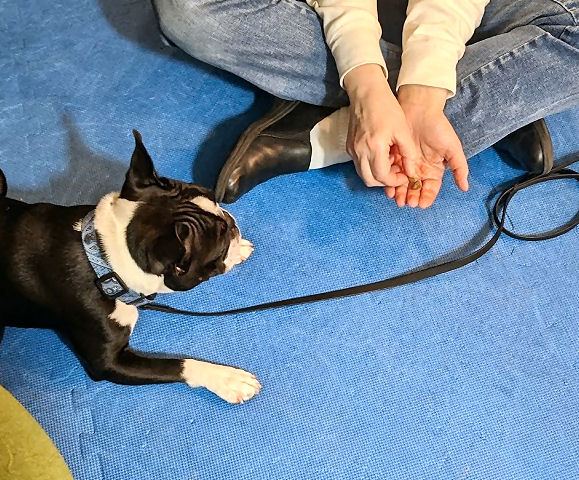
Luring is having a treat in your hand and leading your dog to behave a certain way. Rewarding is asking the dog for something and giving a treat immediately after they do it. The timing has to be so close that the dog knows their action prompted a great reward. Booker has gotten rewarded for spinning, so he’ll do it repeatedly.

The premise here is “What gets rewarded gets repeated.” If your dog got a treat for spinning, chances are strong they’ll spin again. As long as the reward comes right after, the dog will retain the link between the action and its yummy result.

Making dogs think

Dogs aren’t stupid. When they know that something great is going to happen if they behave a certain way, they do it. They’re motivated to act. 

Better yet, dogs will puzzle out what they have to do to earn that treat. When you have a dog trained with positive reinforcement, they’ll try all kinds of things to see what gets them the goodies. As your dog becomes increasingly confident, they’ll show you more and different actions to win the reward.

Patience pays 

The hardest thing about dog training is being patient and letting your dog think. Introducing new things with a lure starts your dog on the path. Fading the lure and replacing it with a reward solidifies your dog’s grasp on the behavior. You’ll know you’re there when you can wave your hand in a circle and your dog spins like a top. Make sure that good dog’s reward is close at hand.