Dog Training Game – Trade Ya

Spread the love

The “Trade Ya!” dog training game works in lots of different scenarios: 

  • Fifi doesn’t like to play with toys. “Trade Ya!” to teach her.
  • Phydeaux’s biting at your pants while you walk down the hall? “Trade Ya!” for a tug toy. 
  • Spot’s grabbing crumpled paper from the wastebasket? “Trade Ya!” for a tossed ball. 
  • Rover’s munching on anything they shouldn’t? “Trade Ya!” for a yummier treat.  

Dogs are great shoppers. They know what they like and what’s not very interesting. The most vivid example we’ve seen is the annual video from the Dogs Trust Ireland. For the holidays, the shelter has a “Santa Paws” day where each dog gets to choose from a roomful of toys. The vast majority of the dogs pick one and stick with it. Not much indecision there. Dogs know what they like. 

Good, better, best

And just like people, dogs have a rating system for their preferences. There’s stuff that’s okay. Other stuff that’s good. The next tier is better. And, at the apex is the stuff they’ll run through fire to get. 

All of these levels have a place in your dog’s life. To play “Trade Ya!,” you need to know your dog’s rankings for toys. As every dog owner knows, the toys you spent the most money on and thought your dog would adore are probably at the bottom of the list. Now you’ll finally get your money’s worth of fun.

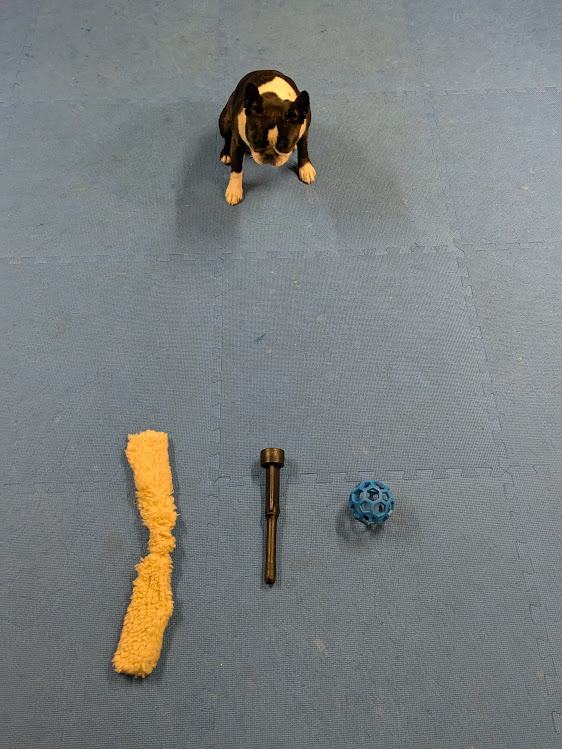
To teach your dog “Trade Ya!,” pick three toys, one each representing good, better, and best. Also have your dog’s absolute favorite treat. Play this game somewhere that’s dog-toy-free. Nothing else around to attract your dog’s focus.

Play with me!

Start with the least-favorite of the three toys. Put the other two someplace you can reach them, but the dog can’t. Slap that toy on the floor and slowly wave it back and forth to get your dog to play tug with you. 

Note: be sure you tug side-to-side. Never tug up-and-down to avoid injury to your dog’s neck. 

If your dog doesn’t play tug, or isn’t showing any interest, lightly contact your dog’s paws with the toy as you move it across the floor in front of them. Be really annoying with it. Don’t take “no” for an answer. Eventually, your dog will succumb and get hold of the toy. 

As soon as the dog grabs the first toy, whip out the second one, slap it on the floor, wiggle it back and forth and say “Trade Ya!” Since this second toy is more interesting to the dog than the first, the dog should readily drop it and grab the new toy you’re offering. (Remember your dog’s reward hierarchy!)

Rinse & repeat
When the dog’s tugging the middle-of-the-road toy, pull out the best toy, slap it on the ground, say “Trade Ya!” Your dog should grab onto the favorite toy and drop the other. Play tug for a moment. Let your dog “win” the game sometimes. 

Tug shouldn’t be a duration game. After a few tugs, say something like “That’s all!” and end it. If your dog won’t give up the “best” toy, reach for the high-value treat you brought and once again, say “Trade Ya!”

Lesson of the game

It may take a few sessions for your dog to understand that they’re trading up with “Trade Ya!” In time, they will readily drop what they have to choose the trade option. 

Always be sure that the next-level toy or treat is handy before you say “Trade Ya!” If you don’t have something “better,” you’d be lying to your dog. That would poison the game and you might have to start over from the beginning. 

Whenever you say “Trade Ya!” your dog will come to expect that they’re getting something even better than whatever it is they have. That applies to anything your dog may have that you’d rather they didn’t. Playing tug is more fun for the dog than biting your pants leg. The best treat is better than chewing on grass. Take advantage of your dog’s pro shopping ability.
Hardest skills for dogs

Spread the love

The hardest skills for dogs are the ones that aren’t natural. Of course the same is true for humans. People naturally want to help their dogs succeed, so patience/waiting is the hardest part of dog training. For dogs, who want to be with their people, the most difficult skills are staying and going.

That sounds contradictory, but it’s not. Both the “Stay!” and the “Go out!” usually involve separation between you and your dog. If you have a good training relationship with your dog, they want to be near you. Always. The closer the better. 

Too much of a good thing

You might think that creating a strong bond might pave the way for unwanted behaviors like separation anxiety. Instead, it actually helps reduce the issue. Dogs with strong training-game experience tend to be more confident and able to deal with everyday anxieties more easily. They’ve been taught how to make good decisions and to persevere through stress. 

It’s one thing for the dog to deal with your routine absences. You probably have a familiar ritual you follow every morning as you leave. It’s probably been choreographed down to a science, with singing out “Be good!” the last thing as you sail out the door.

While dogs don’t know where you’re going or what you’ll be doing there, they never did and probably never will. You don’t miss what you’ve never known. And they don’t have an option. However, a command to “Stay!” requires that the dog actively work against their own instinct to accompany you wherever you go.

“Go out!” is just as difficult, if not more so. At least with the “Stay!” your dog is able to watch you walk away. They may not like it, but they can see what you’re up to and know they can reach you quickly if you suddenly suffer an attack of dog withdrawal. With the “Go Out!” your dog has to choose to go away from you. They can’t see you as they move away. 

Fetch doesn’t count

But wait, you say! My dog runs away from me all the time when we’re playing “Fetch!” In that case, your dog isn’t actually “Going Out!” What they are doing is chasing an object in motion. Just as you’d expect any predator to do.

Both the “Stay!” and the “Go Out!” have three aspects to work on individually. 

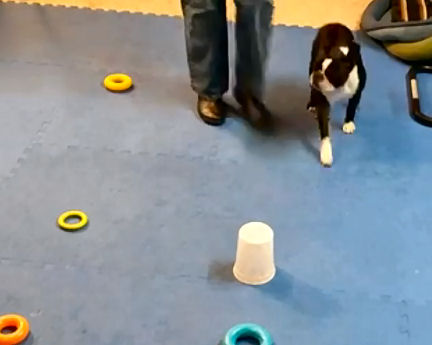
  • Duration – Gradually increase the amount of time the dog is on their own without rewards.This is the first thing to work on with the “Stay!” and the last thing to work on with the “Go Out!”
  • Distance – The first thing to work on for “Go Out!” Gradually increase the distance you put your Target for the dog. For the “Stay!,” randomize the number of steps you take away from your dog and return to the dog to reward. Remember to always reward the dog to the front – don’t make them turn to reach the reward or you’ll pull them out of position.
  • Distraction – Introduce all kinds of distractions. In the “Go Out!” practice with distractions both when the dog is in motion moving away from you and when the dog reaches the Target and is supposed to stay there. For the “Stay!,” use all kinds of distractions at varying distances from the dog. Even the hardest skills for dogs can be taught with patience and consistency. And distractions.

About distractions

A distraction can be anything that’s different. It can be sounds, like someone banging pots in the next room. It can be something in motion, like a tennis ball rolling across the training area. It can be a combination of both, like a sound-and-motion toy in the room. 

The most difficult distraction we’ve ever dealt with was from our very first dog training teacher. For the “graduation” class, he brought freshly-made french fries and spread them around the floor, expecting us and our dogs to navigate across the room through the delicious smells. Every dog/handler team did it. You can, too. Tailor the level of distraction to your dog’s interest. Start with things they don’t care much about and increase the difficulty as their skills improve. 

Distance is your friend

Spread the love

Your dog loves being near you. That’s a wonderful thing. But there are times when a little distance is your friend.

Sometimes, especially if you have a fearful dog, you use distance to help your dog adjust. Slow introductions to new places, things, and people help timid dogs cope. 

In another scenario, you may want to build distance between you and your dog, to encourage your dog to “work” away from you.

Go there, do that

Many dog sports require your dog to leave you to perform some task. Quite a while ago, Hope took her Brussels Griffon Roc to a tracking seminar. They flunked spectacularly. Roc wouldn’t move more than an arm’s length away from Hope, let alone go ten or fifteen feet out to follow a scent. 

In Obedience and Rally there are exercises where you send your dog away – the Directed Jumping in Obedience and the Go To Cone in Rally. Training your dog to listen, even if you’re not right next to them, is helpful.

Staying on course

The most consistent example is probably in Agility. No one, regardless of age or athleticism, can run as fast as their dog. Yet in agility, you run with your dog, directing their path around the course. Distance handling is the answer.

In the most extreme examples, there are handlers who are able to pick a spot somewhere on the course, and direct their speedy dogs faultlessly around. They use body language and vocal commands to steer their dog’s path. It’s impressive to watch, difficult to get right, and takes time to achieve.

Getting on track

French Bulldog touching a target to illustrate distance is your friend.

One of our Rally students would really like to do agility with his dog. But he’s hampered by his physical limitations. He can’t run, due to issues with his spine and hips. He can, however, teach his dog to work away from him.

The first step in distance handling is Target Training. When your dog loves the Target game, you can place the target anywhere. It’s an easy way to teach dogs how to go over jumps, and hit the required contact area on agility obstacles.

Delayed gratification

Dogs transfer the perceived value of the reward to the object and the game. If your dog has been rewarded frequently for touching a target, the target itself becomes a reward. Getting to play the target game is valuable by itself. 

That doesn’t mean you eliminate the reward. It means that you can delay it. After sending your dog to the target you can move to place the reward on the target. Or you can call your dog back to you and reward. Either way, the value of the target remains high. 

Keep it local

For every time you send your dog away, reinforce working close, too. The last thing you want to do is convince your dog that you’re not part of the fun. You always want to be one of the components of any training game. All wonderful things in your dog’s life should involve you.

When your dog learns to work with you, even from a distance, it opens more options for your team in dog sports. Build the distance gradually, and your partnership will grow exponentially.