Your dog loves being near you. That’s a wonderful thing. But there are times when a little distance is your friend.
Sometimes, especially if you have a fearful dog, you use distance to help your dog adjust. Slow introductions to new places, things, and people help timid dogs cope.
In another scenario, you may want to build distance between you and your dog, to encourage your dog to “work” away from you.
Go there, do that
Many dog sports require your dog to leave you to perform some task. Quite a while ago, Hope took her Brussels Griffon Roc to a tracking seminar. They flunked spectacularly. Roc wouldn’t move more than an arm’s length away from Hope, let alone go ten or fifteen feet out to follow a scent.
In Obedience and Rally there are exercises where you send your dog away – the Directed Jumping in Obedience and the Go To Cone in Rally. Training your dog to listen, even if you’re not right next to them, is helpful.
Staying on course
The most consistent example is probably in Agility. No one, regardless of age or athleticism, can run as fast as their dog. Yet in agility, you run with your dog, directing their path around the course. Distance handling is the answer.
In the most extreme examples, there are handlers who are able to pick a spot somewhere on the course, and direct their speedy dogs faultlessly around. They use body language and vocal commands to steer their dog’s path. It’s impressive to watch, difficult to get right, and takes time to achieve.
Getting on track
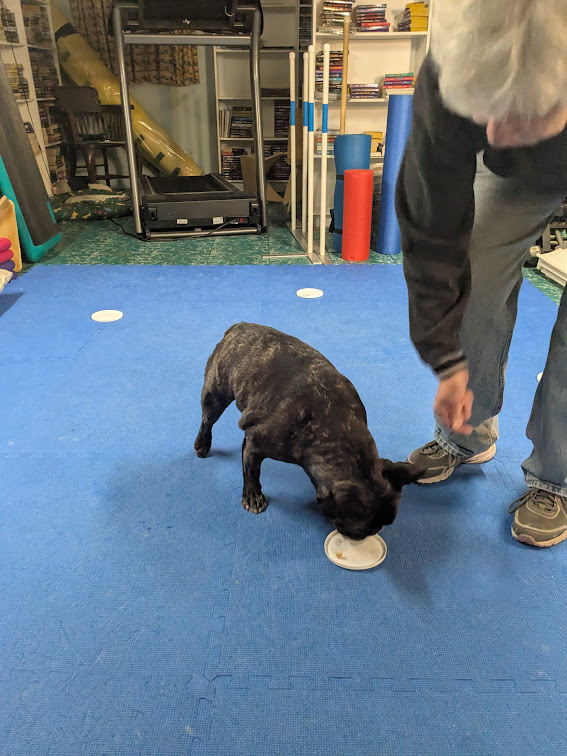
One of our Rally students would really like to do agility with his dog. But he’s hampered by his physical limitations. He can’t run, due to issues with his spine and hips. He can, however, teach his dog to work away from him.
The first step in distance handling is Target Training. When your dog loves the Target game, you can place the target anywhere. It’s an easy way to teach dogs how to go over jumps, and hit the required contact area on agility obstacles.
Delayed gratification
Dogs transfer the perceived value of the reward to the object and the game. If your dog has been rewarded frequently for touching a target, the target itself becomes a reward. Getting to play the target game is valuable by itself.
That doesn’t mean you eliminate the reward. It means that you can delay it. After sending your dog to the target you can move to place the reward on the target. Or you can call your dog back to you and reward. Either way, the value of the target remains high.
Keep it local
For every time you send your dog away, reinforce working close, too. The last thing you want to do is convince your dog that you’re not part of the fun. You always want to be one of the components of any training game. All wonderful things in your dog’s life should involve you.
When your dog learns to work with you, even from a distance, it opens more options for your team in dog sports. Build the distance gradually, and your partnership will grow exponentially.