Is Your Leash a Lifeline or a Crutch?
The people in our impulse control classes all start out clutching their leashes as if they were lifelines. They’re desperate to stop leash pulling fast.
It’s a “fast fixes” class – only four meetings. To achieve loose-leash walking in just a month’s time requires commitment, determination, and a leap of faith.
You have to believe that your dog can, in fact, make good decisions. That they are capable of learning manners and using them in public. You also have to believe that you are the perfect person to teach your dog how to achieve all that.
How’s That Working For You?
There’s a saying: If you always do what you’ve always done, you always get what you’ve always gotten.
So, how is hanging onto that leash for dear life working for you? Is your dog still acting like a jerk on lead? If you’re ready to move on, the first step is to tighten your focus. If you are training, only train. This isn’t the time for texting or running errands. If your dog’s behavior is frustrating, give them just two minutes of your undivided attention. Two minutes a day for two weeks—less than half an hour total—can change everything.
Make a Commitment
You’re not afraid of commitment. You acquired a dog, a decade-plus responsibility. We know you can handle two minutes.
In essence, it’s actually pretty simple. For your dog, you have to be more interesting than anything else on the planet. That battle’s already mostly won. They already follow you around everywhere. Dogs always keep you in sight. When was the last time you went to the bathroom by yourself? If you’re a dog owner, you may not remember.
The next level is if the dog will find you fascinating with distractions. Will your dog stay with you when someone else is in the kitchen preparing food? If not, try talking to your dog while you bend over to meet their eyes. Getting your dog’s eyes on you is the first step in training. If they still won’t look at you, blow on the top of their head.
Once you have your dog’s eyes on you, REWARD! If paying attention to you is the same as not, the dog has no reason to pay attention. There has to be a distinct difference between doing what you want them to do and ignoring you. Make it worth their while.
Sometimes it’s frustrating. We get it. You leaned over, you blew, you waved fingers, you even made funny sounds. Finally something clicks and they look at you. If it were a person, you could say “It’s about damn time!”
But it’s not a person. It’s a dog you’re trying to motivate to focus. So even if it takes forever, you still have to celebrate the win and not let the dog see your frustration. It doesn’t have to be a food reward. Have a toy and play tug. Give them a little shove and run away. Rub their tummy. Whatever floats your dog’s boat is a good reward.
Trust The Process
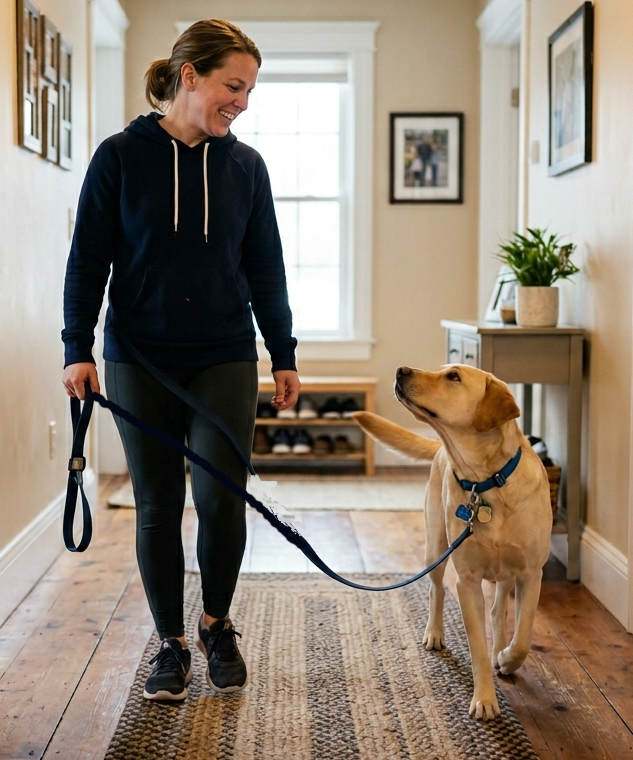
If loose-leash walking is your goal, practice someplace safe, even if that’s inside. For the ultimate challenge? Drape the leash across your neck and keep your hands off it. Keep your dog’s focus with words and actions, not with lures and leashes.
Stay engaged for the length of the hall, or the living room, or the yard. Give your dog a reason to stay with you. Have a one-sided conversation. Your dog doesn’t care what you say. Talk to them!
If your dog stays with you for 10 steps, stop and celebrate! “Yay! What a good dog!” “You’re awesome!” “I knew you could do it!” You’re on your way to stopping leash pulling fast.
You can do it, too. We believe in you.