There’s one training game we use each and every day, multiple times each day. It’s not particularly exciting, or fun. But it has saved us a ton of aggravation. That’s “Put On Your Collar.”
It’s a simple thing. Just getting the dogs to stand still while we put on their collars or harnesses. Our dogs tend to be backer-uppers. When we approach them, they back up. Which is fine, as long as we’re trying to get somewhere. When we’re getting ready for a walk, it’s not so great. We would grab their collars from the wall hooks and, instead of coming near for us to put it on, they’d back up.
It’s not like they don’t want to go out. Unless it’s pouring rain, they’re all eager to explore the great outdoors. But they’re reluctant to have their outside “clothes” on. Truthfully, we don’t know how common the issue is because we’ve never really talked about it with either our training club buddies or our students. We suspect it’s fairly common, but have no proof.
Born of necessity
We were tired of chasing the dogs around to get collars on. It’s not like any of them object to wearing collars. They were just excited to go out. Which, especially with Boston Terriers, means they start doing zoomies around the house. A house which has a circular path through the rooms, making it impossible to catch a zooming Boston.
A word of warning: Don’t start training “Put On Your Collar” when you have somewhere to go by a certain time. It’s a patience game. Yours may be tested to the extreme.
Lots of waiting
Most people have a phrase they use to let their dogs know it’s time to go for a walk. Around here it’s “chewannagwout?” which starts a stampede for the door. Our dogs’ collars and leashes (hooked together) are on coat hooks by the door.
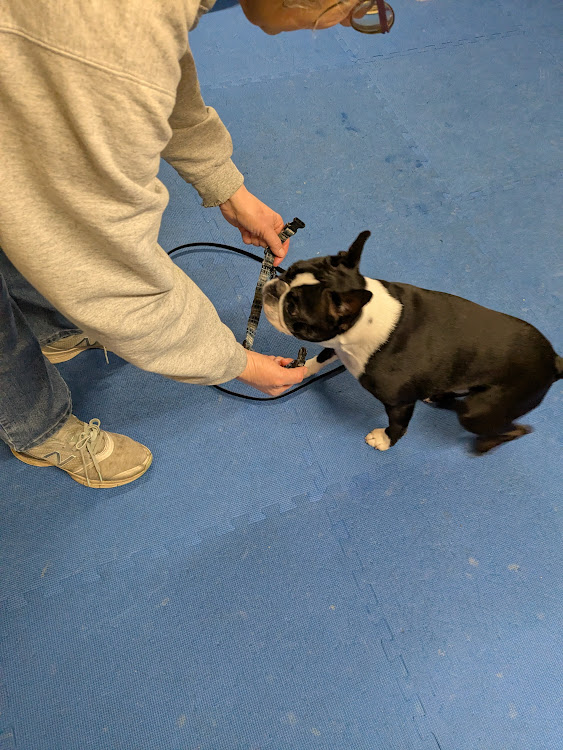
To start playing “Put On Your Collar,” just pick up your dog’s collar, open it, and hold it out. The goal is for your dog to come to you, stretch their neck out over the collar, and wait for you to fasten it.
The hardest part is waiting for your dog to do it. Don’t move. If you take steps toward your dog, they’ll back up. That’s the “Keep Away” game, even if it’s only a step at a time.
Your dog has to come near enough for you to fasten their collar. Say “Collar!” and hold it out. If they don’t, within a few seconds, just hang the collar/leash back on the hook. And do not lure your dog to come closer. It has to be their idea.
Our dogs just about melted down when the collars went back on the hooks. If yours does, too, pick up the collar, open, and hold it out again.
Be willing to do this multiple times over your short training session. Since you probably won’t make it out the door the first time, make sure your dog doesn’t have to eliminate before you start.
Reward every tiny step
It shouldn’t be too long before your dog actually hovers with their neck over the collar. Reward that little step. If your dog is truly reluctant, start rewarding them for staying in the vicinity, rather than running off. Small steps turn into complete behaviors. Reward for staying, for extending their neck, for waiting until the collar is fastened.
Be sure you use the word “Collar!” or whatever word you choose. Dogs like knowing what’s going on and familiar words and actions enhance communication.
When you return home after your walk, use “Collar!” again to take it off. Build the association between the object and the word. If you use a harness instead of a collar, the progression is the same. Reward for coming close, staying there, and every step involved in putting on the harness. You’ll use this behavior multiple times every week, if not daily. It’s worth the patience it takes to teach.